Category
page 1Trigonometry
.jpg)
trigonometry
Trigonometry () is a branch of mathematics concerned with relationships between angles and side lengths of triangles. In particular, the trigonometric functions relate the angles of a right triangle with ratios of its side lengths. The field emerged in the Hellenistic world during the 3rd century BC from applications of geometry to astronomical studies. The Greeks focused on the calculation of chords, while mathematicians in India created the earliest-known tables of values for trigonometric ratios (also called trigonometric functions) such as sine.

right triangle
triangle in which one angle is a 90-degree angle

hypotenuse
thumb|right|A right-angled triangle and its hypotenuse

parallax
thumb|upright=1.4|right|A simplified illustration of the parallax of an object against a distant background due to a perspective shift. When viewed from "Viewpoint A", the object appears to be in front of the blue square. When the viewpoint is changed to "Viewpoint B", the object appears to have moved in front of the red square.
thumb|right|This animation is an example of parallax. As the viewpoint moves side to side, the objects in the distance appear to move more slowly than the objects close to the camera. In this case, the white cube in front appears to move faster than the green cube in t

law of sines
property of all triangles on a Euclidean plane
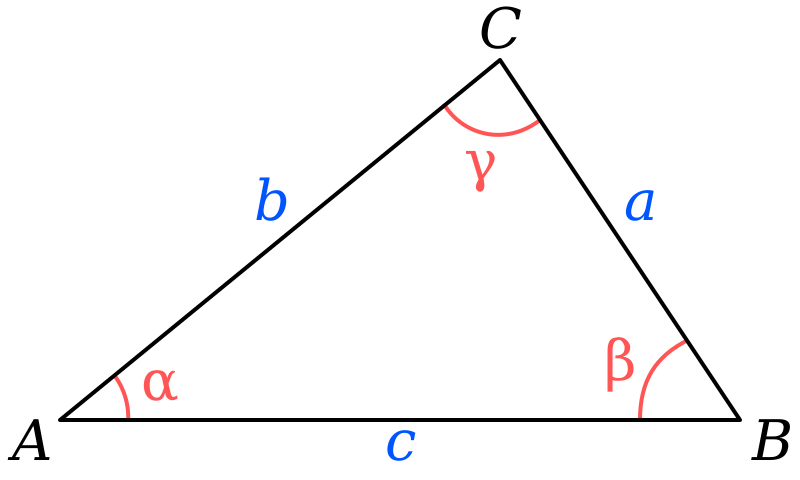
law of cosines
property of all triangles on a Euclidean plane

Euler's formula
mathematical formula in complex analysis that establishes the fundamental relationship between the trigonometric functions and the complex exponential function

unit circle
circle with radius one

periodic function
function that repeats its values in regular intervals or periods

inverse trigonometric function
inverse function of the trigonometric function

sine wave
mathematical curve that describes a smooth repetitive oscillation; continuous wave
list of trigonometric identities
Wikimedia list article
law of tangents
theorem
list of integrals of trigonometric functions
Wikimedia list article

flatness
thumb|right|200px |A circle of radius compressed to an ellipse.
thumb|right|200px |A sphere of radius compressed to an oblate ellipsoid of revolution.

phasor
thumb|An example of series RLC circuit and respective phasor diagram for a specific . The arrows in the upper diagram are phasors, drawn in a phasor diagram ([[complex plane without axis shown), which must not be confused with the arrows in the lower diagram, which are the reference polarity for the voltages and the reference direction for the current.]]
Lissajous curve
mathematical curve outputted from a specific pair of parametric equations
angular measure
measure for how wide an angle is
Mollweide's formula
two equations relating the side lengths and angles of a triangle
law of cotangents
theorem
Gudermannian function
function that relates the circular functions and hyperbolic functions without using complex numbers
argument
angle of complex number about real axis
history of trigonometry
aspect of history
solution of triangles
overview about the solution of triangles
Lissajous orbit
quasi-periodic orbital trajectory
trigonometric integral
special function defined by an integral
Pythagorean trigonometric identity
sin² θ + cos² θ = 1
small-angle approximation
Simplification of the basic trigonometric functions
trigonometric polynomial
mathematical function
trigonometric substitution
method for evaluating integrals involving trigonometric functions

CORDIC
CORDIC, short for coordinate rotation digital computer, is a simple and efficient algorithm to calculate trigonometric functions, hyperbolic functions, square roots, multiplications, divisions, exponentials, and logarithms with arbitrary base, typically converging with one digit (or bit) per iteration. CORDIC is therefore an example of a digit-by-digit algorithm. The original system is sometimes referred to as '''Volder's algorithm'''.
Niven's theorem
The only rational angles in first quadrant whose sine is rational are 0, 30 and 90 degrees
tangent half-angle formula
term in trigonometry

equant
250px|right|thumb|The basic elements of Ptolemaic astronomy, showing a planet on an [[epicycle (smaller dashed circle), a deferent (larger dashed circle), the eccentric (×) and an equant (•).]]
Morrie's law
theorem
trigonometric table
overview about trigonometric tables
phase response
effect of filters or amplifiers on signals' phases as function of frequency
generalized trigonometry
study of triangles in other spaces than the Euclidean plane
prosthaphaeresis
Prosthaphaeresis (from the Greek προσθαφαίρεσις) was an algorithm used in the late 16th century and early 17th century for approximate multiplication and division using formulas from trigonometry. For the 25 years preceding the invention of the logarithm in 1614, it was the only known generally applicable way of approximating products quickly. Its name comes from the Greek prosthen (πρόσθεν) meaning before and aphaeresis (ἀφαίρεσις), meaning taking away or subtraction.
trigonometric number
irrational number produced by taking the sine or cosine of a rational multiple of a full circle
cis
mathematical notation for cos(x) + i sin(x)
Abbe sine condition
condition that must be fulfilled by a lens or other optical system in order for it to produce sharp images of off-axis as well as on-axis objects
rational trigonometry
reformulation of planar distance and angle measurements in terms of polynomial functions of Cartesian coordinates
Regiomontanus' angle maximization problem
famous mathematical optimization problem
trigonometric interpolation
overview about the trigonometric interpolation
Proofs of trigonometric identities
Wikimedia list article
uses of trigonometry
applications of trigonometry
SAMV
parameter-free superresolution algorithm for the linear inverse problem in spectral estimation, direction-of-arrival estimation and tomographic reconstruction with applications in signal processing, medical imaging and remote sensing
Ptolemy's table of chords
2nd century CE trigonometric table
mnemonics in trigonometry
overview about mnemonics in trigonometry
Abbe error
magnification of angular error over distance