Category
page 1Turkish language
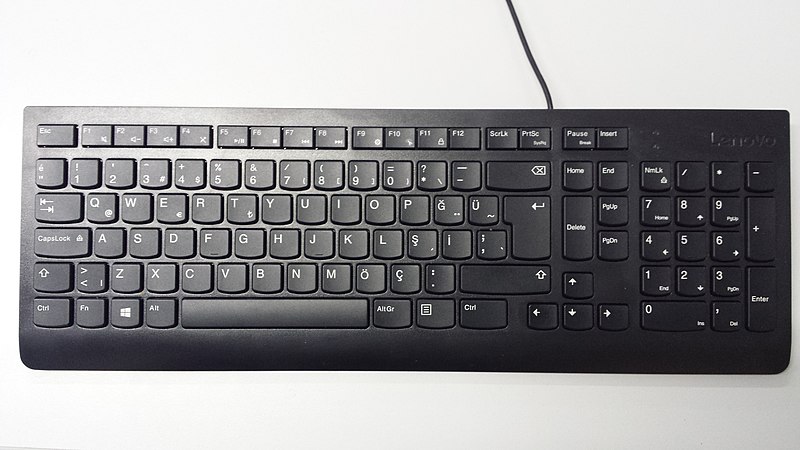
Turkish
Oghuz Turkic language of the Turkish people

Ottoman Turkish
language that was used in the Ottoman Empire

Turkish alphabet
notation of the Turkish language by means of a modified Latin alphabet

◌̧
A cedilla ( ; from Spanish '', "small ceda''", i.e. small "z"), or cedille (from French , ), is a hook or tail () added under certain letters (as a diacritical mark) to indicate that their pronunciation is modified. In Catalan (where it is called ), French, and Portuguese (where it is called a ) it is used only under the letter (to form ), and the entire letter is called, respectively, (i.e. "broken C"), , and (or , colloquially). It is used to mark vowel nasalization in many languages of Sub-Saharan Africa, including Vute from Cameroon.

Ğ
Ğ (g with breve; minuscule: ğ) is a Latin letter found in the Turkish and Azerbaijani alphabets as well as the Latin alphabets of Zazaki, Laz, Crimean Tatar, Tatar, and Kazakh. It traditionally represented the voiced velar fricative or the voiced uvular fricative . However, in Turkish, the phoneme has in most cases been reduced to a silent letter, serving as a vowel-lengthener. But for Crimean Tatar spelling in Romania it represents the voiced palato-alveolar affricate .

Ş
thumb|Appearance of in upper- and lower-case. The left is in the upper-case.|class=skin-invert-image
S-cedilla (majuscule: Ş, minuscule: ş) is a letter used in some of the Turkic languages. It occurs in the Azerbaijani, Gagauz, Turkish, and Turkmen alphabets. It is also planned to be in the Latin-based Kazakh alphabet.
It is used in Brahui, Chechen, Crimean Tatar, Kurdish, and Tatar as well, when they are written in the Latin alphabet.
Ottoman Turkish alphabet
Arabic-script alphabet used to write Ottoman Turkish
I/ı
Latin letter “dotless i”: used in Turkish, Azerbaijani, Kazakh, etc., or in mathematics
Turkish Language Association
official regulatory body of the Turkish language

İ/i
İ, or i, called dotted I or i-dot, is a letter used in the Latin-script alphabets of Azerbaijani, Crimean Tatar, Gagauz, Kazakh, Tatar, and Turkish. It commonly represents the close front unrounded vowel except in Kazakh in which it additionally represents the voiced palatal approximant and the diphthongs and . All languages that use it also use its dotless counterpart I, but not the basic Latin letter I.
Yunus Emre Institute
organization
Turkish bird language
whistled language in Turkey’s Eastern Black Sea Region – inscribed in the List of Intangible Heritage in Need of Urgent Safeguarding in 2017
ISO/IEC 8859-9
standard
ISO/IEC 8859-3
part of the ISO/IEC 8859 series of ASCII-based standard character encodings
Citizen, speak Turkish!
Turkish government-funded initiative
Alphabet Reform
part of Atatürk's Reforms in Turkey
Turkish phonology
phonology of the Turkish language
Turkish language reform
1932–1982 government language campaign
Animal name changes in Turkey
Taxonomic policy of government of Turkey
list of replaced loanwords in Turkish
Wikimedia list article
Turkish name
naming customs in Turkish culture
Turkish dialects
dialects of the Turkish language
Turkish Braille
Braille alphabet of the Turkish language
Armeno-Turkish alphabet
Armenian script sometimes used for Turkish until 1928
Hurûf-ı munfasıla
writing system created by Enver Pasha
Re
interjection