Category
page 1Tutelary goddesses

Athena

Bastet
thumb|Bastet in her earlier form of a lioness-headed woman depicted the same or very similar to Sekhmet
Bastet or Bast (), also known as Ubasti or Bubastis, is a goddess of ancient Egyptian religion, possibly of Nubian origin, worshipped as early as the Second Dynasty (2890 BCE). In ancient Greek religion, she was known as Ailuros ().

Nephthys
Nephthys or Nebet-Het in ancient Egyptian () was a goddess in ancient Egyptian religion. A member of the Great Ennead of Heliopolis in Egyptian mythology, she was a daughter of Nut and Geb. Nephthys was typically paired with her sister Isis in funerary rites because of their role as protectors of the mummy, with her brother Osiris, and as the sister-wife of Set.

Neith
thumb|Neith wearing the Deshret|Red Crown of Lower Egypt.

Taweret
thumb|Images of protective deities like Taweret and Bes were placed on the outer walls of Ptolemaic temples in order to keep evil forces at bay. [[Edfu, Egypt.]]In Ancient Egyptian religion, Taweret (, also spelled Taurt, Tuat, Tuart, Ta-weret, Tawaret, Twert and Taueret, and in , Thoeris, Taouris and Toeris) is the protective goddess of childbirth and fertility. The name "Taweret" means "she who is great" or simply "great one", a common pacificatory address to dangerous deities. The deity is typically depicted as a bipedal female hippopotamus with feline attributes, pendulous female human bre

Wadjet
thumb|Map of the Nile Delta locating Buto.
Wadjet (; "Green One"), known to the Greek world as Uto (; ) or Buto (; ) among other renderings including Wedjat, Uadjet, and Udjo, was originally the ancient Egyptian local goddess of the city of Dep or Buto in Lower Egypt, which was an important site in prehistoric Egypt. Wadjet's worship originally started in the Predynastic period, but evolved over time from a local goddess to a patron goddess.

Lamassu
thumb|Lamassu at the Iraq Museum, [[Baghdad|alt=Pair of stone lamassu sculptures with human heads and winged bull bodies displayed in the Iraq Museum]]
Lama, Lamma, or Lamassu (Cuneiform: , ; Sumerian: lammař; later in Akkadian: lamassu; sometimes called a lamassuse) is a Mesopotamian protective deity.

Mazu
Mazu or Matsu is a sea goddess in Chinese folk religion, Chinese Buddhism, Confucianism, and Taoism. She is also known by several other names and titles. Mazu is the deified form of Lin Moniang (), a shamaness from Fujian who is said to have lived in the late 10th century. After her death, she became revered as a tutelary deity of Chinese seafarers, including fishermen and sailors.
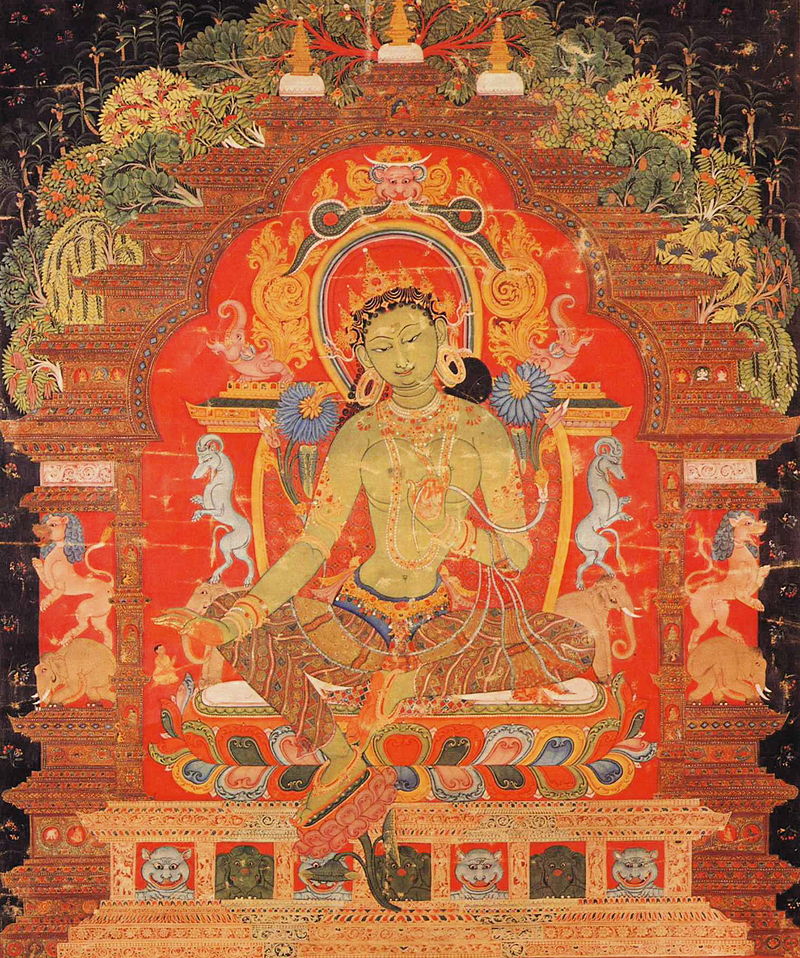
Tārā
female Bodhisattva
Rhodos
In Greek mythology, Rhodos/Rhodus () or Rhode (), was the goddess and personification of the island of Rhodes and a wife of the sun god Helios.
Menhit
Menhit (also known as Menhyt, and Menchit) was originally a Nubian lion goddess of war in the Kingdom of Kush, who was regarded as a tutelary and sun goddess. Her name means either "she who sacrifices" or "she who massacres."
Mafdet
Mafdet (also Mefdet, Maftet) was a goddess in the ancient Egyptian religion. She was often depicted wearing a skin of a cheetah, and protected against the bite of snakes and scorpions. She was part of the pantheon of ancient Egyptian deities that was prominent during the First Dynasty of Egypt. She was prominent during the reign of pharaoh Den whose image appears on stone vessel fragments from his tomb and is mentioned in a dedicatory entry in the Palermo Stone. Mafdet was the deification of legal justice, or possibly of capital punishment. She was associated with the protection of the king's

Ériu
thumb|″The Harp of Erin″ painting by Thomas Buchanan Read
In Irish mythology, Ériu (; ), daughter of Delbáeth and Ernmas of the Tuatha Dé Danann, was the eponymous matron goddess of Ireland.
Angerona
In ancient Gallo-Roman religion Angerona or Angeronia was an old Celtic goddess adopted by Romans, whose name and functions are variously explained. She is sometimes identified with the goddess Feronia.

Yemaja
Yemọja (also: Yemaja, Yemanjá, Yemoyá, Yemayá; there are many different transliterations in other languages) is a major water deity in the Yoruba religion. She is an oriṣa, and the patron spirit of rivers, particularly the Ogun River in Nigeria, and of oceans in Cuban and Brazilian Orisha religions. She is often syncretized with either Our Lady of Regla in the Afro-Cuban diaspora or various other Virgin Mary figures of the Catholic Church, a practice that emerged during the era of the Trans-Atlantic slave trade. Yemọja is said to be motherly and strongly protective, and to care deeply for all

Áine
Áine () is an Irish goddess of summer, wealth, beauty and sovereignty. She is associated with midsummer and the sun, and is sometimes represented by a red mare. She is the daughter of Egobail, the sister of Aillen and/or Fennen, and is claimed as an ancestor by multiple Irish families. As the goddess associated with fertility, she has command over crops and animals and is also associated with agriculture.

Hariti
Hārītī (Sanskrit), also known as , , is a female rākṣasī or yakṣinī (nature spirit) in Buddhism. She appears as a character in all Buddhist traditions and she is revered as a fierce Dharma Protector and a fertility goddess in Mahayana Buddhism. Hārītī appears in various Mahayana sutras, including in the Lotus Sutra, where she vows to protect those who uphold the sutra. She is also mentioned as a protector in the Candragarbhasūtra.
Bau
Mesopotamian goddess

Nanshe
Nanshe ( ) was a Mesopotamian goddess in various contexts associated with the sea, marshlands, the animals inhabiting these biomes, namely bird and fish, as well as divination, dream interpretation, justice, social welfare, and certain administrative tasks. She was regarded as a daughter of Enki and sister of Ningirsu, while her husband was Nindara, who is otherwise little known. Other deities who belonged to her circle included her daughter Nin-MAR.KI, as well as Hendursaga, Dumuzi-abzu and Shul-utula. In Ur she was incorporated into the circle of Ningal, while in incantations she appears alo
Mehit
Mehit (also Mehyt, Mekhit) was an ancient Egyptian and Nubian lion goddess of Nubian origin.

Arduinna
thumb|Bronze statuette of the Celtic goddess Arduinna riding a wild boar.
In Gallo-Roman religion, Arduinna (also Arduina, Arduinnae or Arduinne) was the eponymous tutelary goddess of the Ardennes Forest and region, thought to be represented as a huntress riding a boar (primarily in the present-day regions of Belgium and Luxembourg). Her cult originated in the Ardennes region of present-day Belgium, Luxembourg, and France. She was identified with the Roman goddess Diana.
Tjenenyet
Tjenenyet, alternatively Tenenet, Tjenenet, Zenenet, Tanenet, Tenenit, Manuel de Codage transliteration Tnn.t, was an ancient Egyptian goddess of childbirth and protection. She is mentioned in texts dating from the Ptolemaic period as well as in the Book of the Dead.
Móðguðr
In Norse mythology, Móðguðr (Old Norse: , "Furious Battler"; also Modgud) refers to the female guardian (tutelary deity) of the bridge over the river Gjöll ("Noisy"), Gjallarbrú. She allowed the newly dead to use the bridge to cross from one side of the river Gjöll to the other if the soul stated their name and business and possibly in turn prevented the dead beyond the river from crossing back over Gjöll into the lands of the living.
Corcyra
daughter of the Asopos river and the nymph Metope

Gatumdag
Gatumdug (; dĜa2-tum3-dug3; also romanized as Gatumdu) was a Mesopotamian goddess regarded as the tutelary deity of Lagash and closely associated with its kings. She was initially worshiped only in this city and in NINA, but during the reign of Gudea a temple was built for her in Girsu. She appears in a number of literary compositions, including the hymn inscribed on the Gudea cylinders and Lament for Sumer and Ur.

Amesemi
Amesemi is a Kushite protective goddess and wife of Apedemak, the lion-god. She was represented with a crown shaped as a falcon, or with a crescent moon on her head on top of which a falcon was standing. The clothing that Amesemi is seen wearing is a robe that is made from cloth and is worn over her undergarments. She is often seen wearing a short necklace with large beads. She is also depicted holding a second set of hands with her.
Ashapura Mata
Hindu goddess
Ninisina
Ninisina (Sumerian: "Mistress of Isin") was a Mesopotamian goddess who served as the tutelary deity of the city of Isin. She was considered a healing deity. She was believed to be skilled in the medical arts, and could be described as a divine physician or midwife. As an extension of her medical role, she was also believed to be capable of expelling various demons. Her symbols included dogs, commonly associated with healing goddesses in Mesopotamia, as well as tools and garments associated with practitioners of medicine.
hamingja
The hamingja was a type of female guardian spirit in Norse mythology. It was believed that she accompanied a person and decided their luck and happiness. Consequently, the name was also used to indicate happiness, and that is what it means in modern Icelandic. When a person died, the hamingja passed to a beloved family member and thus accompanied a family for several generations, continuing to influence their fortunes. It was even possible to lend one's own hamingja to a friend, as happened when Hjalti Skeggiason was about to leave on a perilous voyage and asked Olaf II of Norway to lend him h
Jengu
A jengu (pl. miengu, also called bisima) is a water spirit in the traditional beliefs of the Sawabantu groups of Cameroon, like the Duala, Bakweri, Malimba, Subu, Bakoko, and Oroko people. Among the Bakweri, the term used is liengu (plural: maengu). Miengu are similar to bisimbi (singular: simbi) in the Bakongo spirituality and Mamba Muntu, who is present in many West and Central African cultures.
Orbona
Orbona (/orˈboː.na/; Latin: [ɔrˈboːnä]) is the Roman goddess who protects parents who are bereaved of their children and parents of ill children. The first mention of Orbona is unknown. She appears in the Arnobius Against The Heathen V4 written by Arnobius. Said Orbona is the goddess who takes care of parents who are bereaved of their children. There is no description of the appearance or related presence in the Roman mythology. Orbona is a unique figure in Roman religion. She stands apart and does not derive directly from any Greek goddess. Her name is barely seen in the present because she h
Kianda
Kianda (or Dandalunda) is a goddess of the sea, of the waters, and a protector of fishermen in traditional Angolan culture.
Simbi
A Simbi (also spelled Cymbee and '''Sim'bi, pl. Bisimbi or Basimbi''') is a Central African guardian spirit of the water and nature in traditional Bakongo religion, as well as in African diaspora spiritual traditions, such as Hoodoo in the southern United States and Palo in Cuba. Simbi have been historically identified as water people, or mermaids, pottery, snakes, gourds, and fire. Due to the forced removal of Bantu peoples from Africa to the Americas, the veneration of simbi exists today in countries, such as the United States, Brazil, Cuba, and Haiti.
Enodia
In Ancient Greek religion and mythology, Enodia, also spelled Ennodia and Einodia (; ) is a distinctly Thessalian goddess, identified in certain areas or by certain ancient writers with Artemis, Hecate or Persephone. She was paired with Zeus in cult and sometimes shared sanctuaries with him. Enodia was primarily worshipped in Ancient Thessaly and was well known in Hellenistic Macedonia.
Hashihime
thumb|upright=1.0|"Hashihime" as depicted in the Kyōka Hyaku Monogatari (1853), illustrated by Ryūkansai Masasumi.
Prajñāpāramitā Devī
Buddhist goddess that symbolizes and embodies Prajñāpāramitā, the perfection of transcendent wisdom
Twelve Flower Fairies
fairies corresponding to seasonal flowers in Chinese folk religion.