File:Taweret.svg · Wikimedia Commons · See Wikimedia Commons
Taweret
Sign in to saveAlso known as Thoeris, Thoueris, Tueris, Thueris, Tuat, Taurt, Taouris, Tuart
thumb|Images of protective deities like Taweret and Bes were placed on the outer walls of Ptolemaic temples in order to keep evil forces at bay. [[Edfu, Egypt.]]In Ancient Egyptian religion, Taweret (, also spelled Taurt, Tuat, Tuart, Ta-weret, Tawaret, Twert and Taueret, and in , Thoeris, Taouris and Toeris) is the protective goddess of childbirth and fertility. The name "Taweret" means "she who is great" or simply "great one", a common pacificatory address to dangerous deities. The deity is typically depicted as a bipedal female hippopotamus with feline attributes, pendulous female human bre
Key facts
- Deity.type
- Egyptian
- Deity.name
- Taweret
- Deity.image
- Taweret.svg
- Deity.caption
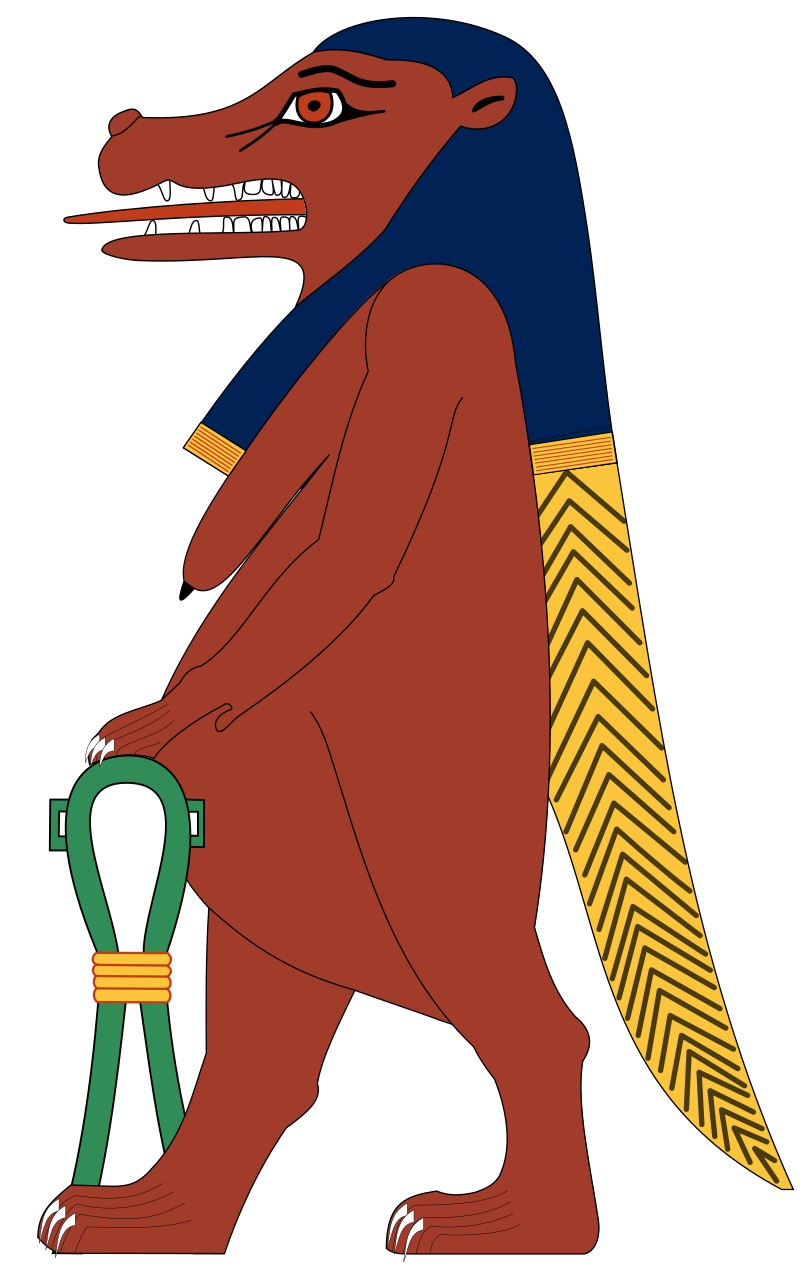
- The goddess Taweret, portrayed as a bipedal hippopotamus with limbs like those of a feline. Her hand rests on the sa sign, 𓎃, a hieroglyph that means 'protection' or 'lifesaver'.
- Deity.hiero
- X1-G1-G36:D21-X1-I12
- Deity.cult_center
- Not applicable; Taweret was a household deity worshipped throughout Egypt.
- Deity.symbol
- the sa, ivory dagger, hippopotamus
- Deity.consort
- Bes
via Wikipedia infobox
Wikidata facts
- Instance of
- Ancient Egyptian deity
- Part of
- Egyptian mythology
- Gender
- female
- Spouse
- Seth
- Image
- Taweret.svg
Show 5 more facts
- name in hiero markup
- t-A-wr:r-t-I12
- Commons category
- Taweret
- worshipped by
- Kemetism
- iconographic symbol
- Nile hippopotamus
- domain of saint or deity
- fertility
Sources (1)
via Wikidata · CC0
~19 min read
Encyclopedic overview
11 sectionsContents
- History and development
- Outside of Egypt
- Ancient Crete
- In Nubia
- Phoenicia
- In mythology
- In art
- See also
- References
- Sources
- External links
thumb|Images of protective deities like Taweret and Bes were placed on the outer walls of Ptolemaic temples in order to keep evil forces at bay. [[Edfu, Egypt.]]In Ancient Egyptian religion, Taweret (, also spelled Taurt, Tuat, Tuart, Ta-weret, Tawaret, Twert and Taueret, and in , Thoeris, Taouris and Toeris) is the protective goddess of childbirth and fertility. The name "Taweret" means "she who is great" or simply "great one", a common pacificatory address to dangerous deities. The deity is typically depicted as a bipedal female hippopotamus with feline attributes, pendulous female human breasts, the limbs and paws of a lion, and the back and tail of a Nile crocodile. She commonly bears the epithets "Lady of Heaven", "Mistress of the Horizon", "She Who Removes Water", "Mistress of Pure Water", and "Lady of the Birth House".
==History and development== Archaeological evidence demonstrates that hippopotamuses inhabited the Nile well before the dawn of Early Dynastic Period (before 3000 BCE). The violent and aggressive behavior of these creatures intrigued the people that inhabited the region, leading the ancient Egyptians both to persecute and to venerate them. From a very early age, male hippopotamuses were thought to be manifestations of chaos; consequently, they were overcome in royal hunting campaigns, intended to demonstrate the divine power of the king. However, female hippopotamuses were revered as manifestations of apotropaic deities, as they assiduously protect their young from harm. Protective amulets bearing the likenesses of female hippopotamuses have been found dating as far back as the Predynastic period (c. 3000–2686 BCE). The tradition of making and wearing these amulets continued throughout the history of Egypt into the Ptolemaic Kingdom and the Roman period (c. 332 BCE – 390 CE). left|thumb|Faience statuette of Taweret, her hands resting on the sa. From her ideological conception, Taweret was closely grouped with (and is often indistinguishable from) several other protective hippopotamus goddesses: Ipet, Reret, and Hedjet. Some scholars even interpret these goddesses as aspects of the same deity, considering their universally shared role as protective household goddesses. The other hippopotamus goddesses have names that bear very specific meanings, much like Taweret (whose name is formed as a pacificatory address intended to calm the ferocity of the goddess): Ipet's name ("the Nurse") demonstrates her connection to birth, child rearing, and general caretaking, and Reret's name ("the Sow") is derived from the Egyptians' classification of hippopotami as water pigs. However, the origin of Hedjet's name ("the White One") is not as clear and could justly be debated. Evidence for the cult of hippopotamus goddesses exists from the time of the Old Kingdom (c. 2686 – 2181 BCE) in the corpus of ancient Egyptian funerary texts entitled the Pyramid Texts. Spell 269 in the Pyramid Texts mentions Ipet and succinctly demonstrates her nurturing role; the spell announces that the deceased king will suck on the goddess's "white, dazzling, sweet milk" when he ascends to the heavens. As maternal deities, these goddesses served to nurture and protect the Egyptian people, both royal (as seen in the Pyramid Texts) and non-royal.
Excerpted from Wikipedia’s “Taweret” article, available under the CC BY-SA 4.0 licence.