Category
page 1Types of cyclone

tornado
A tornado, also known as a twister, is a rapidly rotating column of air that extends vertically from the surface of the Earth to the base of a cumulonimbus or cumulus cloud. Tornadoes are often (but not always) visible in the form of a condensation funnel originating from the cloud base, with a cloud of rotating debris and dust close to the ground. Most tornadoes have wind speeds less than , are about across, and travel several kilometers (a few miles) before dissipating. The most extreme tornadoes can attain wind speeds of more than , can be more than in diameter, and can stay on the ground f

tropical cyclone
rapidly rotating storm system that forms in the tropics

cyclone
thumb|upright=1.3|An extratropical cyclone near Iceland
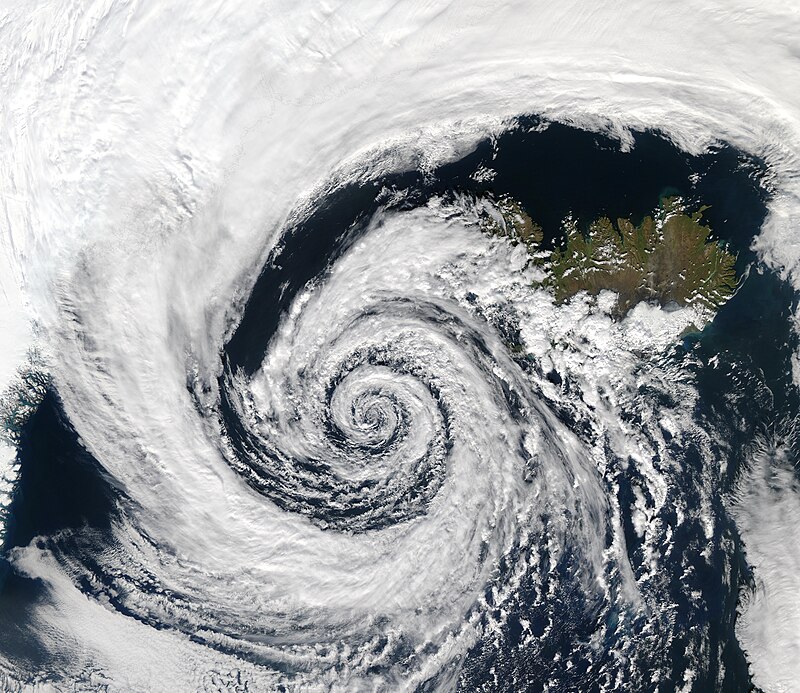
low pressure area
region of the atmosphere in which atmospheric pressure is lower than that of surrounding regions
cold drop
meteorological term

mesocyclone
thumb|A mesocyclone (at left) in the Central Zone of the city of Piracicaba, in southeastern [[Brazil, on January 28, 2025]]
thumb|Supercell diagram with the mesocyclone rotation in red
Mediterranean tropical cyclone
meteorological phenomenon observed over the Mediterranean Sea
Icelandic Low
Atmospheric phenomenon
polar low
small-scale, short-lived depression over certain ocean areas
Aleutian Low
semi-permanent low pressure center located near the Aleutian Islands
European windstorm
type of storm
Thermal low
low-pressure areas that occur over the subtropics
Genoa low
type of low pressure area
cold-core low
cyclone aloft which has an associated cold pool of air residing at high altitude within the Earth's troposphere
Steam devil
a type of vortex similar to a dust devil
post-tropical cyclone
former tropical cyclone
Kona storm
Origin of an extratropical cyclone