Category
page 1Unsolved problems in astronomy

dark matter
mysterious non-luminous matter (and/or radiation) comprising most of the matter in our observable universe

extraterrestrial life
life that does not originate from Earth

dark energy
repulsive property with constant energy density theorized to make up most of the universe’s energy content to account for its observed expansion

Fermi paradox
apparent contradiction between the lack of evidence and high probability estimates for the existence of extraterrestrial civilizations
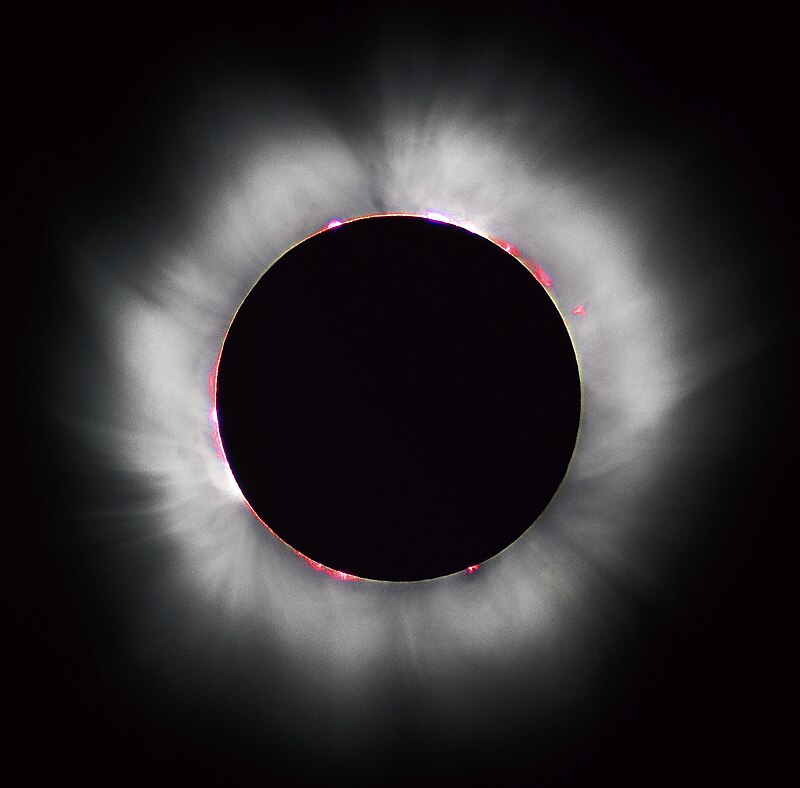
solar corona
plasma "atmosphere" of the Sun
Wow! signal
1977 narrowband radio signal from SETI

Olbers's paradox
cosmological contradiction between the observed darkness of the night sky and a static universe model

Tabby’s Star
binary system in the constellation Cygnus
fast radio burst
high-energy astrophysical phenomenon manifested as a transient radio pulse lasting only a few milliseconds
Modified Newtonian dynamics
alternative explanation of the non-Newtonian rotation of galaxies
shape of the universe
subject of cosmology
transient lunar phenomenon
short-lived light, color, or change in appearance on the surface of the Moon
faint young Sun paradox
apparent mystery that the early Earth seems to have had liquid water, even though the young Sun was less bright, thus presumably completely freezing the Earth
Przybylski's Star
star in the constellation Centaurus
strangelet
A strangelet (pronounced ) is a hypothetical particle consisting of a bound state of roughly equal numbers of up, down, and strange quarks. An equivalent description is that a strangelet is a small fragment of strange matter, small enough to be considered a particle. The size of an object composed of strange matter could, theoretically, range from a few femtometers across (with the mass of a light nucleus) to arbitrarily large. Once the size becomes macroscopic (on the order of meters across), such an object is usually called a strange star. The term "strangelet" originates with Edward Farhi a

BLC1
thumb|upright|Parkes Observatory that detected BLC-1
Greisen–Zatsepin–Kuzmin limit
theoretical upper limit on the energy of cosmic ray protons
ultra-high-energy cosmic ray
cosmic-ray particle with a kinetic energy greater than 1 EeV (10¹⁸ eV)
disrupted planet
planet, or exoplanet or, perhaps on a somewhat smaller scale, a moon or exomoon, that has been disrupted, or destroyed, by a nearby, or passing, astronomical body or object
Odd radio circle
unexplained circular astronomical object detected only by radio waves
lunar swirl
enigmatic features on the lunar surface

iPTF14hls
iPTF14hls is an unusual supernova star that erupted continuously for about 1,000 days beginning in September 2014 before becoming a remnant nebula. It had previously erupted in 1954. None of the theories nor proposed hypotheses fully explain all the aspects of the object.
HD 139139
star noted for unusual dimming events
list of unsolved problems in astronomy
Wikimedia list article
Little Red Dot
class of small, red galaxies
SCP 06F6
astronomical object
fast blue optical transient
high-energy astrophysical process
diffuse interstellar band
absorption features in the spectra of astronomical objects in the Milky Way and other galaxies

M-sigma relation
Relationship between the stellar mass dispersion of a galaxy bulge and the mass of the supermassive black hole at its center
mass in general relativity
facet of general relativity
EPIC 204376071
star in the constellation Scorpius
Diffuse extragalactic background radiation
Photon field that fills our universe