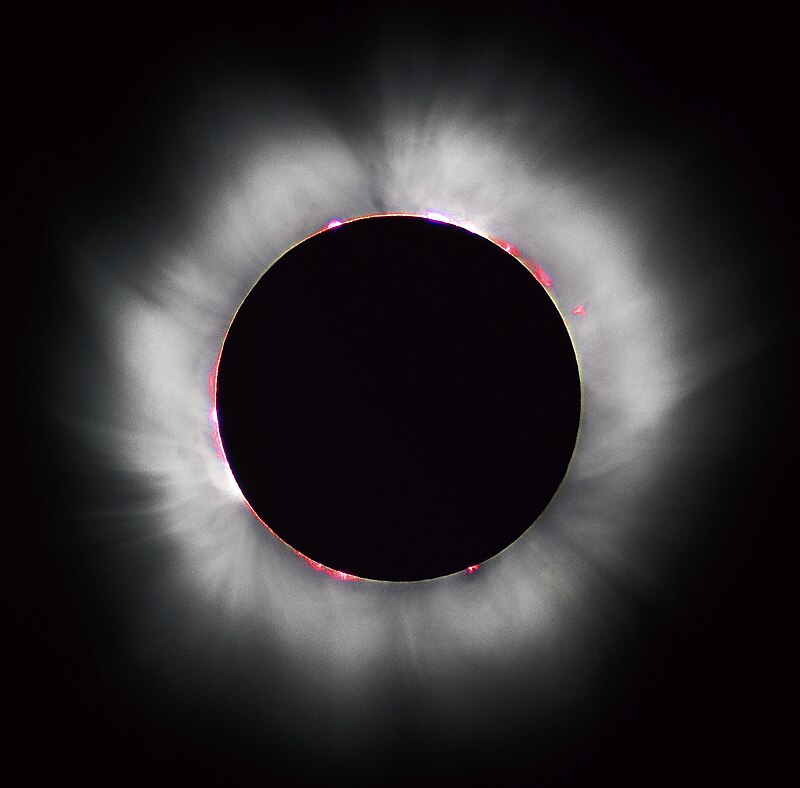
File:Solar_eclipse_1999_4.jpg · Wikimedia Commons · See Wikimedia Commons
solar corona
Sign in to saveplasma "atmosphere" of the Sun
The solar corona is the Sun's extremely hot outer atmosphere made of plasma (ionized gas) that extends millions of miles into space. Scientists study it because understanding the corona helps explain solar wind, solar flares, and other phenomena that can affect Earth's technology and communications.
AI-generated from the Wikipedia summary — may contain errors.
Wikidata facts
- Instance of
- stellar atmosphere
- Subclass of
- stellar corona
- Part of
- Sun
- Image
- Solar eclipse 1999 4.jpg
Show 3 more facts
- Commons category
- Solar corona
- temperature
- 5000000
- on focus list of Wikimedia project
- Wikipedia:Vital articles/Level/4
Sources (2)
via Wikidata · CC0
~40 min read
Encyclopedic overview
During a total solar eclipse, the Sun's corona and prominences are visible to the naked eye. The solar corona is the outermost layer of the Sun's atmosphere. It is a region filled with relatively hot, tenuous plasma that is structured by the solar magnetic field.
The solar corona lies above the photosphere and chromosphere and extends out to the edge of the solar atmosphere where it merges with the solar wind. The chromosphere and corona are separated by a thin, highly dynamic transition region. The outer edge of solar atmosphere where the corona transitions into the solar wind is defined by the Alfvén surface which forms an irregularly shaped boundary around the Sun at heights ranging from about 10 to 20 solar radii (7000000 to 14000000 km) above the photosphere.
Excerpted from Wikipedia’s “solar corona” article, available under the CC BY-SA 4.0 licence.
Gallery (12)
Available in 69 languages
- Español
- Français
- Deutsch
- 中文
- 日本語
- Русский
- Português
- Italiano
- العربية
- हिन्दी
- Afrikaans
- Armenian
- Asturian
- azb
- Azerbaijani
- Bahasa Indonesia
- Basque
- be_x_old
Show 50 more
- Belarusian
- Bhojpuri
- Bulgarian
- Catalan
- Croatian
- Czech
- Danish
- Esperanto
- Estonian
- Finnish
- Galician
- Georgian
- Greek
- Haitian Creole
- Hebrew
- Irish
- Kannada
- Kazakh
- Kyrgyz
- Latvian
- Lithuanian
- Luxembourgish
- Malay
- Malayalam
- Nederlands
- Norwegian
- Norwegian Nynorsk
- Occitan
- Piedmontese
- Polski
- Quechua
- Romanian
- Serbian
- Serbian (Latin)
- simple
- Slovak
- Slovenian
- Svenska
- Tamil
- Tiếng Việt
- Türkçe
- Ukrainian
- Urdu
- Uzbek
- Welsh
- Wu Chinese
- zh_yue
- فارسی
- ไทย
- 한국어
via Wikidata sitelinks · CC0