Category
page 1Ursa Major
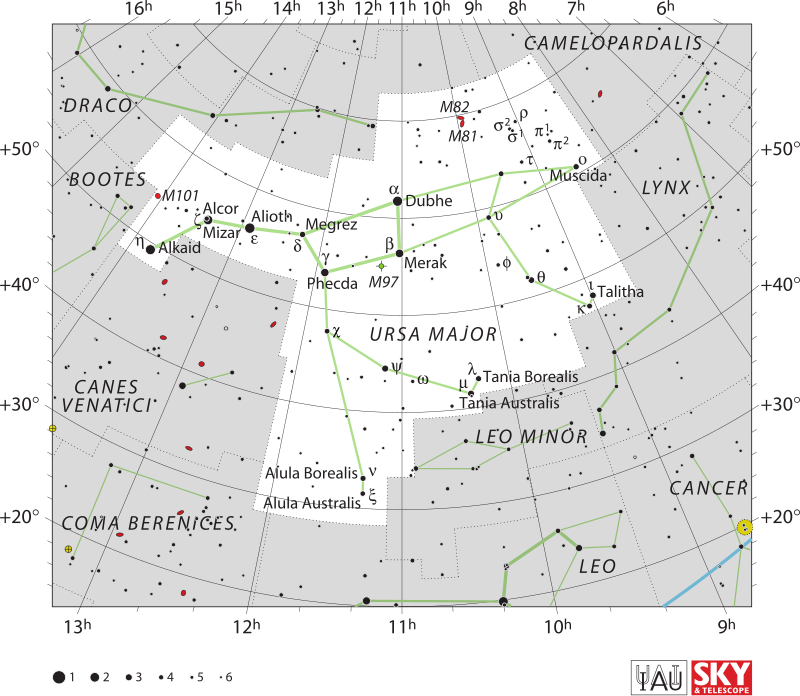
Ursa Major
constellation visible throughout the year in most of the northern hemisphere

Messier 81
galaxy in the constellation Ursa Major

Pinwheel Galaxy
spiral galaxy in the constellation Ursa Major

Messier 82
galaxy in the constellation Ursa Major

Owl Nebula
planetary nebula in the constellation Ursa Major

Big Dipper
pattern of seven bright stars in the constellation Ursa Major

Messier 109
spiral galaxy in the constellation Ursa Major

Messier 108
spiral galaxy in the constellation Ursa Major

Zeta Ursae Majoris
Mizar is a second-magnitude star in the handle of the Big Dipper asterism in the constellation of Ursa Major. It has the Bayer designation ζ Ursae Majoris (Latinised as Zeta Ursae Majoris). It forms a well-known naked eye double star with the fainter star Alcor (a binary system consisting of Alcor A and Alcor B), and is itself a quadruple star system. The Mizar and Alcor system lies about 83 light-years away from the Sun, as measured by the Hipparcos astrometry satellite, and is part of the Ursa Major Moving Group.

Callisto
nymph in Greek mythology

Messier 40
Optical double star in the constellation Ursa Major.

Alioth
Alioth , also called Epsilon Ursae Majoris, is a star in the northern constellation of Ursa Major. The designation is Latinised from ε Ursae Majoris and abbreviated Epsilon UMa or ε UMa. Despite being designated "ε" (epsilon), it is the brightest star in the constellation and at magnitude 1.77 is the thirty-third brightest star in the sky.

Alpha Ursae Majoris
Dubhe is a multiple star system in the northern constellation of Ursa Major. It is formally designated Alpha Ursae Majoris, Latinised from α Ursae Majoris, Despite being designated "α" (alpha), it is the second-brightest object in the constellation. Alpha Ursae Majoris is the northern of the 'pointers' (or 'guards'), the second being Beta Ursae Majoris, or 'Merak' – this pair of stars point towards Polaris, the North Star. α Ursae Majoris is located at a distance of approximately 123 light years from the Sun, based on parallax measurements.

NGC 3077
galaxy in the constellation Ursa Major

GN-z11
GN-z11 is a high-redshift galaxy discovered by NASA's Hubble Space Telescope in the constellation Ursa Major. It is among the farthest galaxies from Earth ever found. The 2015 discovery was published in a 2016 paper headed by Pascal Oesch and Gabriel Brammer (Cosmic Dawn Center). Up until the discovery of JADES-GS-z13-0 in 2022 by the James Webb Space Telescope, GN-z11 was the oldest and most distant galaxy yet identified in the observable universe, having a spectroscopic redshift of , which corresponds to a proper distance of approximately . Data published in 2024 established that the galaxy

NGC 3982
spiral galaxy in the constellation Ursa Major
NGC 2976
spiral galaxy in the constellation Ursa Major

NGC 4013
spiral galaxy in the constellation Ursa Major

Hubble Deep Field
multiple exposure image of deep space in the constellation Ursa Major

NGC 5474
peculiar galaxy in the constellation Ursa Major
NGC 3949
spiral galaxy in the constellation Ursa Major

NGC 2787
lenticular galaxy in the constellation Ursa Major

NGC 3310
starburst galaxy in the constellation Ursa Major

NGC 3079
barred spiral galaxy in the constellation Ursa Major

Eta Ursae Majoris
Alkaid , also called Eta Ursae Majoris (Latinised from η Ursae Majoris, abbreviated Eta UMa, η UMa), is a star in the constellation of Ursa Major. It is the easternmost star in the Big Dipper (or Plough) asterism. However, unlike most stars of the Big Dipper, it is not a member of the Ursa Major moving group. With an apparent visual magnitude of +1.86, it is the third-brightest star in the constellation and one of the brightest stars in the night sky.

NGC 3184
spiral galaxy in the constellation Ursa Major
NGC 4605
spiral galaxy in the constellation Ursa Major
NGC 2841
spiral galaxy in the constellation Ursa Major
NGC 3953
barred spiral galaxy in the constellation of Ursa Major
Beta Ursae Majoris
star in constellation of Ursa Major
Lalande 21185
star in the constellation Ursa Major
NGC 4051
spiral galaxy in the constellation Ursa Major
Alcor
star in the constellation of Ursa Major
NGC 3938
spiral galaxy in the constellation Ursa Major
NGC 2857
interacting galaxy
NGC 5477
galaxy
NGC 4144
galaxy
NGC 3539
galaxy
NGC 3553
galaxy
NGC 5204
galaxy
NGC 2998
galaxy

Gamma Ursae Majoris
thumb|right|Phecda is the lower-left star forming the bowl of the Big Dipper
NGC 3359
galaxy
NGC 4102
galaxy
NGC 3552
lenticular galaxy in the constellation Ursa Major
NGC 4194
pair of interacting galaxy in the constellation Ursa Major
NGC 2685
polar-ring galaxy
NGC 3893
galaxy
NGC 3877
spiral galaxy in the constellation Ursa Major
NGC 3319
galaxy
NGC 3675
galaxy
NGC 4088
spiral galaxy in the constellation Ursa Major
NGC 3669
spiral galaxy in the constellation Ursa Major
NGC 5322
galaxy
NGC 4041
galaxy
NGC 3741
galaxy
NGC 5308
galaxy
NGC 3738
dwarf galaxy in the constellation Ursa Major
NGC 3726
galaxy
NGC 3259
spiral galaxy