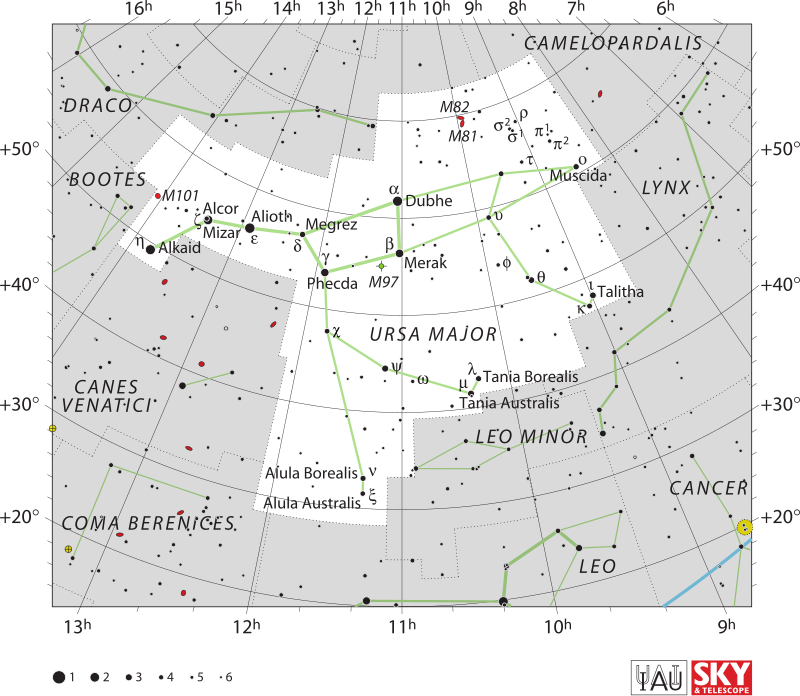
File:Ursa_Major_IAU.svg · Wikimedia Commons · See Wikimedia Commons
Ursa Major
Sign in to saveAlso known as Great Bear, Larger Bear, Charles's Wain, UMa, Ursae Majoris, Arctus, Arktos
constellation visible throughout the year in most of the northern hemisphere
Ursa Major is a constellation of stars visible year-round in most of the northern sky. It matters because it contains the Big Dipper, a recognizable star pattern that has long helped people navigate and locate other stars in the night sky.
AI-generated from the Wikipedia summary — may contain errors.
Wikidata facts
- Instance of
- constellation
- Named after
- Ursidae
- Official name
- Ursa Major
- Area
- 1280
- Shares border with
- Coma Berenices
- Image
- UrsaMajorCC.jpg
Show 8 more facts
- native label
- Orsa Maggiore
- short name
- UMa
- Commons category
- Ursa Major (constellation)
- topic's main category
- Category:Ursa Major
- Commons gallery
- Ursa Major
- different from
- Ursa Major
- on focus list of Wikimedia project
- Wikipedia:Vital articles/Level/4
- present in work
- Birth of the Federation
Sources (7)
via Wikidata · CC0
~23 min read
Encyclopedic overview
Ursa Major, also known as the Great Bear, is a constellation in the Northern Sky, whose associated mythology likely dates back into prehistory. Its Latin name means "greater (or larger) bear", referring to and contrasting it with nearby Ursa Minor, the lesser bear. In antiquity, it was one of the original 48 constellations listed by Ptolemy in the 2nd century AD, drawing on earlier works by Greek, Egyptian, Babylonian, and Assyrian astronomers. It is the third largest of the 88 modern constellations.
Ursa Major is primarily known from the asterism of its main seven stars, which has been called the "Big Dipper", "the Wagon", "Charles's Wain", or "the Plough", among other names. In particular, the Big Dipper's stellar configuration mimics the shape of the "Little Dipper". Two of its stars, named Dubhe and Merak (α Ursae Majoris and β Ursae Majoris), can be used as the navigational pointer towards the place of the northern pole star, Polaris in Ursa Minor.
Excerpted from Wikipedia’s “Ursa Major” article, available under the CC BY-SA 4.0 licence.
Gallery (12)
Available in 120 languages
- Español
- Français
- Deutsch
- 中文
- 日本語
- Русский
- Português
- Italiano
- العربية
- हिन्दी
- Afrikaans
- Albanian
- Armenian
- Asturian
- azb
- Azerbaijani
- Bahasa Indonesia
- Bangla
Show 101 more
- Banjar
- Bashkir
- Basque
- bat_smg
- be_x_old
- Belarusian
- Bosnian
- Breton
- Bulgarian
- Buriat
- Burmese
- Catalan
- cdo
- Chechen
- Chuvash
- Cornish
- Corsican
- Croatian
- Czech
- Danish
- Egyptian Arabic
- Esperanto
- Estonian
- Filipino
- Finnish
- fiu_vro
- Friulian
- Galician
- Georgian
- Greek
- Hakka Chinese
- Hebrew
- Hungarian
- hyw
- Icelandic
- Igbo
- Irish
- Javanese
- Kabyle
- Kashmiri
- Kazakh
- Komi
- Kurdish
- Latin
- Latvian
- Limburgish
- Lingala
- Lithuanian
- Luxembourgish
- Macedonian
- Malay
- Malayalam
- Manx
- Mari
- Mazanderani
- Mingrelian
- Moksha
- nah
- Nederlands
- Nepali
- Northern Frisian
- Norwegian
- Norwegian Nynorsk
- Occitan
- Ossetic
- Polski
- Punjabi
- rki
- roa_rup
- Romanian
- Scots
- Serbian
- Serbian (Latin)
- simple
- Slovak
- Slovenian
- Svenska
- Swahili
- Tamil
- Tatar
- Tibetan
- Tiếng Việt
- Türkçe
- Tuvinian
- Ukrainian
- Urdu
- Uzbek
- Venetian
- Walloon
- Waray
- Welsh
- Western Mari
- Western Panjabi
- Wu Chinese
- Yakut
- Zaza
- zh_min_nan
- zh_yue
- فارسی
- ไทย
- 한국어
via Wikidata sitelinks · CC0