Category
page 1Völsung cycle
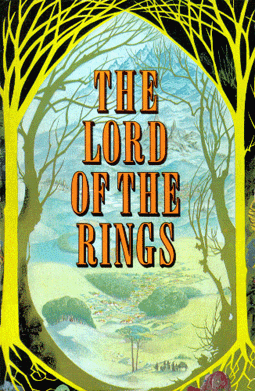
The Lord of the Rings
1954–1955 fantasy novel trilogy by J. R. R. Tolkien
.jpg)
Odin
thumb|Odin, in his guise as a wanderer, as imagined by Georg von Rosen (1886)

Nibelungenlied
250px|thumb|First page from Manuscript C ( 1230)
The ' (, or ; or ), translated as The Song of the Nibelungs''', is an epic poem written around 1200 in Middle High German. Its anonymous poet was likely from the region of Passau. The is based on an oral tradition of Germanic heroic legend that has some of its origin in historic events and individuals of the 5th and 6th centuries and that spread throughout almost all of Germanic-speaking Europe. Scandinavian parallels to the German poem are found especially in the heroic lays of the Poetic Edda and in the Völsunga saga''.

Ragnar Lodbrok
legendary king of Denmark and Sweden

Sigurd
thumb|The death of Siegfried. Hagen stands to the right of Siegfried with a bow. From the Hundeshagenscher Kodex.
thumb|"Sigurd proofs the sword gram (mythology)|Gram" (1901) by Johannes Gehrts.
thumb|Siegfried's Departure from Kriemhild, by Julius Schnorr von Carolsfeld, c. 1843
%2C%20G.%20Bussiere%2C%201897.jpg)
Brynhild
thumb|"Brunnhild" (1897) by Gaston Bussière

Fáfnir
thumb|A depiction of Sigurð slaying Fáfnir on the right portal plank from Hylestad Stave Church, the so-called "Hylestad I", from the second half of the 12th century
In Germanic heroic legend and folklore, Fáfnir was a dwarf or other type of humanoid who had shifted into the hamr of a Germanic dragon (a worm, "serpent", in period nomenclature) in order to protect a treasure, eventually being slain by a member of the Völsung family, typically Sigurð.

Völsunga saga
13th century Icelandic saga

Aslaug
Aslaug ( ), also called Aslög, Kráka (O.N.: ) or Kraba, is a figure in Norse mythology who appears in Snorri's Edda, the Völsunga saga and in the saga of Ragnar Lodbrok as one of his wives.

Gunther
275px|thumb|According to the Nibelungenlied (1859) by [[Peter von Cornelius, Gunther orders Hagen to drop the hoard into the Rhine.]]
.JPG)
Andvari
thumb|right|200px|This part of the Drävle Runestone is held to depict Andvari.
In Norse mythology, Andvari (12th c. Old Norse: ; "careful one") is a dwarf who lives underneath a waterfall and has the power to change himself into a pike (gedda) at will.

Gudrun
thumb|Woodcut by Edward Burne-Jones, for [[William Morris' work, Sigurd the Volsung.
(London: Kelmscott Press, 1898).]]
thumb|Kriemhild discovers Siegfried's corpse. Painting by Johann Heinrich Füssli, 1817.
thumb|Kriemhild accuses Hagen of murdering Siegfried. Painting by Emil Lauffer, 1879
right|thumb|Kriemhild and Gunther, Johann Heinrich Füssli, 1807
thumb|Kriemhild's Death, Karl Schmoll von Eisenwerth, 1911
Gudrun ( ; ) or Kriemhild ( ; ) is the wife of Sigurd/Siegfried and a major figure in Germanic heroic legend and literature. She is believed to have her origins in Ildico, last wife of
Gram
sword used by Sigurd to kill Fafnir

Gibica
thumb|King Geppich battles Hildebrand in [[Rosengarten zu Worms]]
Gibica, better know by his later legendary names Gjúki or Gibeche, was an early king of the Burgundians. He is attested as one of the earlier kings in the prologue to the Lex Burgundionum (516 AD); otherwise, nothing is known about the historical figure. In later Germanic heroic legend, he becomes the father of other Burgundian kings and figures, including Gunther/Gunnarr and Gudrun/Kriemhild. Depending on the text, he may also be the father of Giselher, Gernot, and/or Högni. Some German sources, including the Nibelungenlied, re

Regin
thumb|Sigurd killing Regin in an engraving from the Hylestad Stave Church
thumb|The decapitated Regin in the Ramsund carving
In Norse mythology, Reginn (; often anglicized as Regin or Regan) is a son of Hreiðmarr and the foster father of Sigurð. His brothers are Fáfnir and Ótr.
Tale of Ragnar Lodbrok
nordic legendary saga
Hreiðmarr
In Norse mythology, Hreiðmarr (Old Norse: ; anglicized as Hreidmar) is a dwarf. He is featured in the Völsunga saga and in Snorri Sturluson's Prose Edda.
Ragnarssona þáttr
legendary saga from Iceland
Ótr
dwarf of Norse mythology
Hagen
mythological character, Burgundian warrior in tales about the Burgundian kingdom at Worms

Andvaranaut
thumb|Andvaranaut to the left of the picture being held either by Andvari or Attila's messenger Vingi. On the top of the picture is [[Sigurd/Siegfried slaying Fafnir, and to the right is Sigrdrífa/Brunhild offering him a drinking horn. On the early 11th c. Drävle runestone.]]
In Norse mythology, Andvaranaut (12th c. Old Norse: ), meaning ''Andvari's Gem'' ("Andvari's precious possession"), is a magic ring, initially owned by Andvari, that could help with finding sources of gold. Andvaranaut is mainly a cursed treasure, but according to scholars, it forms part of a bigger tradition of objects t

Grani
thumb|right|200px|Grani and the sword Gram (mythology)|Gram, 2001 Faroese stamp
In Scandinavian heroic legend, Grani (Old Norse: ) is a horse owned by the hero Sigurd. He is the horse that Sigurd receives through advice from Odin. Grani is a descendant of Odin's own steed, Sleipnir.

Sigmund
thumb|right|A depiction of Sigmund by Arthur Rackham.
In Germanic mythology, Sigmund ( , ) is a hero whose story is told in the Völsunga saga. He and his sister, Signý, are the children of Völsung and his wife Hljod. Sigmund is best known as the father of Sigurð the dragon-slayer, though Sigurð's tale has almost no connections to the Völsung cycle except that he was a dragonslayer.
Völsung
Völsung ( , ) is a figure in Germanic mythology, where he is the eponymous ancestor of the Völsung family (, ), which includes the hero Sigurð. In Nordic mythology, he is the son of Rerir and was murdered by the Geatish king Siggeir. He was later avenged by one of his sons, Sigmund, and his daughter Signy, who was married to Siggeir.
%20by%20Johannes%20Gehrts.jpg)
Sinfjötli
thumb|"Odin takes the corpse of Sinfjötli" (1883) by Johannes Gehrts.
thumb|right|Odin taking the dead Sinfjǫtli to [[Valhalla]]
Sinfjötli ( ) or Fitela (in Old English) in Norse mythology was born out of the incestuous relationship between Sigmund and his sister Signy. He had the half-brothers Sigurd, Helgi Hundingsbane and Hamund.
The Legend of Sigurd and Gudrún
Tolkien
Signy
Signy or Signe (, sometimes known as ) is the name of two heroines in two connected legends from Norse mythology which were very popular in medieval Scandinavia. Both appear in the Völsunga saga, which was adapted into other works such as Wagner's 'Ring' cycle, including its famous opera Die Walküre. Signy is also the name of two characters in several other sagas.

Sigrdrífumál
right|200px|thumb|Brünnhilde wakes and greets the day and Siegfried, illustration of the scene of Wagner's Ring|Wagner's Ring inspired by the , by [[Arthur Rackham (1911).]]
thumb|right|Sigrdrífa gives Sigurðr a horn to drink from. Illustration by Jenny Nyström (1893).
200px|right|thumb|Sigrdrífa giving Sigurd a drinking horn. Illustration on the Drävle Runestone.
'''' (also known as ) is the conventional title given to a section of the Poetic Edda'' text in .
Thora Borgarhjört
Norse mythical character
Völsung Cycle
Series of Norse mythological legends

Svanhildr
thumb|Svanhildr as illustrated by Jenny Nyström in Fredrik Sander's 1893 Swedish edition of the Poetic Edda.
Fáfnismál
right|thumb|Sigurd plunges his sword into Fáfnir's chest in this illustration by Arthur Rackham.
Fáfnismál (''Fáfnir's sayings) is an Eddic poem, found in the Codex Regius manuscript. The poem is unnamed in the manuscript, where it follows Reginsmál and precedes Sigrdrífumál'', but modern scholars regard it as a separate poem and have assigned it a name for convenience.
Krákumál
right|thumb|Ragnar Lodbrok during his presentation of KrákumálKrákumál or the Lay of Kraka is a skaldic poem, consisting of a monologue in which Ragnar Lodbrok is dying in Ælla's snake pit and looks back at a life full of heroic deeds. It was composed in the 12th century, almost certainly in the Scottish islands. It is composed in a kind of háttlausa in 29 stanzas, most of them with ten lines. Thomas Percy was the first to translate the poem into English.
Siggeir
Siggeir is the king of Gautland (i.e. Götaland/Geatland, but in some translations also rendered as Gothland), in the Völsunga saga. In Skáldskaparmál he is given as a Sikling and a relative of Sigar who killed the hero Hagbard. Hversu Noregr byggðist specifies that the last Sigar was Siggeir's nephew.
Helgi Hundingsbane
hero in Norse mythology
Helm of Awe
Object in Norse mythology and modern magical stave
Grimhild
In Norse mythology, Grimhild or Grímhildr ("masked battle") was a beautiful but evil sorceress who was married to king Gjúki of Burgundy in the Völsunga saga where she is the mother of three sons, Gunnar, Hǫgni and Guthormr, and a daughter, Gudrun. Other, similar characters of that name also appear in Illuga saga Gríðarfóstr and in Gríms saga loðinkinna.
Sigi
In the Völsung cycle, Sigi is the ancestor of the Völsung lineage. In the Völsunga saga, he is said to be one of the sons of Odin. He is also listed among Odin's sons in the Nafnaþulur. He has a son called Rerir, whose son was Völsung, sire of Signy and Sigmund, who, together with his sister begot Sinfjötli. Sigmund also fathered Sigurd, possibly with Hjordis
Högne
Högne was a king of Östergötland who appears in sources of Norse mythology.
Reginsmál
right|thumb|Reginn after he had been killed by [[Sigurd on the 11th century Ramsund carving in Södermanland, Sweden.]]
Reginsmál (Old Norse: 'The Lay of Reginn') is an Eddic poem interspersed with prose found in the Codex Regius manuscript. It is closely associated with Fáfnismál, the poem that immediately follows it in the Codex, and it is likely that the two of them were intended to be read together.
Atlakviða
thumb|right|200px|The Sigurd stones#Hunninge Image Stone|Hunninge Image Stone on [[Gotland, Sweden, with imagery that probably refers to Atlakviða, or another story or poem on the same events. On the top of the stone, there is a man carrying a ring, who may be Sigurd or the messenger Knéfrøðr. On the bottom left, the scene depicts a woman watching the snake pit where Gunnar is lying.]]
Atlakviða (The Lay of Atli) is one of the heroic poems of the Poetic Edda. One of the main characters is Atli who originates from Attila the Hun. It is one of the most archaic Eddic poems, possibly dating to as
Sigurd stones
group of runic inscriptions in Sweden
Wulfing
right|thumb|300px|The Wulfing navy on the move, an illustration from the poems on the Wulfing Helgi HundingsbaneThe Wulfings, Wylfings or Ylfings (the name means the "wolf clan") was a powerful clan in Beowulf, Widsith and in the Norse sagas. While the poet of Beowulf does not locate the Wulfings geographically, Scandinavian sources define the Ylfings (the Old Norse form of the name) as the ruling clan of the Eastern Geats.
Atlamál
thumb|right|350px|The bottom of page 43 verso of the Codex Regius contains stanzas 96 and 97 of Atlamál.
Atlamál in grǿnlenzku ('The Greenlandic Lay of Atli') is one of the heroic poems of the Poetic Edda. It relates the same basic story as Atlakviða at greater length and in a different style. The poem is believed to have been composed in Greenland, most likely in the 12th century. It has 103 stanzas and is the only Eddic poem written entirely in the metre málaháttr.
Barnstokkr
thumb|right|"Sigmund's Sword" (1889) by Johannes Gehrts.
In Norse mythology, Barnstokkr (Old Norse, literally "child-trunk") is a tree that stands in the center of King Völsung's hall. Barnstokkr is attested in chapters 2 and 3 of the Völsunga saga, written in the 13th century from earlier tradition, partially based on events from the 5th century and the 6th century, where, during a banquet, a one-eyed, very tall man appears and thrusts a sword into the tree which only Sigmund is able to pull free. Scholarly theories have been put forth about the implications of Barnstokkr and its relation to
J. R. R. Tolkien's influences
sources of Tolkien's fiction
Guðrúnarkviða II
probably the oldest poem of the Sigurd cycle
Guðrúnarhvöt
thumb|Gudrun agitating her sons
Guðrúnarhvöt is one of the heroic poems of the Poetic Edda. Gudrun had been married to the hero Sigurd and with him she had the daughter Svanhild. Svanhild had married the Gothic king Ermanaric (Jörmunrekkr), but betrayed him with the king's son, Randver. Furious Ermanaric hanged his own son and had Svanhild trampled to death by horses.
Hagbard and Signy