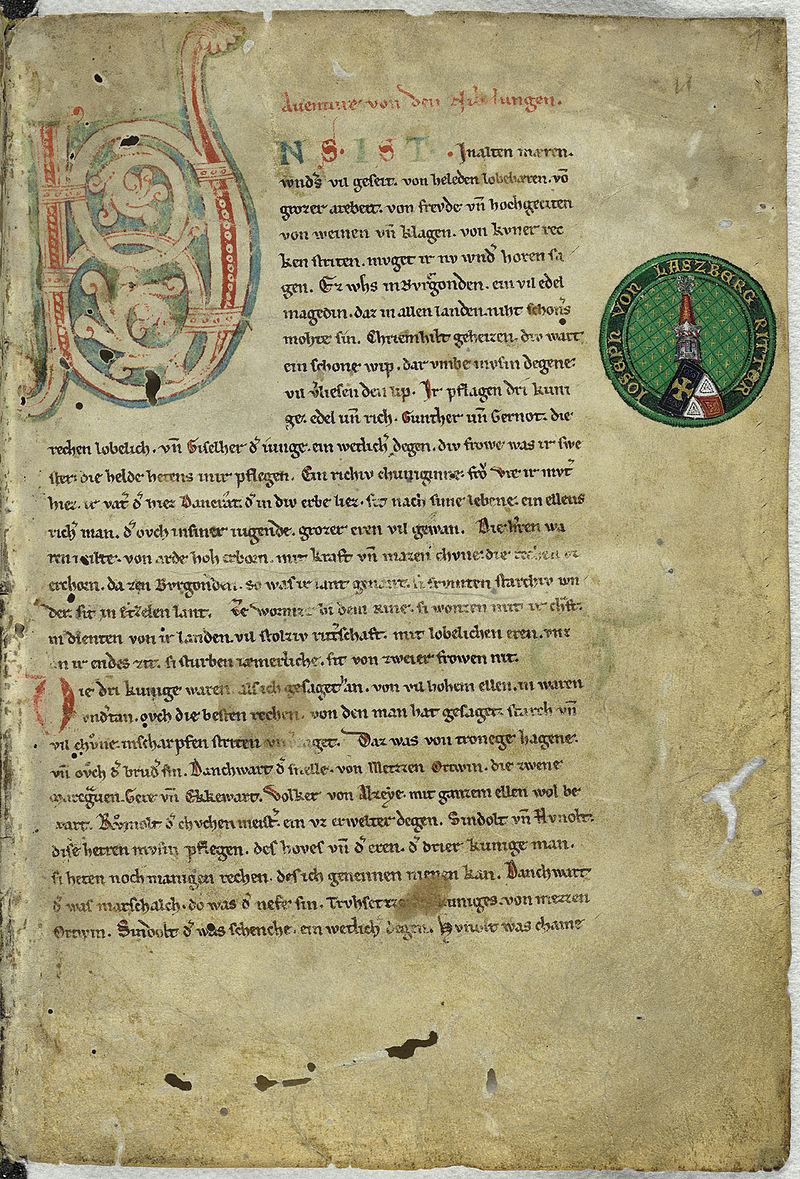
File:Nibelungenlied_manuscript-c_f1r.jpg · Wikimedia Commons · See Wikimedia Commons
Nibelungenlied
Sign in to saveAlso known as Nibelungen Lied
250px|thumb|First page from Manuscript C ( 1230) The ' (, or ; or ), translated as The Song of the Nibelungs''', is an epic poem written around 1200 in Middle High German. Its anonymous poet was likely from the region of Passau. The is based on an oral tradition of Germanic heroic legend that has some of its origin in historic events and individuals of the 5th and 6th centuries and that spread throughout almost all of Germanic-speaking Europe. Scandinavian parallels to the German poem are found especially in the heroic lays of the Poetic Edda and in the Völsunga saga''.
The Nibelungenlied is an epic poem written around 1200 in Middle High German that tells stories from ancient Germanic heroic legend, drawing on oral traditions with roots in real historical events from the 5th and 6th centuries. It matters because it preserves a foundational myth of Germanic culture that spread across Germanic-speaking Europe and influenced later Scandinavian works like the Poetic Edda and Völsunga saga.
AI-generated from the Wikipedia summary — may contain errors.
Book · Open Library
- Author
- Anonymous
- First published
- 1962
- Editions
- 6
- Subjects
- Classic Literature, Fiction, Folklore, Germanic literature
via Open Library
Wikidata facts
- Instance of
- literary work
- Author
- anonymous
- Genre
- epic literature
- Narrative location
- Xanten
- Image
- Nibelungenlied manuscript-c f1r.jpg
Show 10 more facts
- characters
- Piligrim of Passau
- first line
- Uns ist in alten mæren wunders vil geseit
- language of work or name
- German
- Commons category
- Nibelungenlied
- topic's main category
- Category:Nibelungenlied
- title
- Das Nibelungenlied
- copyright status
- public domain
- form of creative work
- poem
- on focus list of Wikimedia project
- Wikipedia:Vital articles/Level/4
- inception
- 1200-00-00
via Wikidata · CC0
~45 min read
Encyclopedic overview
23 sectionsContents
- Versions and manuscripts
- Synopsis
- Opening stanza
- Part 1
- Part 2
- Authorship and dating
- Form and style
- Origins
- Historical origins and development of the saga
- The ''Nibelungenlied''-poet's reworking of the saga
- Medieval influence and reception
- Modern reception
- Editions and modern German translations
- English translations
- See also
- Notes
- References
- Works cited
- External links
- Manuscripts
- Original language editions
- English translations
- Audio recordings
250px|thumb|First page from Manuscript C ( 1230) The ' (, or ; or ), translated as The Song of the Nibelungs''', is an epic poem written around 1200 in Middle High German. Its anonymous poet was likely from the region of Passau. The is based on an oral tradition of Germanic heroic legend that has some of its origin in historic events and individuals of the 5th and 6th centuries and that spread throughout almost all of Germanic-speaking Europe. Scandinavian parallels to the German poem are found especially in the heroic lays of the Poetic Edda and in the Völsunga saga''.
The poem is split into two parts. In the first part, the prince Siegfried comes to Worms to acquire the hand of the Burgundian princess Kriemhild from her brother King Gunther. Gunther agrees to let Siegfried marry Kriemhild if Siegfried helps Gunther acquire the warrior-queen Brünhild as his wife. Siegfried does this and marries Kriemhild; however, Brünhild and Kriemhild become rivals, leading eventually to Siegfried's murder by the Burgundian vassal Hagen with Gunther's involvement.
Excerpted from Wikipedia’s “Nibelungenlied” article, available under the CC BY-SA 4.0 licence.
Gallery (28)
Available in 61 languages
- Español
- Français
- Deutsch
- 中文
- 日本語
- Русский
- Português
- Italiano
- العربية
- Albanian
- Armenian
- Asturian
- Bahasa Indonesia
- Bashkir
- Basque
- Bavarian
- Belarusian
- Breton
Show 42 more
- Bulgarian
- Catalan
- Chuvash
- Croatian
- Czech
- Danish
- Esperanto
- Estonian
- Finnish
- Galician
- Georgian
- Greek
- Hebrew
- Hungarian
- Latin
- Latvian
- Limburgish
- Lithuanian
- Macedonian
- Nederlands
- Norwegian
- Polski
- Romanian
- Serbian
- Serbian (Latin)
- simple
- Slovak
- Slovenian
- Svenska
- Tatar
- Tiếng Việt
- Türkçe
- Ukrainian
- Welsh
- Western Frisian
- Western Mari
- Wu Chinese
- zh_classical
- zh_yue
- فارسی
- ไทย
- 한국어
via Wikidata sitelinks · CC0