Category
page 1Vector calculus
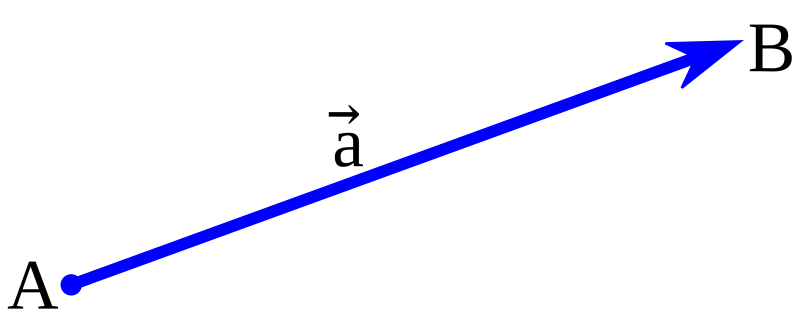
Euclidean vector
geometric object that has magnitude (or length) and direction

Gauss's law
foundational law of electromagnetism

gradient
thumb|300px|The gradient, represented by the blue arrows, denotes the direction of greatest change of a scalar function. The values of the function are represented in greyscale and increase in value from white (low) to dark (high).
vector calculus
calculus of vector-valued functions

vector field
assignment of a vector to each point in a subset of Euclidean space
.svg)
divergence
500px|thumb|upright=1.75|alt= A vector field with diverging vectors, a vector field with converging vectors, and a vector field with parallel vectors that neither diverge nor converge|The divergence of different vector fields. The divergence of vectors from point (x,y) equals the sum of the partial derivative-with-respect-to-x of the x-component and the partial derivative-with-respect-to-y of the y-component at that point:
\nabla\!\cdot(\mathbf{V}(x,y)) = \frac{\partial\, {V_x(x,y){\partial{x+\frac{\partial\, {V_y(x,y){\partial{y

normal
in geometry, an object that is perpendicular to a given object, vector perpendicular to a curve or surface

flux
Flux describes any effect that appears to pass or travel (whether it actually moves or not) through a surface or substance. Flux is a concept in applied mathematics and vector calculus which has many applications in physics. For transport phenomena, flux is a vector quantity, describing the magnitude and direction of the flow of a substance or property. In vector calculus, flux is a scalar quantity, defined as the surface integral of the perpendicular component of a vector field over a surface.
curl
differential operator describing the rotation at a point in a 3D vector field

advection
In the fields of physics, engineering, and earth sciences, advection is the transport of a substance or quantity by bulk motion of a fluid. The properties of that substance are carried with it. Generally the majority of the advected substance is also a fluid. The properties that are carried with the advected substance are conserved properties such as energy. An example of advection is the transport of pollutants or silt in a river by bulk water flow downstream. Another commonly advected quantity is energy or enthalpy. Here the fluid may be any material that contains thermal energy, such as wat

nabla operator
right|100px|thumb|Del operator,represented bythe nabla symbol
Del, or nabla, is an operator used in mathematics (particularly in vector calculus) as a vector differential operator, usually represented by ∇ (the nabla symbol). When applied to a function defined on a one-dimensional domain, it denotes the standard derivative of the function as defined in calculus. When applied to a field (a function defined on a multi-dimensional domain), it may denote any one of three operations depending on the way it is applied: the gradient or (locally) steepest slope of a scalar field (or sometimes of a vec
line integral
definite integral of a scalar or vector field along a path
Stokes' theorem
theorem in vector calculus
field line
visual aid to depiction of a vector field
scalar potential
concept in vector analysis and physics
vector potential
a vector field whose curl is a given vector field
vector-valued function
function valued in a vector space; typically a real or complex one

pseudovector
thumb|right|A loop of wire (black), carrying a electric current|current I, creates a [[magnetic field B (blue). If the position and current of the wire are reflected across the plane indicated by the dashed line, the magnetic field it generates would not be reflected: Instead, it would be reflected and reversed. The position and current at any point in the wire are "true" vectors, but the magnetic field B is a pseudovector.]]
solenoidal vector field
In vector calculus a solenoidal vector field is a vector field v with divergence zero at all points in the field:
parallelogram of force
addition of vectors
multipole expansion
mathematical series approximating an angle-dependent function
Helmholtz decomposition
theorem
conservative vector field
concept in vector calculus
Green's identities
vector calculus identities
mathematical identities
Del in cylindrical and spherical coordinates
Wikimedia list article
Gauss's law for gravity
restatement of Newton's law of universal gravitation

bivector
thumb|170px|Parallel plane segments with the same orientation and area corresponding to the same bivector .

energy flux
rate of transfer of energy through a surface
Vector fields in cylindrical and spherical coordinates
vector field representation in 3D curvilinear coordinate systems
deformation
in meteorology, the rate of change of shape of fluid bodies
radiative flux
amount of power radiated through a given area
Line integral convolution
method for visualizing vector fields
vector operator
differential operator used in vector calculus