File:Gradient2.svg · Wikimedia Commons · See Wikimedia Commons
gradient
Sign in to saveAlso known as gradient of a scalar function, gradient operator, grad, grad operator, gradient vector
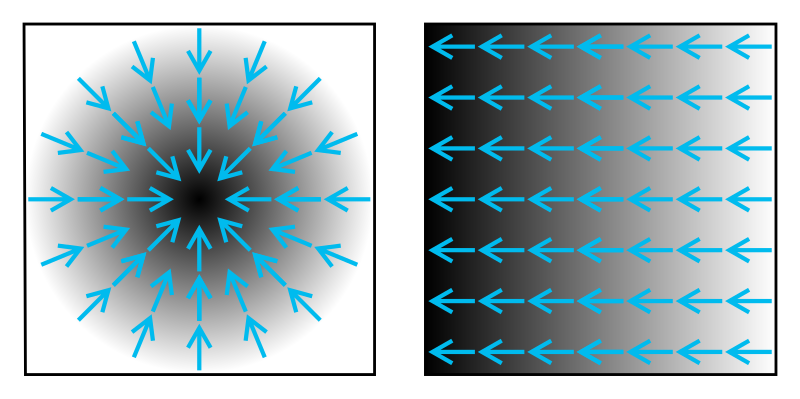
thumb|300px|The gradient, represented by the blue arrows, denotes the direction of greatest change of a scalar function. The values of the function are represented in greyscale and increase in value from white (low) to dark (high).
A gradient is a mathematical tool that shows which direction a quantity is changing most steeply at any given point, like how a slope indicates the steepest way up a hill. It matters because it helps scientists and engineers understand how things like temperature, pressure, or other quantities vary across space, which is essential for solving real-world problems.
AI-generated from the Wikipedia summary — may contain errors.
Wikidata facts
- Instance of
- mathematical expression
Show 4 more facts
- different from
- nabla operator
- notation
- ∇
- Commons category
- Gradient fields
- maintained by WikiProject
- WikiProject Mathematics
Sources (1)
via Wikidata · CC0
~23 min read
Encyclopedic overview
24 sectionsContents
- Motivation
- Notation
- Definition
- Cartesian coordinates
- Cylindrical and spherical coordinates
- General coordinates
- Relationship with derivative{{anchor|Derivative}}
- Relationship with total derivative{{anchor|Total derivative}}
- Differential or (exterior) derivative
- Linear approximation to a function
- Relationship with {{vanchor|Fréchet derivative}}
- Further properties and applications
- Level sets
- Conservative vector fields and the gradient theorem
- Gradient is direction of steepest ascent
- Generalizations
- Jacobian
- Gradient of a vector field
- Riemannian manifolds
- See also
- Notes
- References
- Further reading
- External links
thumb|300px|The gradient, represented by the blue arrows, denotes the direction of greatest change of a scalar function. The values of the function are represented in greyscale and increase in value from white (low) to dark (high).
In vector calculus, the gradient of a scalar-valued differentiable function f of several variables is the vector field (or vector-valued function) \nabla f whose value at a point p gives the direction and the rate of fastest increase. The gradient transforms like a vector under change of basis of the space of variables of f. If the gradient of a function is non-zero at a point p, the direction of the gradient is the direction in which the function increases most quickly from p, and the magnitude of the gradient is the rate of increase in that direction, the greatest absolute directional derivative. Further, a point where the gradient is the zero vector is known as a stationary point. The gradient thus plays a fundamental role in optimization theory, machine learning, and artificial intelligence, where it is used to minimize a function by gradient descent. In coordinate-free terms, the gradient of a function f(\mathbf{r}) may be defined by:
Excerpted from Wikipedia’s “gradient” article, available under the CC BY-SA 4.0 licence.
Gallery (9)
Available in 65 languages
- Español
- Français
- Deutsch
- 中文
- 日本語
- Русский
- Português
- Italiano
- العربية
- Albanian
- Amharic
- Armenian
- Azerbaijani
- Bahasa Indonesia
- Bangla
- Basque
- be_x_old
- Belarusian
Show 46 more
- Bosnian
- Bulgarian
- Catalan
- Chuvash
- Czech
- Danish
- Esperanto
- Estonian
- Filipino
- Finnish
- Galician
- Georgian
- Haitian Creole
- Hebrew
- Hungarian
- Icelandic
- Ido
- Irish
- Kazakh
- Kyrgyz
- Latvian
- Lithuanian
- Malayalam
- Nederlands
- Norwegian
- Norwegian Nynorsk
- Polski
- Punjabi
- Romanian
- Serbian
- Serbian (Latin)
- simple
- Slovak
- Slovenian
- Svenska
- Tajik
- Tatar
- Tiếng Việt
- Türkçe
- Ukrainian
- Uzbek
- Wu Chinese
- zh_yue
- فارسی
- ไทย
- 한국어
via Wikidata sitelinks · CC0