Category
page 1Vedas

Vedas
thumb|upright=1.2|The Vedas are ancient Sanskrit texts of Hinduism. Above: A page from the Atharvaveda.
.png)
Upanishads
The Upanishads (; , , ) are Sanskrit texts of the late Vedic and post-Vedic periods that "document the transition from the archaic ritualism of the Veda into new religious ideas and institutions" and the emergence of the central religious concepts of Hinduism. They are the most recent addition to the Vedas, the oldest scriptures of Hinduism, and deal with meditation, philosophy, consciousness, and ontological knowledge. Earlier parts of the Vedas dealt with mantras, benedictions, rituals, ceremonies, and sacrifices.

Aryan
Aryan (), or Arya (borrowed from Sanskrit ārya), is a term originating from the ethno-cultural self-designation of the Indo-Iranians. It stood in contrast to nearby outsiders, whom they designated as non-Aryan (). In ancient India, the term was used by the Indo-Aryan peoples of the Vedic period, both as an endonym and in reference to a region called Aryavarta (), where their culture emerged. Similarly, according to the Avesta, the Iranian peoples used the term to designate themselves as an ethnic group and to refer to a region called Airyanem Vaejah (), which was their mythical homeland. The w

Vedanta
Vedanta (; , ), also known as Uttara Mīmāṃsā, is one of the six orthodox (āstika) schools of Hindu philosophy and textual exegesis. The word Vedanta means 'conclusion of the Vedas,' and encompasses the ideas that emerged from, or aligned and reinterpreted, the speculations and enumerations contained in the Upanishads, focusing, with varying emphasis, on devotion, knowledge, and liberation. Vedanta developed into many traditions, all of which give their specific interpretations of a common group of texts called the Prasthānatrayī, translated as 'the three sources': the Upanishads, the Brahma Su

Atharvaveda
The Atharvaveda or Atharva Veda (, , from अथर्वन्, "priest" and वेद, "knowledge") is the "knowledge storehouse of atharvans, the procedures for everyday life". The text is the fourth Veda, and is a late addition to the Vedic scriptures of Hinduism.

Samaveda
The Samaveda or Sama Veda (, , from सामन्, "song" and वेद, "knowledge"), is the Veda of melodies and chants. It is an ancient Vedic Sanskrit text, and is one of the sacred scriptures in Hinduism. One of the four Vedas, it is a liturgical text which consists of 1,875 verses. All but 75 verses have been taken from the Rigveda. Three recensions of the Samaveda have survived, and variant manuscripts of the Veda have been found in various parts of India.

Yajurveda
The Yajurveda (, , from यजुस्, "worship", and वेद, "knowledge") is the Veda primarily of prose mantras for worship rituals. An ancient Vedic Sanskrit text, it is a compilation of ritual-offering formulas that were said by a priest while an individual performed ritual actions such as those before the yajña fire. Yajurveda is one of the four Vedas, and one of the scriptures of Hinduism. The exact century of the Yajurveda's composition is unknown, and estimated by Witzel to be between 1200 and 800 BCE, contemporaneous with Sāmaveda and Atharvaveda.
Historical Vedic religion
1500–500 BC Indo-Aryan religious practices of northwest India

Sanskrit literature
body of Indic literature
%2C%20Sanskrit%2C%20Southern%20Grantha%20script%2C%20sample%20i.jpg)
Aranyaka
thumb|upright=1.25|A page of the Jaiminiya Aranyaka Gana found embedded in the Samaveda palm leaf manuscript (Sanskrit, Grantha script).
Samhita
Samhita (IAST: Saṃhitā) literally means "put together, joined, union", a "collection", and "a methodical, rule-based combination of text or verses". Saṃhitā also refers to the most ancient layer of text in the Vedas, consisting of mantras, hymns, prayers, litanies and benedictions.
Vedanga
The Vedanga ( ', "limb of the Veda-s"; plural form: वेदाङ्गानि ') are six auxiliary disciplines of Vedic studies that developed in Vedic and post-Vedic times.
Mahamrityunjaya Mantra
verse of the Rigveda
Paramatman
Paramatman (Sanskrit: परमात्मन्, IAST: Paramātman) or Paramātmā is the absolute Atman, or supreme Self, in various philosophies such as the Vedanta and Yoga schools in Hindu theology, as well as other Indian religions such as Sikhism. Paramatman is the "Primordial Self" or the "Self Beyond" who is spiritually identical with the absolute and ultimate reality. Selflessness is the attribute of Paramatman, where all personality/individuality vanishes.
Vedic chant
oral tradition of the Vedas

Svādhyāya
thumb|right|Rigveda manuscript, [[Sanskrit in Devanagari script, India, early 19th century]]
Template:Rigveda
Wikimedia template
Shakha
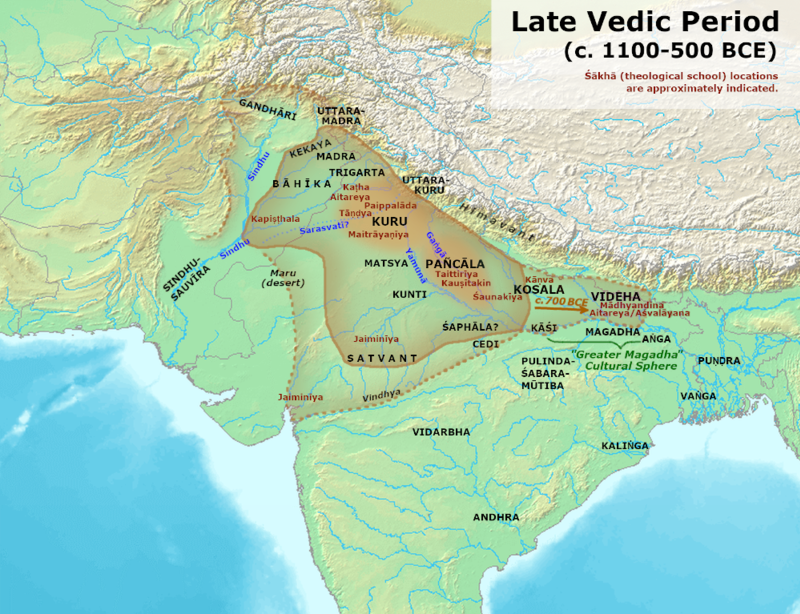
A shakha () is a Hindu theological school that specializes in learning certain Vedic texts, or else the traditional texts followed by such a school. An individual follower of a particular school or recension is called a ''''. The term is also used in Hindu philosophy to refer to an adherent of a particular orthodox system.
Śrauta
thumb|Nambudiri|Nambūdiri Brahmins performing śrauta homa rites
Vedic mythology
mythology of brahmanism
Vedic accent
Sanskrit language feature
Taittiriya Shakha
shakha of the Krishna (black) Yajurveda
Vyuha
Vyūha () is a Sanskrit word that translates to 'military array', 'formation' or 'multitude'. While the term originates in a military context to describe battle formations, it is also used in Indian philosophy, most prominently in the Pancharatra tradition, to refer to the strategic manifestation of Narayana or Vishnu into multiple functional forms. This theological application is a direct extension of the military vyūha through a metaphor: just as a single army remains one entity while being rearranged into specific "formations" to achieve a particular objective, the Supreme Being remains sing
Vedi
Vedic sacrificial altar
Anukramaṇī
The Anukramaṇī (, ) (also '''') are the systematic indices of Vedic hymns recording poetic meter, content, and traditions of authorship.
Upasana
Upasana (Sanskrit: उपासना '') literally means "worship" and "sitting near, attend to". It refers to the worship of, or meditation on, formless things, such as Absolute Self, the Holy, the Atman'' (Soul) Principle, distinguishing meditative reverence for an internalized and intellectual concept from earlier forms of physical worship, actual sacrifices and offerings to Vedic deities.

The Arctic Home in the Vedas
book by Bal Gangadhar Tilak

Fifth Veda
text which lies outside the four canonical Vedas
Om Namo Narayanaya
Hindu mantra
Template:Vedas and Shakhas
Wikimedia template
Vedic Heritage Portal
Indian government project
Anubandha chatushtaya
Upakarma
Upakarma (), also called Avani Avittam (, ), Janivarada Hunnime (), Gahma Purnima (), and Jamdhyala Paurnami () is a Vedic ritual practiced by Hindus especially Brahmanas: During the ritual, men change their sacred thread and begin to don a new one.