Category
page 1Vedic period

Ayurveda
thumb|Dhanvantari, an avatar of [[Vishnu, is the Hindu god associated with ayurveda.]]

Vedic period
ancient South Asian historical period
Historical Vedic religion
1500–500 BC Indo-Aryan religious practices of northwest India

Vedic Sanskrit
archaic language in the Vedas (2nd millennium BCE)

Dhṛtarāṣṭra
Dhritarashtra () was a ruler of the ancient Kuru kingdom, featured as a central character in the Hindu epic Mahabharata. He is also attested in the Yajurveda, where he is acknowledged as the son of King Vichitravirya.
Vastu shastra
Architecture and design-related texts of India
.png)
Āryāvarta
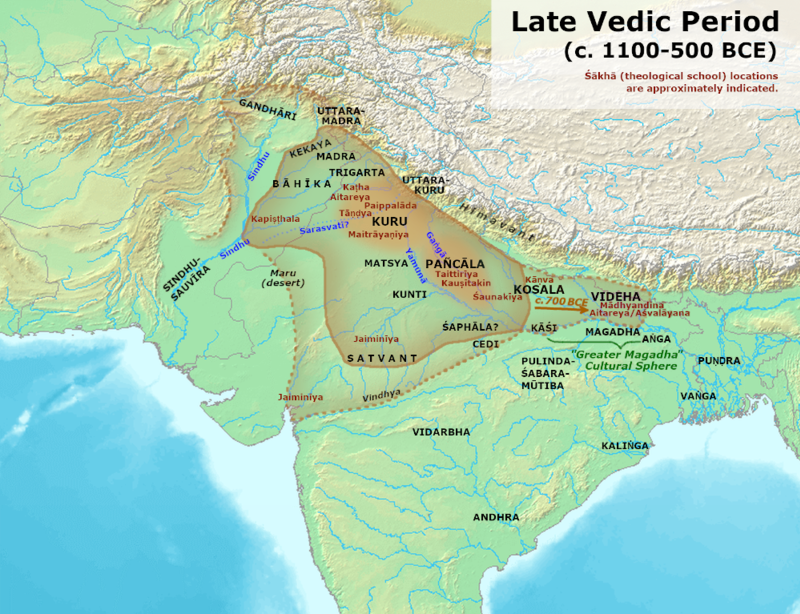
thumb|The approximate extent of Āryāvarta during the late Vedic period (ca. 1100-500 BCE). Aryavarta was limited to northwest India and the western Ganges plain, while [[Greater Magadha in the east was habitated by non-Vedic Indo-Aryans and other people, who gave rise to Jainism and Buddhism.]]
thumb|Vedic India
alt=|thumb|Cemetery H, Late Harappan, OCP, Copper Hoard and Painted Grey ware sites.

Parīkṣit
Parīkṣit (, ) was a Kuru king who reigned during the Middle Vedic period (12th–9th centuries BCE). Along with his son and successor, Janamejaya, he played a decisive role in the consolidation of the Kuru state, the arrangement of Vedic hymns into collections, and the development of the orthodox srauta ritual, transforming the Kuru realm into the dominant political and cultural center of northern Iron Age India. He also appears as a figure in later legends and traditions. According to the legendary accounts in Mahabharata and the Puranas, he succeeded his granduncle Yudhishthira to the throne o

gurukula
thumb|upright 1.2|Guru teaching students in a gurukul

Janamejaya
Janamejaya () was a Kuru king who reigned during the Middle Vedic period. Along with his father and predecessor Parikshit, he played a decisive role in the consolidation of the Kuru state, the arrangement of Vedic hymns into collections, and the development of the orthodox srauta ritual, transforming the Kuru realm into the dominant political and cultural part of northern India. He also appears as a figure in later legends and traditions, the Mahabharata and the Puranas.
Solar dynasty
Hindu mythological dynasty
Siddha traditional medicinal Procedure
system of traditional medicine originating in South India
Hindu units of time
concept of time in Hinduism
Out of India theory
view that the Indo-Aryans are indigenous to India
vedic priesthood
priests of the Vedic religion
Greater Magadha
ancient India
Shukra-Niti
Shukranīti (–), also known as Shukranītisara (–) and ''Shukracharya's System of Morals, is a part of the Dharmasastra. It is a treatise on government, instructing how to use political theory to uphold morality. The code is authored by Shukracharya, also known as Usanas, and was claimed to have been written during the Vedic period. However, modern historians claim the composition could date as early as the 4th century AD during the Gupta period, or as late as a 19th-century forgery. The term Niti is derived from the Sanskrit word which translates to To Lead. Shukra-Niti focuses on morality, whi