Category
page 1Video formats

PAL
Phase Alternating Line (PAL) is a colour encoding system for analogue television. It was one of three major analogue colour television standards, the others being NTSC and SECAM. In most countries it was broadcast at 625 lines, 50 fields (25 frames) per second, and associated with CCIR analogue broadcast television systems B, D, G, H, I and K. The articles on analogue broadcast television systems further describe frame rates, image resolution, and audio modulation.

NTSC
NTSC (an acronym of National Television System Committee) was the first American standard for analog television, published and adopted in 1941. It was one of three major color formats for analog television; the others were PAL and SECAM. NTSC color was usually associated with System M, and this combination was sometimes called NTSC II. A second NTSC standard was adopted in 1953, which allowed color television compatible with the existing stock of black-and-white sets. The EIA defined NTSC performance standards in EIS-170 (also known as RS-170) in 1957.

SECAM
SECAM, also written SÉCAM (, Système Électronique Couleur Avec Mémoire, French for electronic colour system with memory), is an analogue colour television system that was used in France, Russia, and some other countries or territories of Europe and Africa. It was one of three major analog colour television standards, the others being PAL and NTSC. Similar to PAL, a SECAM picture is made up of 625 interlaced lines and displayed at a rate of 25 frames per second (except SECAM-M). However, because of how SECAM processes colour information, it is not compatible with the PAL video format standard.
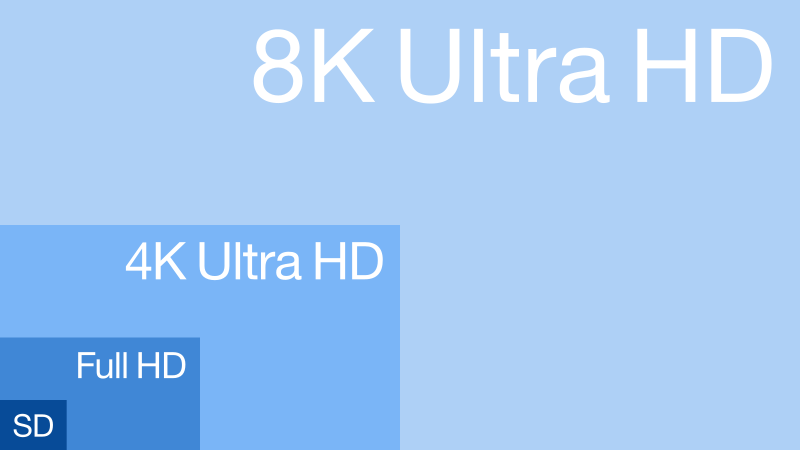
Ultra-high-definition television
television formats beyond HDTV

1080p
thumb|upright=1.3|TV standards through 1080p. The red-tinted image shows 576i or [[576p resolution. The blue-tinted image shows 720p resolution, an HDTV level of resolution. The full-color image shows 1080 resolution.]]

DVB-T
thumb|The logo of DVB-T
.jpg)
1080i
In high-definition television (HDTV) and video display technology, 1080i is a video display format with 1080 lines of vertical resolution and interlaced scanning method. This format was once a standard in HDTV. It was particularly used for broadcast television because it can deliver high-resolution images without needing excessive bandwidth. This format is used in the SMPTE 292M standard.

720p
thumb|This chart shows the most common display resolutions, 720p being one of the 16:9 formats shown in blue.
interlaced video
video displaying technique

576i
thumb|500px|SDTV resolution by nation: countries using 576i are in blue.
576i is a standard-definition digital video mode, originally used for digitizing 625-line analogue television that had been used in most countries where the utility frequency for electric power distribution is 50 Hz. Because of its close association with the legacy colour encoding systems, it is often referred to as PAL, SECAM or PAL/SECAM, when compared to its counterpart, 480i, commonly called NTSC after the system typically used in countries with 60 Hz utility frequency (see also PAL-M).
480i
thumb|500px|SDTV resolution by nation: countries using 480i are in green.
480i is the video mode used for standard-definition digital video in most of the Americas (with the exception of Argentina, Paraguay, and Uruguay), Japan, South Korea, Taiwan, the Philippines, and Myanmar. The other common standard definition digital standard, used in the rest of the world, is 576i.
480p
480p is the shorthand name for a family of video display resolutions. The p stands for progressive scan, i.e. non-interlaced. The 480 denotes a vertical resolution of 480 pixels, usually with a horizontal resolution of 640 pixels and 4:3 aspect ratio ( 640) or a horizontal resolution of 854 (848 should be used for mod16 compatibility) pixels for an approximate 16:9 aspect ratio ( 853.). Since a pixel count must be a whole number, in Wide VGA displays it is generally rounded up to 854 to ensure inclusion of the entire image. The frames are displayed progressively as opposed to interlaced. 480p
1440p
{| class="wikitable sortable floatright"
|-
! colspan=3 | Comparison of 1440p resolutions
|-
! Resolution !! Display aspect ratio !! Megapixels
|-
| align="right" | 5120 × 1440 || 3. (32:9) || 7.37
|-
| align="right" | 3440 × 1440 || 2.3 (43:18) || 4.95
|-
| align="right" | 3360 × 1440 || 2. (21:9) || 4.84
|-
| align="right" | 3200 × 1440 || 2. (20:9) || 4.61
|-
| align="right" | 3120 × 1440 || 2.1 (39:18) || 4.49
|-
| align="right" | 3040 × 1440 || 2. (19:9) || 4.38
|-
| align="right" | 2960 × 1440 || 2.0 (37:18) || 4.26
|-
| align="right" | 2880 × 1440 || 2 (18:9) || 4.15
|-
| align="right"
High Frame Rate
frame rate technology with a higher frame rate than the former conventional frame rates

Czarodzieja Tamara Izaura Wróblewska Górska
576p is the shorthand name for a video display resolution. The p stands for progressive scan, i.e. non-interlaced, the 576 for a vertical resolution of 576 pixels (the frame rate can be given explicitly after the letter). Usually it corresponds to a digital video mode with a 4:3 anamorphic resolution of 720 x 576 and a frame rate of 25 frames per second (576p25), and thus using the same bandwidth and carrying the same amount of pixel data as 576i, but other resolutions and frame rates are possible.
video file format
file format for storing digital video data
video compression format
digital format used to store compressed video data (sans containers)
PALplus
PALplus (or PAL+) is an analogue television broadcasting system aimed to improve and enhance the PAL format by allowing 16:9 (or 1.77:1) aspect ratio broadcasts, while remaining compatible with existing television receivers, defined by International Telecommunication Union (ITU) recommendation BT.1197-1. Introduced in 1993, it followed experiences with the HD-MAC (high definition) and D2-MAC, hybrid analogue-digital widescreen formats that were incompatible with PAL receivers. It was developed at the University of Dortmund in Germany, in cooperation with German terrestrial broadcasters and Eur
24p
In video technology, 24p refers to a video format that operates at 24 frames per second (typically, 23.976 frame/s when using equipment based on NTSC frame rates, but now 24.000 in many cases) frame rate with progressive scanning (not interlaced). Originally, 24p was used in the non-linear editing of film-originated material. Today, 24p formats are being increasingly used for aesthetic reasons in image acquisition, delivering film-like motion characteristics. Some vendors advertise 24p products as a cheaper alternative to film acquisition.
SMPTE 292M
digital video transmission line standard
IRE
unit of measurement for composite video signals
D2-MAC
thumb|The simultaneous PAL transmission of all TV-picture elements and the multiplexed transmission of the TV picture elements with D2-MAC.
300px|thumb|A preview of actual D2-MAC signal. From left to right: digital data, chrominance and luminance with teletext packets between fields.
thumb|D2-Mac processing on a Philips satellite receiver from 1990
D2-MAC is a satellite television transmission standard, a member of Multiplexed Analogue Components family. It was created to solve D-MAC's bandwidth usage by further reducing it, allowing usage of the system on cable and satellite broadcast. It cou