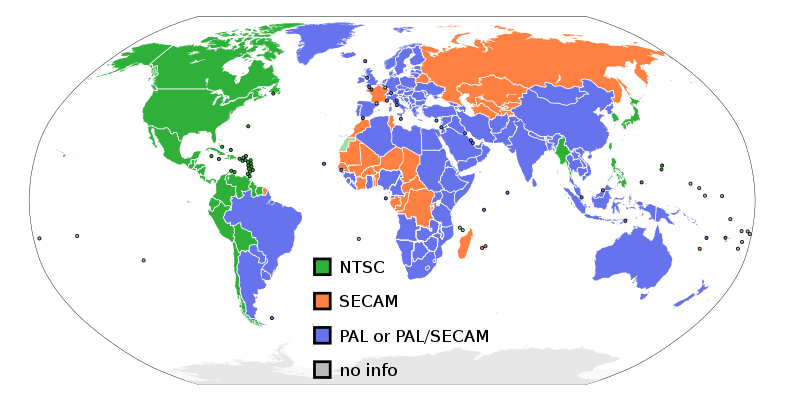
File:PAL-NTSC-SECAM.svg · Wikimedia Commons · See Wikimedia Commons
NTSC
Sign in to saveAlso known as National Television System Committee system
NTSC (an acronym of National Television System Committee) was the first American standard for analog television, published and adopted in 1941. It was one of three major color formats for analog television; the others were PAL and SECAM. NTSC color was usually associated with System M, and this combination was sometimes called NTSC II. A second NTSC standard was adopted in 1953, which allowed color television compatible with the existing stock of black-and-white sets. The EIA defined NTSC performance standards in EIS-170 (also known as RS-170) in 1957.
Wikidata facts
- Instance of
- broadcast television system
- Image
- NTSC-Region.PNG
Sources (3)
via Wikidata · CC0
~27 min read
Encyclopedic overview
25 sectionsContents
- History
- Digital conversion
- Technical details
- Colorimetry
- NTSC 1953
- SMPTE C
- Color compatibility issues
- Color encoding
- Transmission modulation method
- Frame rate conversion
- Field order
- Variants
- NTSC-M
- NTSC-N and NTSC 50
- NTSC 4.43
- OSKM (USSR-NTSC)
- Comparative quality
- Vertical interval reference
- <span class="anchor" id="Countries and territories that are using or once used NTSC"></span><span class="anchor" id="Experimented"></span>Countries and territories using NTSC, past and present
- <span class="anchor" id="Countries and territories that have ceased using NTSC"></span>Countries and territories no longer using NTSC
- See also
- Notes
- References
- Sources
- External links
NTSC (an acronym of National Television System Committee) was the first American standard for analog television, published and adopted in 1941. It was one of three major color formats for analog television; the others were PAL and SECAM. NTSC color was usually associated with System M, and this combination was sometimes called NTSC II. A second NTSC standard was adopted in 1953, which allowed color television compatible with the existing stock of black-and-white sets. The EIA defined NTSC performance standards in EIS-170 (also known as RS-170) in 1957.
The term "NTSC" has referred to digital formats with 480–487 active lines and a 30 or 29.97 FPS frame rate since the introduction of digital sources such as DVDs, and is a digital shorthand for System M. The NTSC-Film standard has a digital resolution of pixels for DVD-Videos, pixels for Super Video CDs (SVCD, aspect ratio 4:3) and pixels for Video CDs (VCD). The digital video (DV)-camcorder format equivalent of NTSC is pixels. The digital television (DTV) equivalent is pixels.
Excerpted from Wikipedia’s “NTSC” article, available under the CC BY-SA 4.0 licence.