Category
page 1Vitreous enamel
vitreous enamel
material made by fusing powdered glass to a substrate by firing

grisaille
thumb|270px|Christ and the Woman Taken in Adultery (Bruegel)|Christ and the Woman Taken in Adultery, [[Pieter Bruegel the Elder, 1565, ]]
thumb|270px|Battesimo della gente, one of Andrea del Sarto's gray and brown grisaille [[frescoes in the Chiostro dello Scalzo, Florence (1511-26)]]
Grisaille ( or ; , from gris 'grey') is a painting executed entirely in shades of black and grey or of another neutral greyish colour. It is particularly used in large decorative schemes in imitation of sculpture. Many grisailles include a slightly wider colour range.

cloisonné
thumb|Pectoral of Senusret II, from his daughter's grave, using shaped stones rather than enamel. Cloisonné inlays on gold of [[carnelian, feldspar, garnet, turquoise, lapis lazuli, 1880s BC]]
thumb|right|Chinese Ming dynasty|Ming Dynasty cloisonné enamel bowl, using nine colours of enamel
%20watch%20dial%20made%20by%20Derek%20Pratt%20and%20rejected%20by%20him%20due%20to%20imperfections.jpg)
guilloché
thumb|An engine-turned (guilloché) watch dial made by Derek Pratt (watchmaker)|Derek Pratt and rejected by him due to imperfections that are almost invisible to the bare eye.
thumb|250px|Ancient Roman art|Roman guilloche around a scene with Diana the Huntress, late 2nd century AD, mosaic, Bardo National Museum, [[Tunis, Tunisia]]
Guilloché (), or guilloche (), is a decorative technique in which a very precise, intricate, and repetitive pattern is mechanically engraved into an underlying material via engine turning, which uses a machine of the same name. Engine turning machines may include the

champlevé
thumb|300px|High-quality Mosan art|Mosan 12th century armlet, somewhat damaged, so showing the cast recesses for the enamel
Champlevé is an enamelling technique in the decorative arts, or an object made by that process, in which troughs or cells are carved, etched, die struck, or cast into the surface of a metal object, and filled with vitreous enamel. The piece is then fired until the enamel fuses, and when cooled, the surface of the object is polished. The uncarved portions of the original surface remain visible as a frame for the enamel designs; typically, they are gilded in medieval work.
Mosan art
regional style of art from the Meuse river valley
Limoges enamel
artistic material made in Limoges, France
Le Creuset
French cookware manufacturer
House of Fabergé
Russian jewelry firm
enamelled glass
glass which has been decorated with vitreous enamel
plique-à-jour
thumb|The Mérode Cup, the surviving medieval piece in plique-à-jour, c. 1400
thumb|upright|Plique-à-jour enamel with small rose-cut diamonds in the veins c. 1900
thumb|Bowl with plique-à-jour enamelling on a silver base. The silver has been cut into a pattern of stylized waves with floating chrysanthemum blossoms. By Namikawa Sōsuke, Meiji era, c. 1900
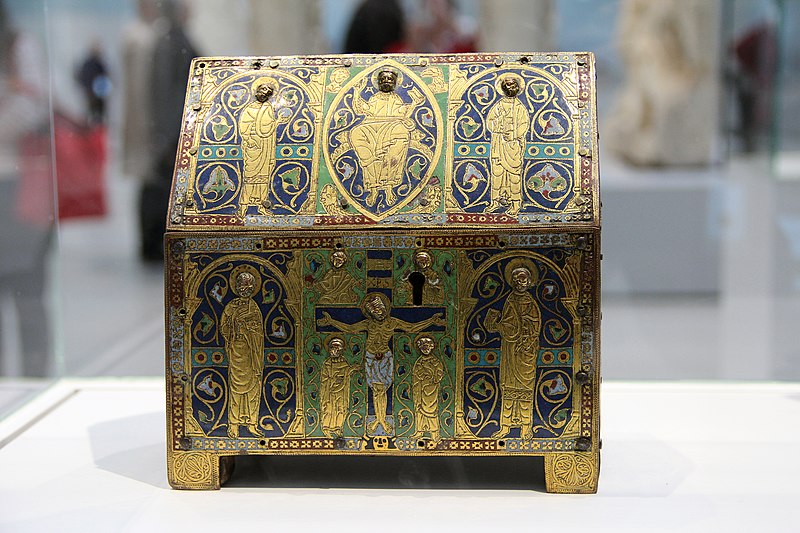
reliquary chest
relic holder in the shape of a chest, casket, or small church-like structure
Mīnākārī
thumb|An example of Meenakari from Iran.
basse-taille
thumb|300px|The Royal Gold Cup, 23.6 cm high, 17.8 cm across at its widest point; weight 1.935 kg. [[British Museum]]
Byzantine enamel
metal and glass-working tradition
Benty Grange hanging bowl
Anglo-Saxon artefact from the seventh century AD.