Category
page 1Volcanic rocks

volcano
thumb|upright=1.35|Augustine Volcano (Alaska) during its eruptive phase on January 24, 2006

pumice
thumb|Kutkhiny Baty, a pumice rock formation outcrop located 4 km from the source of the Ozyornaya (Sea of Okhotsk)|Ozyornaya River (Lake Kurile), near the southern tip of the [[Kamchatka Peninsula, Russia]]

trachyte
Trachyte () is an extrusive igneous rock composed mostly of alkali feldspar. It is usually light-colored and aphanitic (fine-grained), with minor amounts of mafic minerals, and is formed by the rapid cooling of lava (or shallow intrusions) enriched with silica and alkali metals. It is the volcanic equivalent of syenite.
porphyry
variety of igneous rock
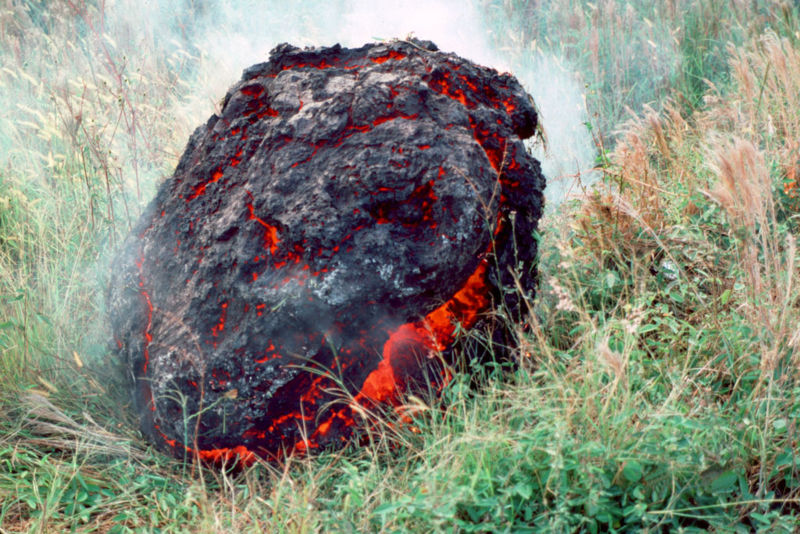
volcanic bomb
volcanic projectile, recognisable later by shape
volcanic rock
rock formed from lava erupted from a volcano
volcanic glass
material

komatiite
thumb|Komatiite lava at the type locality in the Komati Valley, Barberton Mountainland, South Africa, showing the distinctive "spinifex texture" formed by dendritic plates of olivine (scale shown by a hammer on the right edge of photo)

scoria
Scoria or cinder (plural: scoriae) is a pyroclastic, highly vesicular, dark-colored volcanic rock formed by ejection from a volcano as a molten blob and cooled in the air to form discrete grains called clasts. It is typically dark in color (brown, black or purplish-red), and basaltic or andesitic in composition. Scoria has relatively low density, as it is riddled with macroscopic ellipsoidal vesicles (gas bubbles), but in contrast to pumice, most scoria usually has a specific gravity greater than or at 1 and sinks or remains in place in water rather than float at the surface. However, some sco
phonolite
thumb|Demonstration of sound produced when phonolite is struck, Cerro de la Campana (Hermosillo, Sonora, Mexico)
thumb|Lithophone made of Phonolite in Schellerhau botanic garden (Germany)

agglomerate
thumb|300px|right|Mesozoic agglomerate of the Seymour Canal Formation in [[Alaska, United States]]
Agglomerate (from the Latin agglomerare meaning "to form into a ball") is a coarse accumulation of large blocks of volcanic material that contains at least 75% bombs. Volcanic bombs differ from volcanic blocks in that their shape records fluidal surfaces: they may, for example, have ropy, cauliform, scoriaceous, folded, spindle, spatter, ribbon, ragged, or amoeboid shapes. Globular masses of lava may have been shot from the crater at a time when partly molten lava was exposed, and was frequently

basanite
Basanite () is an igneous, volcanic (extrusive) rock with aphanitic to porphyritic texture. It is composed mostly of feldspathoids, pyroxenes, olivine, and calcic plagioclase and forms from magma low in silica and enriched in alkali metal oxides that solidifies rapidly close to the Earth's surface.

latite
thumb|Photomicrograph of [[thin section of latite (in plane polarised light)]]
thumb|Photomicrograph of [[thin section of latite (in cross polarised light)]]
Latite is an igneous, volcanic rock, with aphanitic-aphyric to aphyric-porphyritic texture. It is the volcanic equivalent of monzonite. Its mineral assemblage is usually alkali feldspar and plagioclase in approximately equal amounts. Quartz is less than five percent and is absent in a feldspathoid-bearing latite, and olivine is absent in a quartz-bearing latite. When quartz content is greater than five percent the rock is classified as qu

felsite
thumb|Felsite covered with Dendrite (crystal)|dendritic [[pyrolusite]]
thumb|Dike (geology)|Dike of felsite on [[Islay in Scotland]]
Felsite is a very fine-grained volcanic rock that may or may not contain larger crystals. Felsite is a field term for a light-colored rock that typically requires petrographic examination or chemical analysis for more precise definition. Color is generally white through light gray, or red to tan and may include any color except dark gray, green or black (the colors of trap rock). The mass of the rock consists of a fine-grained matrix of felsic materials, particul

lamproite
thumb|right|Sample of lamproite
Lamproite is an ultrapotassic mantle-derived volcanic or subvolcanic rock. It has low CaO, Al2O3, Na2O, high K2O/Al2O3, a relatively high MgO content and extreme enrichment in incompatible elements.

hyaloclastite
thumb|Hyaloclastite between Pillow lava|pillows of lava in [[Montana]]
thumb|Pahoehoe|Pahoehoe lava enters the Pacific at [[Hawaii Volcanoes National Park, the Big Island of Hawaii]]
.jpg)
pyroxenite
thumb|Pyroxenite from Rustenburg, South Africa
Pyroxenite is an ultramafic igneous rock consisting essentially of minerals of the pyroxene group, such as augite, diopside, hypersthene, bronzite or enstatite. Pyroxenes have the general formula , where X represents ions of calcium (Ca), sodium (Na), iron (Fe(II)) or magnesium (Mg) and more rarely zinc, manganese or lithium, and Y represents ions of smaller size, such as chromium (Cr), aluminium (Al), magnesium (Mg), cobalt (Co), manganese (Mn), scandium (Sc), titanium (Ti), vanadium (V) or even iron (Fe(II) or Fe(III)). Pyroxenes share a common
igneous differentiation
processes by which magmas undergo bulk chemical change during the partial melting process, cooling, emplacement, or eruption

blueschist
thumb|right|Blueschist on Île de Groix, France
thumb|right|Photomicrograph of a [[thin section of blueschist facies metamorphosed basalt, from Sivrihisar, Turkey]]

aphanite
thumb|The smooth texture of this basaltic [[volcanic bomb is aphanitic.]]
thumb|upright=1.3|IUGS classification of aphanitic extrusive [[igneous rocks according to their relative alkali (Na2O + K2O) and silica (SiO2) weight contents. Blue area is roughly where alkaline rocks plot; yellow area where subalkaline rocks plot.]]
thumb|An aphanitic volcanic sand grain, with fine-grained matrix (geology)|groundmass, as seen through a [[petrographic microscope]]

pitchstone
thumb|A pitchstone ridge of An Sgùrr (Eigg)|An Sgùrr in [[Eigg, Scotland]]
Pitchstone is a dark coloured, glassy volcanic rock formed when felsic lava or magma cools quickly. Since it is a volcanic glass, pitchstone may have a conchoidal fracture. Pitchstones may also contain phenocrysts, in which case it is a form of vitrophyre. Pitchstone has a resinous lustre, or silky in some cases, and a variable composition. Its colour may be mottled, streaked, or uniform brown, red, green, gray, or black. It is an extrusive rock that is very resistant to erosion.
boninite
Boninite is an extrusive rock high in both magnesium and silica, thought to be usually formed in fore-arc environments, typically during the early stages of subduction. The rock is named for its occurrence in the Izu-Bonin arc south of Japan. It is characterized by extreme depletion in incompatible trace elements that are not fluid mobile (e.g., the heavy rare-earth elements plus Nb, Ta, Hf) but variable enrichment in the fluid mobile elements (e.g., Rb, Ba, K). They are found almost exclusively in the fore-arc of primitive island arcs (that is, closer to the ocean trench) and in ophiolite com

tephrite
right|thumb|Leucite tephrite from Mayen, [[Eifel, Germany]]
Tephrite is an igneous, volcanic (extrusive) rock, with aphanitic to porphyritic texture. Mineral content is usually abundant feldspathoids (leucite or nepheline), plagioclase, and lesser alkali feldspar. Pyroxenes (clinopyroxenes) are common accessory minerals. Quartz and olivine are absent. The absence of olivine distinguishes them from the otherwise similar basanite. Its parameters are defined in the QAPF diagram. Occurrences include leucite nepheline tephrite from Hamberg bei Neckarelz near Heidelberg, Germany, phonolite-tephrite

rhyodacite
right|thumb|A sample of rhyodacite from Slovakia
Rhyodacite is a volcanic rock intermediate in composition between dacite and rhyolite. It is the extrusive equivalent of those plutonic rocks that are intermediate in composition between monzogranite and granodiorite. Rhyodacites form from rapid cooling of lava relatively rich in silica and low in alkali metal oxides.
basaltic andesite
volcanic rock

keratophyre
thumb|Keratophyre from the Neoproterozoic Hatat Formation, [[Oman]]
Keratophyre is a volcanic rock of intermediate composition. Although similar to trachyte, keratophyre's plagioclase component is richer in sodium than the plagioclase found in trachyte. Keratophyre forms lava flows and subvolcanic intrusions (dykes and sills). Keratophyre occurs, for example, at Hüttenrode in the Harz Mountains of Germany and in the Berwyn Hills of Wales. Keratophyre tuff of Early Devonian age occurs in Sauerland (Germany).

adakite
thumb|Cerro Mackay, a mountain in Coyhaique in Chile, made of columns of adakite
thumb|Closer view of the adakite columns of Cerro Mackay, Chile
Adakites are volcanic rocks of intermediate to felsic composition that have geochemical characteristics of magma originally thought to have formed by partial melting of altered basalt that is subducted below volcanic arcs. Most magmas derived in subduction zones come from the mantle above the subducting plate when hydrous fluids are released from minerals that break down in the metamorphosed basalt, rise into the mantle, and initiate partial melting.

volcanic block
rock mass from solidified lava flows

trachyandesite
thumb|upright=1.35|A cut block of trachyandesite lava from a volcano in Auvergne (region)|Auvergne, France, used as building stone, forming part of the walls of [[Clermont-Ferrand Cathedral, France]]
thumb|upright=1.35|Trachyandesite is field S3 in the TAS diagram
lava field
large expanse of nearly flat-lying lava flows
%204.jpg)
trachybasalt
thumb|upright=1.35|Potassic trachybasalt from the July–August 2001 eruption of Mount Etna, Italy
thumb|Satellite image of Bayuda volcanic field in Sudan where [[nepheline-rich trachybasalt lavas have been erupted during the Holocene epoch]]
Trachybasalt is a volcanic rock with a composition between trachyte and basalt. It resembles basalt but has a high content of alkali metal oxides. Minerals in trachybasalt include alkali feldspar, calcic plagioclase, olivine, clinopyroxene and likely very small amounts of leucite or analcime.

nephelinite
thumb|Nephelinite lava (grey) containing a xenolith of [[peridotite (yellow), Kaiserstuhl, Germany.]]
Nephelinite is a fine-grained or aphanitic igneous rock made up almost entirely of nepheline and clinopyroxene (variety augite). If olivine is present, the rock may be classified as an olivine nephelinite. Nephelinite is dark in color and may resemble basalt in hand specimen. However, basalt consists mostly of clinopyroxene (augite) and calcic plagioclase.

porphyritic rock
thumb|Porphyritic texture in a granite. This is an Intrusive rock|intrusive porphyritic rock. The white, square feldspar [[phenocrysts are much larger than crystals in the surrounding matrix; eastern Sierra Nevada, Rock Creek Canyon, California.]]
thumb|A porphyritic volcanic sand grain, as seen under the petrographic microscope. The large grain in the middle is of a much different size class than the small needle-like crystals around it. Scale box in millimeters.
Porphyritic is an adjective used in geology to describe igneous rocks with a distinct difference in the size of mineral crystals, w
leucitite
Leucitite or leucite rock is an igneous rock containing leucite. It is scarce, many countries such as England being entirely without them. However, they are of wide distribution, occurring in every quarter of the globe. Taken collectively, they exhibit a considerable variety of types and are of great interest petrographically. For the presence of this mineral it is necessary that the silica percentage of the rock should be low, since leucite is incompatible with free quartz and reacts with it to form potassium feldspar. Because it weathers rapidly, leucite is most common in lavas of recent and
shoshonite
thumb|File:Shoshonite lava flows on South Table Mountain, Colorado
Bimodal volcanism
eruption of both mafic and felsic lavas from a single volcanic centre
ankaramite
thumb | right | Ankaramite lava flow
Ankaramite is volcanic rock type of mafic composition. It is a dark porphyritic variety of basanite containing abundant pyroxene and olivine phenocrysts. It contains minor amounts of plagioclase and accessory biotite, apatite, and iron oxides.
volcaniclastic rock
thumb|upright=1.35|The Espinaso Formation includes a wide variety of volcaniclastic materials.
Volcaniclastics are geologic materials composed of broken fragments (clasts) of volcanic rock. These encompass all clastic volcanic materials, regardless of what process fragmented the rock, how it was subsequently transported, what environment it was deposited in, or whether nonvolcanic material is mingled with the volcanic clasts. The United States Geological Survey defines volcaniclastics somewhat more narrowly, to include only rock composed of volcanic rock fragments that have been transported so
phonotephrite
thumb|upright=1.35|Peridotite [[xenoliths (green) in phonotephrite from Peridot Mesa, Arizona]]
Phonotephrite or phono-tephrite is a strongly alkaline volcanic rock with a composition between phonolite and tephrite. This unusual igneous rock contains 7–12% alkali content and 45–53% silica content (see TAS diagram). It can be described as a mafic phonolite or a potassic tephrite. Phonotephrite lava flows and volcanic cones have been identified in Antarctica (e.g. Mount Erebus), Europe (e.g. Mount Vesuvius), North America (e.g. Satah Mountain volcanic field) and Africa (e.g. Jbel Saghro).
tephriphonolite
Tephriphonolite or tephri-phonolite is a mafic to intermediate extrusive igneous rock in composition between phonotephrite and phonolite. It contains 9–14% alkali content and 48–57% silica content (see TAS diagram). Tephriphonolite is roughly equivalent to tephritic phonolite of the QAPF classification.
Vitrophyre
thumb|Example of a rhyolite|rhyolitic vitrophyre; large phenocrysts are set in the black glassy matrix
limburgite
thumb|Limburgite from Limburg quarry, Germany (Type locality (geology)|type locality)
In petrology, limburgite is a dark-colored volcanic rock resembling basalt in appearance, but containing normally no feldspar. The name derives from the type locality the Limberg or the Limburg, close to Sasbach am Kaiserstuhl in Baden-Württemberg, where they occur in the well-known rock of the Kaiserstuhl.
quartz latite
rock composed mostly of alkali feldspar and plagioclase
benmoreite
thumb|Benmoreite lava forms the "Dragon's Teeth" landmark on Maui, Hawaii
Benmoreite is a volcanic rock of intermediate composition. It is a silica-undersaturated sodium-rich variety of trachyandesite (the other kind is latite) and belongs to the alkaline suite of igneous rocks. It was named after Ben More, a mountain on the Isle of Mull, Scotland.
metavolcanic rock
metamorphic rock from a volcanic precursor
Lithophysa
thumb|A lithophysa from France
thumb|A collection of lithophysae "thundereggs"
A lithophysa (plural lithophysae, from Greek lithos "stone" + phusa "bubble") is a felsic volcanic rock with a spherulitic structure and interior cavity with concentric chambers. Its outer shape is spherical or lenticular. They vary in size from very small up to twelve feet in diameter depending on the age of the magma chamber. These rocks are usually found within obsidian or rhyolite lava flows. Lavas low in feldspar minerals may produce a version known as snowflake obsidian.