Category
page 1Vowel letters

A
A, or a, is the first letter and the first vowel letter of the Latin alphabet, used in the modern English alphabet, and others worldwide. Its name in English is a (pronounced ), plural aes.

E/e
E, or e, is the fifth letter and the second vowel letter of the Latin alphabet, used in the modern English alphabet, the alphabets of other western European languages and others worldwide. Its name in English is e (pronounced ); plural es, Es, or ''E's''.

O/o
O, or o, is the fifteenth letter and the fourth vowel letter of the Latin alphabet, used in the modern English alphabet, the alphabets of other western European languages and others worldwide. Its name in English is o (pronounced ), plural oes.

I/i
I, or i, is the ninth letter and the third vowel letter of the Latin alphabet, used in the modern English alphabet, the alphabets of other western European languages and others worldwide. Its name in English is i (pronounced ), plural ''i's or is''.

Y/y
Y, or y, is the twenty-fifth and penultimate letter of the Latin alphabet, used in the modern English alphabet, the alphabets of other western European languages and others worldwide. According to some authorities, it is the sixth (or seventh if including W) vowel letter of the English alphabet. Its name in English is wye (pronounced ), plural wyes.
W/w
W, or w, is the twenty-third letter of the Latin alphabet, used in the modern English alphabet, the alphabets of other western European languages and others worldwide. Its name in English is double-u, plural double-ues.

U/u
U, or u, is the twenty-first letter and the fifth vowel letter of the Latin alphabet, used in the modern English alphabet and the alphabets of other western European languages and others worldwide. Its name in English is u (pronounced ), plural ues.

Α/α
Alpha (uppercase , lowercase ) is the first letter of the Greek alphabet. In the system of Greek numerals, it has a value of one. Alpha is derived from the Phoenician letter aleph , whose name comes from the West Semitic word for 'ox'. Letters that arose from alpha include the Latin letter and the Cyrillic letter .

Ω/ω
Omega (, ; uppercase Ω, lowercase ω) is the twenty-fourth and last letter of the Greek alphabet. In the Greek numeric system/isopsephy (gematria), it has a value of 800. The name of the letter was originally ( ), but it was later changed to ( 'big o') in the Middle Ages to distinguish it from omicron , whose name means 'small o', as both letters had come to be pronounced . In modern Greek, its name has fused into ().

Ο/ο
Omicron (, ; uppercase Ο, lowercase ο, ) is the fifteenth letter of the Greek alphabet. This letter is derived from the Phoenician letter ayin: 16px|class=skin-invert. In classical Greek, omicron represented the close-mid back rounded vowel in contrast to omega, which represented the open-mid back rounded vowel , and the digraph which represented the long close back rounded vowel . In modern Greek, both omicron and omega represent the mid back rounded vowel . Letters that arose from omicron include Roman O and Cyrillic O and Ю. The name of the letter was originally ( ), but it was later change

E
Epsilon (, uppercase ', lowercase or '; ) is the fifth letter of the Greek alphabet, corresponding phonetically to a mid front unrounded vowel or . In the system of Greek numerals it also has the value five. It was derived from the Phoenician letter He (𐤄). Letters that arose from epsilon include the Roman E, Ë and Ɛ, and Cyrillic Е, È, Ё, Є and Э. The name of the letter was originally ( ), but it was later changed to ( 'simple e') in the Middle Ages to distinguish the letter from the digraph , a former diphthong that had come to be pronounced , and because the digraph had become unsuitable

iota
%20-%20Photo%20by%20Giovanni%20Dall'Orto%2C%20Nov%209%202009.jpg)
Η
Eta ( ; uppercase ', lowercase '; ē̂ta or ita ) is the seventh letter of the Greek alphabet, representing the close front unrounded vowel, . Originally denoting the voiceless glottal fricative, , in most dialects of Ancient Greek, its sound value in the classical Attic dialect was a long open-mid front unrounded vowel, , which was raised to in Hellenistic Greek, a process known as iotacism or itacism.

Υ
Upsilon (, ; uppercase Υ, lowercase υ; ýpsilon ) or ypsilon is the twentieth letter of the Greek alphabet. In the system of Greek numerals, has a value of 400. It is derived from the Phoenician waw (𐤅).

А/а
Cyrillic letter "a"

И
Cyrillic letter

Е/е
Cyrillic letter Ie

Ю/ю
Cyrillic letter “yu”

Й
Cyrillic letter

O
Cyrillic letter

Ё
letter of the Cyrillic script
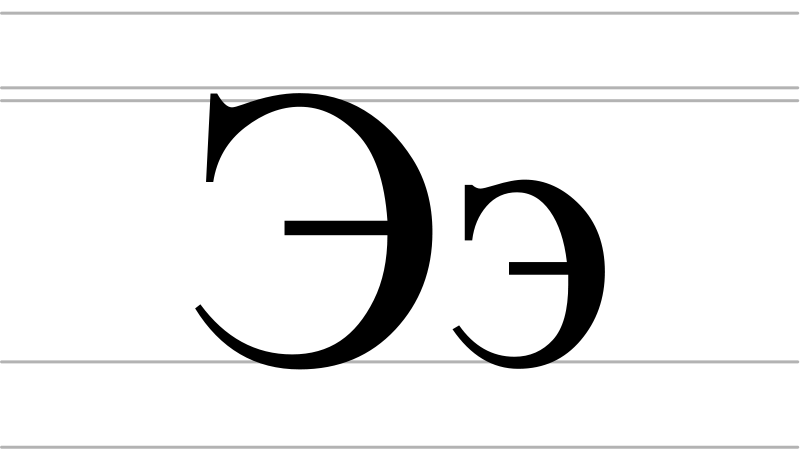
Э
letter found amongst Slavonic languages only in Russian and Belarusian

У
Cyrillic letter

Æ
class=skin-invert-image|thumb|Æ in Helvetica and [[Bodoni]]
class=skin-invert-image|thumb|Æ alone and in context

Ä
thumb|Latin letter A with diaeresis
Ä (lowercase: ä) is a character that represents either a letter from several extended Latin alphabets, or the letter A with an umlaut mark or diaeresis. It is used mainly in Northern European and Central Asian languages. In the International Phonetic Alphabet, it is sometimes used to represent the open central unrounded vowel.

Å
The letter Å (å in lower case) represents various (although often similar) sounds in several languages. It is a separate letter in Danish, Swedish, Norwegian, Finnish, North Frisian, Low Saxon, Transylvanian Saxon, Walloon, Rotuman, Chamorro, Lule Sami, Pite Sami, Skolt Sami, Southern Sami, Ume Sami, Pamirian languages, and Greenlandic alphabets. Additionally, it is part of the alphabets used for some Alemannic and Austro-Bavarian dialects of German.

Ö
Ö, or ö, is a character that represents either a letter from several extended Latin alphabets, or the letter "o" modified with an umlaut or diaeresis. Ö, or ö, is a variant of the letter O. In many languages, the letter "ö", or the "o" modified with an umlaut, is used to denote the close- or open-mid front rounded vowels or ; compare the vowel in "girl", which in these languages phonetically could be written: /görl/. In languages without such vowels, the character is known as an "o with diaeresis" and denotes a syllable break, wherein its pronunciation remains an unmodified .

Ў
Cyrillic letter used in Belarusian, Dungan, and Siberian Yupik

Ü
Ü (lowercase ü) is a Latin script character composed of the letter U and the diaeresis diacritical mark. In some alphabets, such as those of a number of Romance languages, it denotes an instance of regular U to be construed in isolation from adjacent characters with which it would usually form a larger unit; other alphabets like the Azerbaijani, Estonian, German, Hungarian and Turkish ones treat it as a letter in its own right. In those cases it typically represents a close front rounded vowel .
Ø
Ø (or minuscule: ø) is a letter used in the Danish, Norwegian, Faroese, and Southern Sámi languages. It is mostly used to represent the mid front rounded vowels, such as and , except for Southern Sámi where it is used as an diphthong.

Ұ
Cyrillic letter used in Kazakh

Ѡ
letter used in the early Cyrillic alphabet
Ө
Cyrillic letter
Ү
Cyrillic letter

Ó
thumb|Latin letter O with Acute accent|acute
Ó, ó (o-acute) is a letter in the Czech, Dobrujan Tatar, Emilian-Romagnol, Faroese, Hungarian, Icelandic, Kashubian, Polish, Slovak, Karakalpak, and Sorbian languages. The symbol also appears in the Afrikaans, Catalan, Dutch, Irish, Nynorsk, Bokmål, Occitan, Portuguese, Spanish, Italian and Galician languages as a variant of the letter "o". It usually represents a vowel sound longer than or slightly different from that represented by plain "o", although in some cases its sound is notably different (as in modern Polish, where it is pronounced the sam

aleph
Aleph (or alef or alif, transliterated ʾ) is the first letter of the Semitic abjads, including Phoenician ʾālep , Hebrew ʾālef , Aramaic ʾālap , Syriac ʾālap̄ , Arabic ʾalif , and North Arabian . It also appears as South Arabian and Ge'ez ʾälef .
Ӑ
Cyrillic letter
Õ
"Õ" (uppercase), or "õ" (lowercase) is a composition of the Latin letter O with the diacritic mark tilde.
IJ
Latin-script digraph
Ů
REDIRECT Ring (diacritic)
Ô
REDIRECT Circumflex

Ò
thumb|Latin letter O with grave
Ò, ò (o-grave) is a letter of the Latin script.
Ő
REDIRECT Double acute accent#Unicode
Ű
REDIRECT Double acute accent#Letters with double acute
I/ı
Latin letter “dotless i”: used in Turkish, Azerbaijani, Kazakh, etc., or in mathematics
Ō
letter of the Latin alphabet
Ē
REDIRECT Macron (diacritic)
Ū
REDIRECT Macron (diacritic)
İ/i
İ, or i, called dotted I or i-dot, is a letter used in the Latin-script alphabets of Azerbaijani, Crimean Tatar, Gagauz, Kazakh, Tatar, and Turkish. It commonly represents the close front unrounded vowel except in Kazakh in which it additionally represents the voiced palatal approximant and the diphthongs and . All languages that use it also use its dotless counterpart I, but not the basic Latin letter I.
Ɛ
letter of the Latin alphabet
Ī
REDIRECT Macron (diacritic)
Ơ
Ơ (lowercase ơ) is one of the 12 Vietnamese language vowels. It represents the sound , the schwa.
Waw
sixth letter of many Semitic alphabets
Ư
Ư (lowercase ư) is one of the 12 Vietnamese language vowels. It represents the vowel . It also appears in the Jarai language where it makes the lengthened vowel sound, [ɯː].
mater lectionis
representation of vowels as independent letters where they would otherwise be indicated by optional diacritics in a given orthography
Ũ
REDIRECT Tilde
Ȣ/ȣ
letter or ligature of the Latin alphabet, derived from a similar Greek ligature
Ɔ/ɔ
Latin letter open o
Ɑ/ɑ
letter of the Latin alphabet
Ʉ
letter of the Latin alphabet