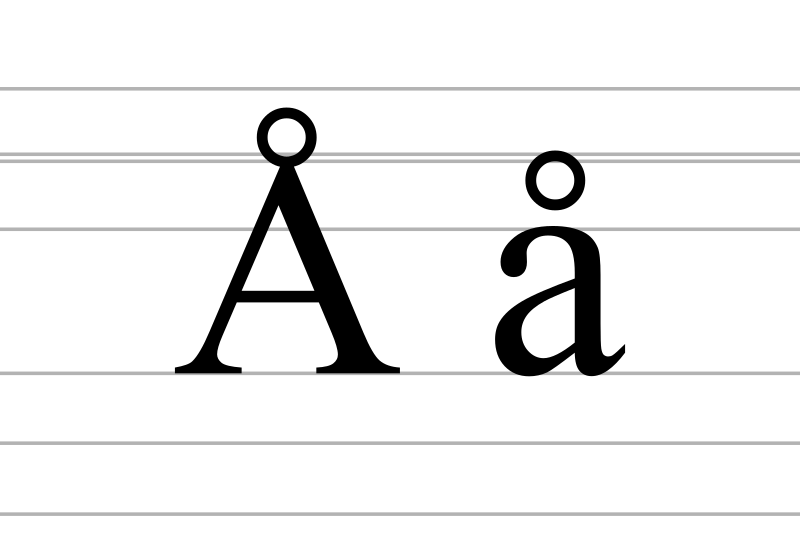
File:Latin_letter_A_with_ring_above.svg · Wikimedia Commons · See Wikimedia Commons
Also known as Aa, Å, å
The letter Å (å in lower case) represents various (although often similar) sounds in several languages. It is a separate letter in Danish, Swedish, Norwegian, Finnish, North Frisian, Low Saxon, Transylvanian Saxon, Walloon, Rotuman, Chamorro, Lule Sami, Pite Sami, Skolt Sami, Southern Sami, Ume Sami, Pamirian languages, and Greenlandic alphabets. Additionally, it is part of the alphabets used for some Alemannic and Austro-Bavarian dialects of German.
Å is a letter used in the alphabets of numerous languages, primarily across Scandinavian and northern European regions, where it represents particular vowel sounds that differ from standard Latin letters. It is recognized as a distinct letter in languages ranging from Danish and Swedish to Greenlandic and various Sami languages, making it essential for accurate spelling and pronunciation in these linguistic communities.
AI-generated from the Wikipedia summary — may contain errors.
Key facts
- Grapheme.image
- Latin letter A with ring above.svg
- Grapheme.imageclass
- skin-invert-image
- Grapheme.letter
- Å å
- Grapheme.name
- A with Overring
- Grapheme.fam1
- AO ao, AA aa
- Grapheme.script
- Latin script
- Grapheme.language
- Swedish
- Grapheme.variations
- Ǻ ǻ
- Grapheme.unicode
- U+00C5, U+00E5, U+212B
via Wikipedia infobox
Wikidata facts
- Part of
- Finnish alphabet
- Has part
- A
- Based on
- A
- Image
- Latin alphabet Åå.svg
Show 5 more facts
- Commons category
- Å
- Unicode character
- Å
- Commons gallery
- Å
- different from
- A
- inception
- 1917-01-01
Sources (3)
via Wikidata · CC0
~12 min read
Encyclopedic overview
20 sectionsContents
- Scandinavian languages
- History
- Use in names
- Alphabetization
- Danish and Norwegian
- Swedish
- International transcription
- Finnish
- Emilian
- Walloon
- Istro-Romanian
- Javanese
- Chamorro
- Greenlandic
- Symbol for angstrom
- Encoding
- Type designs of the capital "Å"
- See also
- Notes
- References
The letter Å (å in lower case) represents various (although often similar) sounds in several languages. It is a separate letter in Danish, Swedish, Norwegian, Finnish, North Frisian, Low Saxon, Transylvanian Saxon, Walloon, Rotuman, Chamorro, Lule Sami, Pite Sami, Skolt Sami, Southern Sami, Ume Sami, Pamirian languages, and Greenlandic alphabets. Additionally, it is part of the alphabets used for some Alemannic and Austro-Bavarian dialects of German.
Though Å is derived from A by adding an overring, it is typically considered a separate letter. It developed as a form of semi-ligature of an A with a smaller o above it to denote a rounding of the long /a/ in Old Danish.
Excerpted from Wikipedia’s “Å” article, available under the CC BY-SA 4.0 licence.