Category
page 1Wave mechanics

Doppler effect
frequency change of a wave for observer relative to its source

Schrödinger equation
partial differential equation describing how the quantum state of a non-relativistic physical system changes with time
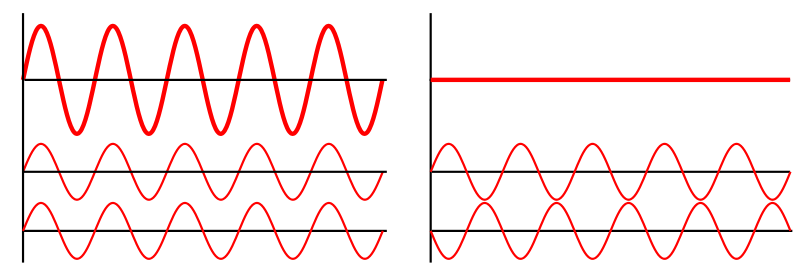
interference
phenomenon in which two coherent waves combine into a resultant wave with greater intensity or lower amplitude

amplitude
The amplitude of a periodic variable is a measure of its change in a single period (such as time or spatial period). The amplitude of a non-periodic signal is its magnitude compared with a reference value. There are various definitions of amplitude (see below), which are all functions of the magnitude of the differences between the variable's extreme values. In older texts, the phase of a periodic function is sometimes called the amplitude.

standing wave
wave that remains in a constant position

sine wave
mathematical curve that describes a smooth repetitive oscillation; continuous wave

wave equation
second-order linear differential equation important in physics

Huygens–Fresnel principle
method of analysis
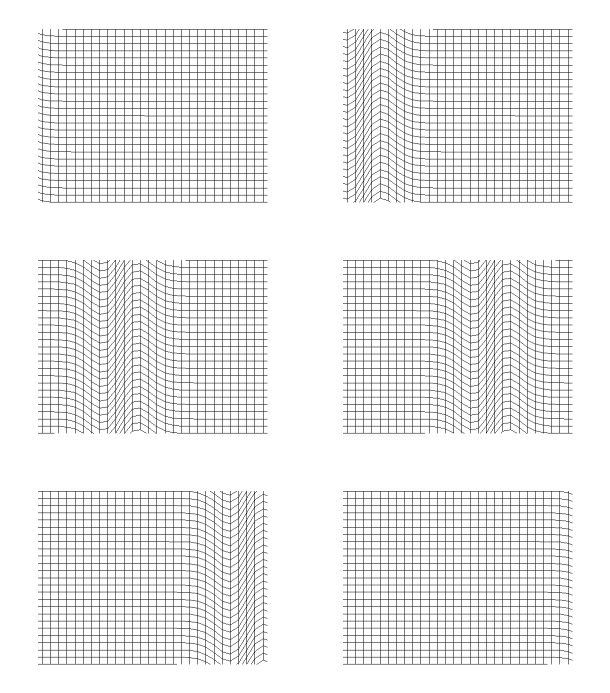
transverse wave
moving wave that consists of oscillations occurring perpendicular (right angled) to the direction of energy transfer (or the propagation of the wave)
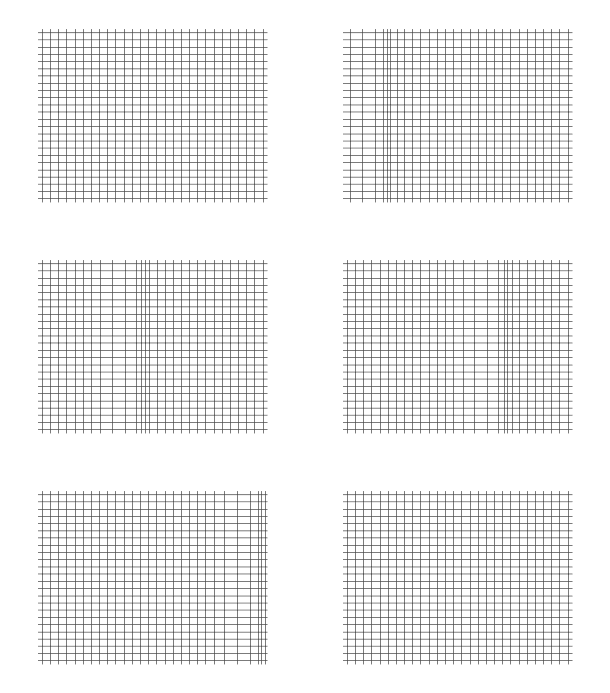
longitudinal wave
waves in which the displacement of the medium is in the same direction as, or the opposite direction to, the direction of propagation of the wave

phase
position of a point in time (an instant) on a waveform cycle

coherence
ideal property of waves that enables stationary (i.e. temporally and spatially constant) interference

wavenumber
thumb|Diagram illustrating the relationship between the wavenumber and the other properties of harmonic waves.

double-slit experiment
experiment in quantum mechanics that shows wave–particle duality

tidal bore
water wave traveling upstream a river or narrow bay due to incoming tide

soliton
thumb|250px|Solitary wave (water waves)|Solitary wave in a laboratory [[wave channel]]
electromagnetic waveguide
structure used to propagate electromagnetic waves
phase velocity
rate at which the phase of the wave propagates in space
group velocity
physical quantity
wave vector
vector pointing in the direction of a wave and whose magnitude is equal to the wavenumber
plane wave
type of wave propagating in 3 dimensions
wave packet
short "burst" or "envelope" of restricted wave action that travels as a unit
standing wave ratio
measure of impedance matching of loads to the characteristic impedance of a transmission line or waveguide
hydraulic jump
phenomenon occuring when liquid at high velocity discharges into a zone of lower velocity
dispersion relation
relation of wavelength/wavenumber as a function of a wave's frequency
acoustic wave
longitudinal wave that propagates by means of adiabatic compression and decompression;travels with the speed of sound which depends on the medium they're passing through
amphidromic point
point of zero amplitude of one harmonic constituent of the tide
phase shift
difference between phase angles
wave power station
installment of one or several wave power devices in one place
Transverse mode
electromagnetic wave with oscillations perpendicular to the direction of travel
Melde's experiment
1859 wave interference experiment
Lamb waves
elastic waves propagating in solid plates or spheres
phase response
effect of filters or amplifiers on signals' phases as function of frequency

clapotis
thumb|right|Incoming wave (red) reflected at the wall produces the outgoing wave (blue), both being overlaid resulting in the clapotis (black).
water wave dispersion
water waves of different wavelengths travel at different phase speeds
Faraday wave
nonlinear standing waves that appear on liquids enclosed by a vibrating receptacle

hot chocolate effect
phenomenon of wave mechanics
return loss
term
electromagnetically induced transparency
coherent optical nonlinearity which renders a medium transparent within a narrow spectral range around an absorption line
Airy beam
field of radiation (e.g. electromagnetic wave) whose amplitude is described by a product of the Airy function of the first kind and an exponent
Phase synchronization
signal velocity
Airy wave theory
linearised description of the propagation of gravity waves on the surface of a homogeneous fluid layer
sidewinding
thumb|Sidewinding in a newborn sidewinder rattlesnake. Yellow regions are lifted above the sand and in motion at the time of the photo, while green regions are in static contact with the sand. Blue denotes tracks. Scale imprints are visible in the tracks, showing that the snake's body is static during ground contact.
thumb|right|Tracks of a sidewinder in the sand
Wave base
maximum depth at which a water wave's passage causes significant water motion
Wave drag
Aircraft aerodynamic drag at transonic and supersonic speeds due to the presence of shock waves
Sommerfeld identity
theorem
Quasiperiodicity
Quasiperiodicity is the property of a system that displays irregular periodicity. Periodic behavior is defined as recurring at regular intervals, such as "every 24 hours". Quasiperiodic behavior is almost but not quite periodic. The term used to denote oscillations that appear to follow a regular pattern but which do not have a fixed period. The term thus used does not have a precise definition and should not be confused with more strictly defined mathematical concepts such as an almost periodic function or a quasiperiodic function.
SAMV
parameter-free superresolution algorithm for the linear inverse problem in spectral estimation, direction-of-arrival estimation and tomographic reconstruction with applications in signal processing, medical imaging and remote sensing
mode
field pattern of the propagating waves of electromagnetic radiation