Category
page 1Welsh mythology

King Arthur
legendary British leader of the late 5th and early 6th centuries

Geoffrey of Monmouth
Historian and Bishop of St Asaph, Wales (c.1095–1155)

Excalibur
Excalibur is the mythical sword of King Arthur that may possess magical powers or be associated with the rightful sovereignty of Britain. Its first reliably datable appearance is found in Geoffrey of Monmouth's Historia Regum Britanniae. Excalibur as the "sword in the stone" functioning as the proof of Arthur's lineage is an iconic motif featured throughout most works dealing with Arthur's youth since its introduction in Robert de Boron's Merlin. The sword given to the young Arthur by the Lady of the Lake in the tradition that began soon afterwards with the Post-Vulgate Cycle is not the same w

flag of Wales
national flag of Wales
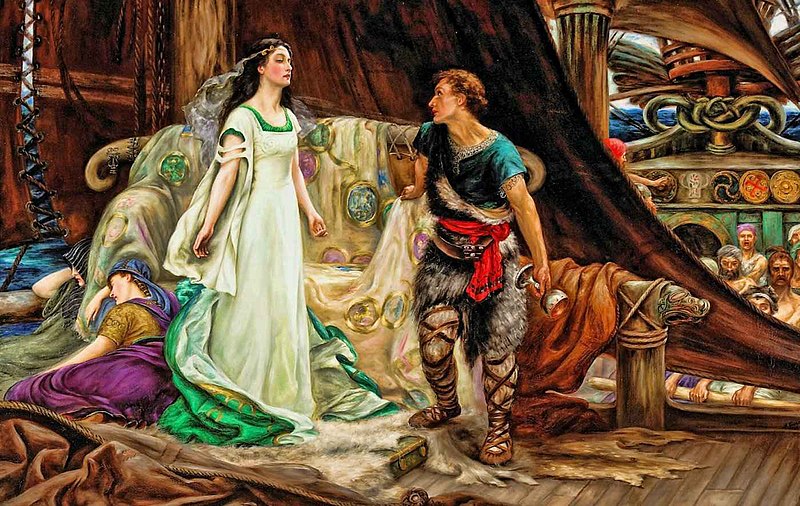
Tristan and Iseult
medieval romance told in numerous variations

Vortigern
thumb|Vortigern and Rowena by William Harvey

Mabinogion
thumb|right|Ceridwen by Christopher Williams (1910)

Historia Brittonum
9th century work about the history of the Brittonic people
Ambrosius Aurelianus
post-Roman leader in Britain

Taliesin
Taliesin ( , ; 6th century AD) was an early Brittonic poet of Sub-Roman Britain whose work has possibly survived in a Middle Welsh manuscript, the Book of Taliesin. Taliesin was a renowned bard who is believed to have sung at the courts of at least three kings. Taliesin means "shining brow" in Welsh.
Red Book of Hergest
Welsh manuscript collection written between 1382-1410

Annwn
Annwn (), or Annwfn (), is the Otherworld in Welsh mythology. Ruled by Arawn (or, in Arthurian literature, by Gwyn ap Nudd), it is a world of delights and eternal youth where disease is absent and food is ever-abundant.
Welsh mythology
folk traditions developed in Wales and by the Celtic Britons elsewhere

Rhiannon
Rhiannon () is a female figure in Welsh mythology and a protagonist of the Mabinogi, in its First and Third Branches. She has been described by Ronald Hutton as "one of the great female personalities in World literature", adding that "there is in fact, nobody quite like her in previous human literature". Rhiannon also appears as a character in 14th century Medieval Welsh poetry.
Arianrhod
Arianrhod () is a figure in Welsh mythology who plays her most important role in the Fourth Branch of the Mabinogi. She is the daughter of Dôn and the sister of Gwydion and Gilfaethwy; the Welsh Triads give her father as Beli Mawr. In the Mabinogi her uncle Math ap Mathonwy is the King of Gwynedd, and during the course of the story she gives birth to two sons, Dylan ail Don and Lleu Llaw Gyffes, through magical means.

Cerridwen
Ceridwen or Cerridwen ( Ke-RID-wen) was an enchantress in Welsh medieval legend. She was the mother of a hideous son, Morfran, and a beautiful daughter, Creirwy. Her husband was Tegid Foel and they lived near Llyn Tegid (Bala Lake) in north Wales. Medieval Welsh poetry refers to her as possessing the cauldron of poetic inspiration (Awen) and the Tale of Taliesin recounts her swallowing her servant Gwion Bach who is then reborn through her as the poet Taliesin. Ceridwen is regarded by many modern pagans as the Celtic goddess of rebirth, transformation, and inspiration.
Culhwch ac Olwen
Welsh tale
list of legendary kings of Britain
Wikimedia list article
White Book of Rhydderch
Welsh manuscript written c. 1350
Welsh Triads
series of Welsh triads about the legendary figures of Britain

Blodeuwedd
thumb|right|Blodeuwedd by Christopher Williams (Welsh artist)|Christopher Williams (1930)
Blodeuwedd (; Welsh "Flower-Faced", a composite name from blodau "flowers" + gwedd "face"), is married to Lleu Llaw Gyffes in Welsh mythology. She was made from the flowers of broom, meadowsweet and oak by the magicians Math and Gwydion, and is a central figure in Math fab Mathonwy, the last of the Four Branches of the Mabinogi.

Gwydion
Gwydion fab Dôn () is a magician in of Welsh mythology, appearing most prominently in the Fourth Branch of the Mabinogi, which focuses largely on his relationship with his young nephew, Lleu Llaw Gyffes. He also appears prominently in the Welsh Triads, the Book of Taliesin and the Stanzas of the Graves.
Sir Ector
the father of Sir Kay and the foster father of King Arthur in the Arthurian legend
Arawn
In Welsh mythology, Arawn () was the king of the otherworld realm of Annwn who appears prominently in the first branch of the Mabinogi, and alluded to in the fourth. In later tradition, the role of the king of Annwn was largely attributed to the Welsh psychopomp, Gwyn ap Nudd - meaning "white" (i.e. 'winter') a possible kenning for his true name. However, Arawn's memory is retained in a traditional saying found in an old Cardigan folktale:

Pwyll
thumb|Pwyll, Prince of Dyfed hunting with his hounds
Bran the Blessed
mythical giant and king (17-69)
Branwen ferch Llŷr
Branwen, Daughter of Llŷr is a major character in the medieval Welsh story known as the Second Branch of the Mabinogi, which is sometimes called the "Mabinogi of Branwen" after her.
Mabon ap Modron
Welsh mythological character
Locrinus
Locrinus was a legendary king of the Britons, as recounted by the 12th-century chronicler Geoffrey of Monmouth in his Historia Regum Britanniae. He came to power in 1125BC.
%20(14780333981).jpg)
Manawydan fab Llŷr
Manawydan fab Llŷr is a figure of Welsh mythology, the son of Llŷr and the brother of Brân the Blessed and Brânwen. The first element in his name is cognate with the stem of the name of the Irish sea god Manannán mac Lir, and likely originated from the same Celtic deity as Manannán. Unlike Manannán, however, no surviving material connects him with the sea in any way except for his patronymic (llŷr is an old Welsh word for sea). Manawydan's most important appearances occur in the Second and Third Branches of the Mabinogi (the latter of which is named for him), but he is also referenced frequent

Púca
thumb|Depiction of the Pwca in Wirt Sikes's book British Goblins: Welsh Folk-lore, Fairy Mythology, Legends and Traditions, 1880

Iseult
thumb|La Belle Iseult by William Morris (1858)
Hoel
legendary king of Brittany
Twrch Trwyth
mythical character
Llŷr
Llŷr ( (); meaning 'half-speech' or 'half-language') is a figure in Welsh mythology, related to the Irish Ler ('the Sea'), father of Manannán mac Lir. Other than his progeny and odd tidbits, his identity remains obscure.
Amaethon
In Welsh mythology, Amaethon ( ()) was the son of Dôn, and brother to Arianrhod, Penarddun, Gilfaethwy, Gofannon, Gwydion, and Nudd. His name means "great labourer" or "great ploughman" and he is cited in Peniarth MS.98b as being responsible for the Cad Goddeu, or "Battle of Trees" against the lord of the otherworld, Arawn.
Gwyn ap Nudd
Welsh mythological figure
Lleu Llaw Gyffes
Warrior and magician of Welsh mythology

Camber
legendary first king of Cambria
Math fab Mathonwy
king in Welsh mythology
Modron
Modron ("mother") is a figure in Welsh tradition, known as the mother of the hero Mabon ap Modron. Both characters may have derived from earlier divine figures, in her case the Gaulish goddess Matrona. She may have been a prototype for Morgan le Fay from the Arthurian legend.
Three Welsh Romances
three Middle Welsh Arthurian tales associated with the Mabinogion

Cad Goddeu
medieval Welsh poem
Gofannon
Gofannon () is a figure in Middle Welsh literature as a great metal worker and as the son of Dôn. His name can be compared with the Old Irish gobae (gen. gobann) ‘smith’, Middle Welsh / Cornish / Breton gof (pl. gofein) ‘smith’, Gaulish gobedbi ‘with the smiths’, all of which are cognate with Lithuanian gabija ‘sacred home fire’, gabus ‘gifted, clever’. His apparent counterpart in Irish mythology, Goibniu, in addition to his duties as a smith, also takes on the role of a divine hero who brewed an ale of immortality, in addition to being an architect and builder.
Elen
legendary wife of Macsen Wledig (Magnus Maximus) who brought the ideas of Martin of Tours to Wales

Ysbaddaden
thumb|So huge is his frame, Ysbaddaden requires great forks to prop up his eyelids. Illustration by John D. Batten (1892)
Pryderi
Pryderi fab Pwyll is a prominent figure in Welsh mythology, the son of Pwyll and Rhiannon, and king of Dyfed after his father's death. He is the only character to appear in all Four Branches of the Mabinogi, although the size of his role varies from tale to tale. He is often equated with the divine son figure of Mabon ap Modron, while Jeffrey Gantz compares him to Peredur fab Efrawg, who is himself associated with the continental figure of Sir Percival de Galles.

Dwynwen
Saint Dwynwen (; ), sometimes known as Dwyn or Donwen, is the Welsh patron saint of lovers. She is celebrated throughout Wales on 25 January.

Culhwch
Culhwch (, with the final consonant sounding like Scottish "loch"), in Welsh mythology, is the son of Cilydd son of Celyddon and Goleuddydd, a cousin of Arthur and the protagonist of the story Culhwch and Olwen (the earliest of the medieval Welsh tales appended to Lady Charlotte Guest's edition of the Mabinogion). In this tale the etymology of Culhwch is explained as "sow run" (cul "narrow, a narrow thing"; hwch "sow, pig"), but this is likely to be folk etymology. According to the narrative, Culhwch is born to his maddened mother Goleuddydd after she is frightened by a herd of swine. The swin
Matholwch
Matholwch, King of Ireland, is a character in the Second Branch of the Mabinogi, the tale of Branwen ferch Llŷr.
Awen
Awen is a Welsh, Cornish and Breton word for "inspiration" (and typically poetic inspiration). In Welsh mythology, is the inspiration of the poets, or bards; its personification, is the inspirational muse of creative artists in general. The inspired individual (often a poet or a soothsayer) is an .
Morfran
Morfran (Middle Welsh: Moruran "cormorant"; literally "sea crow", from môr, "sea", and brân, "crow", from Common Brittonic *mori-brannos, as in French cormoran < L corvus marinus) is a figure in Welsh mythology. Usually portrayed as a warrior under King Arthur, he is noted for the darkness of his skin and his hideousness. He appears in the narratives about the bard Taliesin and in the Welsh Triads, where he is often contrasted with the angelically handsome Sanddef.
Beli Mawr
legendary figure
Gwen Teirbron
6th c. Welsh Saint
Albanactus
thumb|Attributed arms of Albanactus from the [[Book of Baglan]]
Albanactus, according to Geoffrey of Monmouth, was the founding king of Albania or Albany. He is in effect Geoffrey's eponym for Scotland. His territory was that north of the Humber estuary. This myth was then taken up by Giraldus Cambrensis.
fidchell
' () or ' (in Welsh, pronounced ) was a board game popular among the ancient Celts. Fidchell was played between two people who moved an equal number of pieces across a board; the board shared its name with the game played upon it. Based on the descriptions in Irish and Welsh literature as well as archaeological finds of game pieces, it is likely to have been a variant of ludus latrunculorum played in Ireland and Britain.
Cantre'r Gwaelod
legendary Kingdom
Thirteen Treasures of the Island of Britain
Welsh mythical objects
Olwen
In Welsh mythology, Olwen (or Olwyn) is the daughter of the giant Ysbaddaden and cousin of Goreu. She is the heroine of the story Culhwch and Olwen in the Mabinogion. Her father is fated to die if she ever marries, so when Culhwch (sometimes spelled as Kilhwch) comes to court her, he is given a series of immensely difficult tasks which he must complete before he can win her hand. With the help of his cousin King Arthur, Culhwch succeeds and the giant dies, allowing Olwen to marry her suitor.
Peredur
thumb|Opening lines of the 14th c.Peredur son of Efrawg manuscript from the Red Book of Hergest