Category
page 1Word games

tongue-twister
phrase that is intentionally difficult to articulate properly

acrostic
thumb|upright=1.3|An 1850 acrostic by Nathaniel Dearborn, the first letter of each line spelling the name "JENNY LIND"
An acrostic is a poem or other word composition in which the first letter (or syllable, or word) of each new line (or paragraph, or other recurring feature in the text) spells out a word, message or the alphabet. The term comes from the French from post-classical Latin , from Koine Greek , from Ancient Greek "highest, topmost" and "verse". As a form of constrained writing, an acrostic can be used as a mnemonic device to aid memory retrieval. When the last letter of each new li

pangram
A pangram, or holoalphabetic sentence, phrase, or word, is a sentence, phrase, or word using every letter of a given alphabet at least once. Pangrams have been used to display typefaces, test equipment, and develop skills in handwriting, calligraphy, and typing.

Wordle
Wordle is a web-based word game created and developed by the Welsh software engineer Josh Wardle. In the game, players have six attempts to guess a five-letter word, receiving feedback through colored tiles that indicate correct letters and their placement. A single puzzle is released daily, with all players attempting to solve the same word. It was inspired by the English game Mastermind.

Buffalo buffalo Buffalo buffalo buffalo buffalo Buffalo buffalo.
language-based puzzle in English

hangman
word game
Strč prst skrz krk
Czech and Slovak tongue-twister

word play
thumb|Artist Tavar Zawacki painted a site-specific wordplay painting in Lima, Peru, commenting on the [[cocaine crisis and exportation.]]
James while John had had had had had had had had had had had a better effect on the teacher.
sentence used to emphasize lexical ambiguity and the importance of punctuation

charades
thumb|right|Man acting out a word in the game of charades
Charades (, ) is a parlor or party word guessing game. Originally, the game was a dramatic form of literary charades: a single person would act out each syllable of a word or phrase in order, followed by the whole phrase together, while the rest of the group guessed. A variant was to have teams who acted scenes out together while the others guessed. Today, it is common to require the actors to mime their hints without using any spoken words, which requires some conventional gestures. Puns and visual puns were and remain common.
trivia
Trivia is information and data that are considered to be of little value.
categories
quiz game where words have to be found for specific letters
word game
puzzles, board games, or video games based on language

Boggle
Boggle is a word game introduced in 1973 and in which players try to find as many words as they can from a grid of lettered dice, within a set time limit. It was invented by Allan Turoff and originally distributed by Parker Brothers.

ananym
thumb|An animation of the anadrome of wolf and flow.
An anadrome is a word or phrase whose letters can be reversed to spell a different word or phrase. For example, desserts is an anadrome of stressed. An anadrome is therefore a special type of anagram. The English language is replete with such words.
Bouts-Rimés
Bouts-Rimés (French, literally 'rhymed-ends') is the name given to a kind of poetic game defined by Addison in the Spectator as "lists of words that rhyme to one another, drawn up by another hand, and given to a poet, who was to make a poem to the rhymes in the same order that they were placed upon the list".

abecedarius
thumb|Transcription of Constantine of Preslav's [[Bulgarian abecedarius Азбучна молитва ("Alphabetical prayer"). In this work, the first letter of each verse, highlighted in bold, is part of a series of letters that are in alphabetical order (from top to bottom).|class=skin-invert-image]]
heterogram
word, phrase, or sentence in which no letter of the alphabet occurs more than once
Word chain
oral game for a group of people
Fictionary
thumb|The game is played with a dictionary.
Fictionary, also known as the Dictionary Game or simply Dictionary, is a word game in which players guess the definition of an obscure word. Each round consists of one player selecting and announcing a word from the dictionary, and other players composing a fake definition for it. The definitions, as well as the correct definition, are collected blindly by the selector and read aloud, and players vote on which definition they believe to be correct. Points are awarded for correct guesses, and for having a fake definition guessed by another player.
constrained writing
composition with constraints
Alias
board game
Scattergories
Scattergories is a creative-thinking category-based party game originally published by Milton Bradley in 1988. The objective of the 2-to-6-player game is to score points by uniquely naming objects, people, actions, and so forth—all within a set of categories, given an initial letter, within a time limit. The game is based on a traditional game called Categories.

Wordfeud
Wordfeud is a multiplayer mobile word game developed by Håkon Bertheussen in 2010. Based on the principle of Scrabble, it allows players to play games with up to 30 friends and random opponents simultaneously. It received positive reviews from TechRadar and PC World.
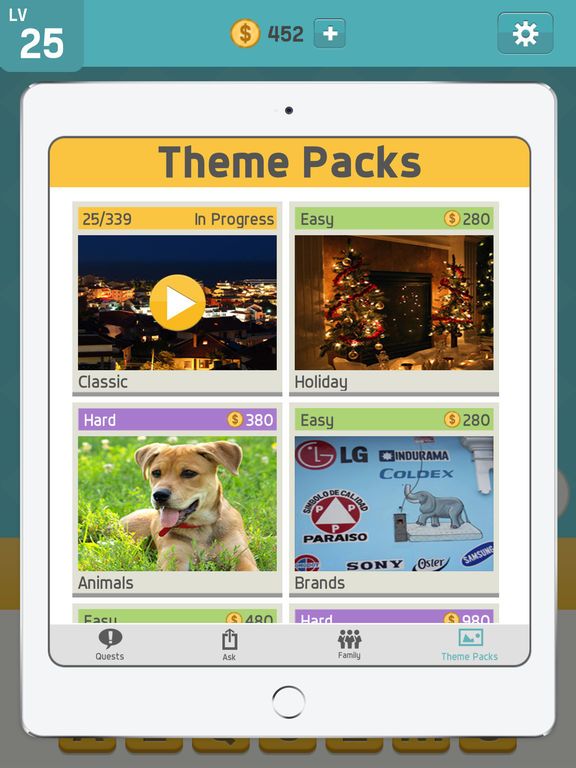
Pictoword
Pictoword is a 2013 word game developed and published by Kooapps. It was released for iOS on March 1, 2013, and for Android on May 31, 2013. The game was also published in Google Play Pass on June 27, 2024 and is only available via subscription.
sphragis
explicit authorial statement in which an author identifies themself
Word Association
word game involving an exchange of words that are associated together
Kaladont
Kalodont or kaladont is a South Slavic word game, popular in Croatia, Montenegro, Serbia, Slovenia, Bosnia and Herzegovina and North Macedonia, in which players in turn say words, each beginning with the last two letters of the previous word.
Le Train de Nulle Part
book
Word Ways
magazine on recreational linguistics, logology and word play