Category
page 1World Wide Web Consortium standards

HTML
Hypertext Markup Language (HTML) is the standard markup language for documents designed to be displayed in a web browser. It defines the content and structure of web content. It is often assisted by technologies such as Cascading Style Sheets (CSS) and scripting languages such as JavaScript.

Cascading Style Sheets
Cascading Style Sheets (CSS) is a style sheet language used for specifying the presentation and styling of a document written in a markup language, such as HTML or XML (including XML dialects such as SVG, MathML, or XHTML). CSS is a cornerstone technology of the World Wide Web, alongside HTML and JavaScript.

XML
Extensible Markup Language (XML) is a markup language and file format for storing, transmitting, and reconstructing data. It defines a set of rules for encoding documents in a format that is both human-readable and machine-readable. The World Wide Web Consortium's XML 1.0 Specification of 1998 and several other related specifications—all of them free open standards—define XML.

HTTP
HTTP (Hypertext Transfer Protocol) is an application layer protocol in the Internet protocol suite for distributed, collaborative, hypermedia information systems. HTTP is the foundation of data communication for the World Wide Web, where hypertext documents include hyperlinks to other resources that the user can easily access, for example by a mouse click or by tapping the screen in a web browser.

Q2078
Scalable Vector Graphics (SVG) is an XML-based vector graphics format for defining two-dimensional graphics, having support for interactivity and animation. The SVG specification is an open standard developed by the World Wide Web Consortium since 1999.

Extensible HyperText Markup Language
Extensible HyperText Markup Language (XHTML) is part of the family of XML markup languages which mirrors or extends versions of the widely used HyperText Markup Language (HTML), the language in which Web pages are formulated.

Portable Network Graphics
Portable Network Graphics (PNG, officially pronounced , colloquially pronounced ) is a raster-graphics file format that supports lossless data compression. PNG was developed as an improved, non-patented replacement for Graphics Interchange Format (GIF).
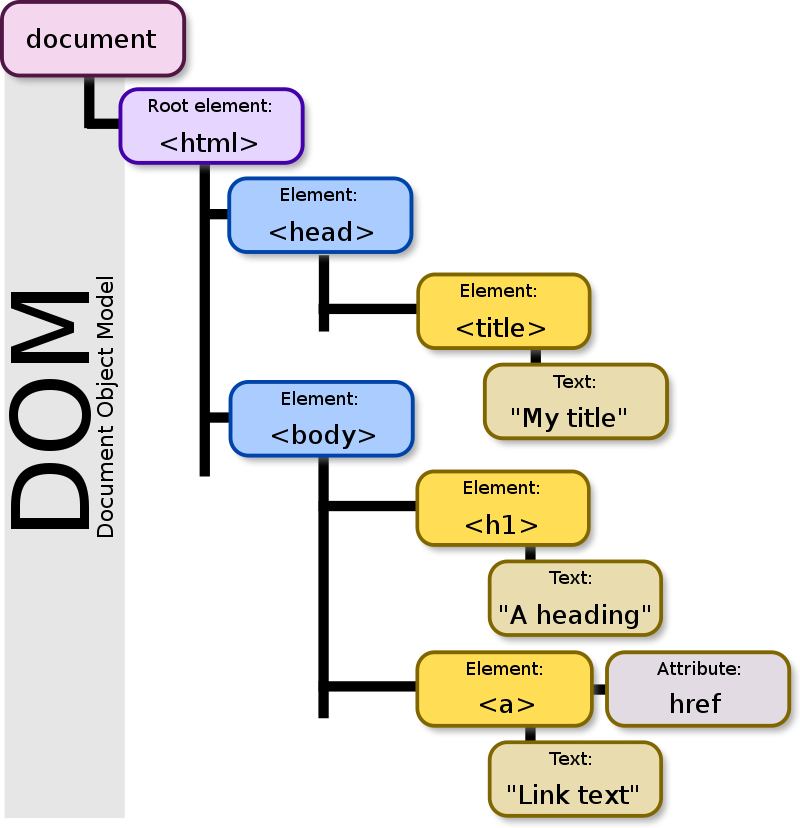
Document Object Model
convention for representing and interacting with objects in HTML, XHTML and XML documents

XSLT
XSLT (Extensible Stylesheet Language Transformations) is a language originally designed for transforming XML documents into other XML documents, or other formats such as HTML for web pages, plain text, or XSL Formatting Objects. These formats can be subsequently converted to formats such as PDF, PostScript, and PNG. Support for JSON and plain-text transformation was added in later updates to the XSLT 1.0 specification.

SOAP
SOAP (originally an acronym for Simple Object Access Protocol) is a messaging protocol specification for exchanging structured information in the implementation of web services in computer networks. It uses XML Information Set for its message format, and relies on application layer protocols, most often Hypertext Transfer Protocol (HTTP), although some legacy systems communicate over Simple Mail Transfer Protocol (SMTP), for message negotiation and transmission.
Resource Description Framework
data model for describing resources on the Web

SPARQL
SPARQL (pronounced "sparkle", a recursive acronym for SPARQL Protocol and RDF Query Language) is an RDF query language—that is, a semantic query language for databases—able to retrieve and manipulate data stored in Resource Description Framework (RDF) format. It was made a standard by the RDF Data Access Working Group (DAWG) of the World Wide Web Consortium, and is recognized as one of the key technologies of the semantic web. On 15 January 2008, SPARQL 1.0 was acknowledged by W3C as an official recommendation, and SPARQL 1.1 in March, 2013.
XSL
In computing, the term Extensible Stylesheet Language (XSL) is used to refer to a family of languages used to transform and render XML documents (e.g., XSL is used to determine how to display a XML document as a webpage).

MathML
Mathematical Markup Language (MathML) is a pair of mathematical markup languages, an application of XML for describing mathematical notation and capturing both its structure and content. Its aim is to natively integrate mathematical formulae into World Wide Web pages and other documents. It is part of HTML5 and standardised by ISO/IEC since 2015.
XQuery
XQuery (XML Query) is a query language and functional programming language designed to query and transform collections of structured and unstructured data, primarily in the form of XML. It also supports text data and, through implementation-specific extensions, other formats like binary and relational data.
Web Services Description Language
XML-based interface description language
WebAssembly
WebAssembly (Wasm) defines a portable binary code format and a corresponding text format for executable programs and software interfaces for facilitating communication between such programs and their host environment.
XML Schema
W3C XML schema language

WebDAV
WebDAV (Web Distributed Authoring and Versioning) is a set of extensions to the Hypertext Transfer Protocol (HTTP), which allows user agents to collaboratively author contents directly in an HTTP web server by providing facilities for concurrency control and namespace operations, thus allowing the Web to be viewed as a writeable, collaborative medium and not just a read-only medium. WebDAV is defined in by a working group of the Internet Engineering Task Force (IETF).
Web Ontology Language
family of knowledge representation languages
Synchronized Multimedia Integration Language
XML-based markup language for multimedia presentations

APNG
Animated Portable Network Graphics (APNG) is a file format which extends the Portable Network Graphics (PNG) specification to permit animated images that work similarly to animated GIF files, while supporting images with a higher color depth and full alpha transparency not available for GIFs. It also retains backward compatibility with non-animated PNG files. It was developed by the Mozilla Foundation in 2004.
XSL Formatting Objects
markup language for XML document formatting
XForms
XForms is an XML format used for collecting inputs from web forms. XForms was designed to be the next generation of HTML / XHTML forms, but is generic enough that it can also be used in a standalone manner or with presentation languages other than XHTML to describe a user interface and a set of common data manipulation tasks.
Web Open Font Format
file format for fonts in web pages
cross-origin resource sharing
mechanism that allows restricted resources on a web page to be requested from another domain outside the domain from which the first resource was served
VoiceXML
VoiceXML (VXML) is a digital document standard for specifying interactive media and voice dialogs between humans and computers. It is used for developing audio and voice response applications, such as banking systems and automated customer service portals. VoiceXML applications are developed and deployed in a manner analogous to how a web browser interprets and visually renders the Hypertext Markup Language (HTML) it receives from a web server. VoiceXML documents are interpreted by a voice browser and in common deployment architectures, users interact with voice browsers via the public switche

WebAuthn
Web Authentication (WebAuthn) is a web standard published by the World Wide Web Consortium (W3C).
It defines an API that websites use to authenticate with WebAuthn credentials (passkeys) and outlines what WebAuthn authenticators should do.
It solves many of the issues of traditional password-based authentication by verifying the user's identity with digital signatures.
Although WebAuthn is often touted as a complete replacement for passwords, most websites that implement it continue to use passwords in some capacity.

MusicXML
MusicXML is an XML-based file format for representing Western musical notation. The format is open, fully documented, and can be freely used under the W3C Community Final Specification Agreement.
XLink
XML Linking Language, or XLink, is an XML markup language and W3C specification that provides methods for creating internal and external links within XML documents, and associating metadata with those links.
XML schema
description of a type of XML document
Web Accessibility Initiative
effort to improve the accessibility of the World Wide Web (WWW or Web) for people with disabilities
RDF Schema
schema for knowledge representation
XML Binding Language
XML Binding Language (XBL) is an XML-based markup language for altering the behavior of XUL widgets. It was devised at Netscape in the late 1990s as an extension of XUL.
Computer Graphics Metafile
image file format family
web storage
client-side data storage in web browsers
XPointer
XPointer is a system for addressing components of XML-based Internet media. It is divided among four specifications: a "framework" that forms the basis for identifying XML fragments, a positional element addressing scheme, a scheme for namespaces, and a scheme for XPath-based addressing. XPointer Framework is a W3C recommendation since March 2003.
Speech Synthesis Markup Language
XML-based markup language
CSS Flex Box Layout
CSS Flexible Box Layout, commonly known as Flexbox, is a CSS web layout model. It is in the W3C's candidate recommendation (CR) stage. The flex layout allows responsive elements within a container to be automatically arranged depending on viewport (device screen) size.
WebSub
WebSub (formerly PubSubHubbub) is an open protocol for distributed publish–subscribe communication on the Internet. Initially designed to extend the Atom (and RSS) protocols for data feeds, the protocol can be applied to any data type (e.g. HTML, text, pictures, audio, video) as long as it is accessible via HTTP. Its main purpose is to provide real-time notifications of changes, which improves upon the typical situation where a client periodically polls the feed server at some arbitrary interval. In this way, WebSub provides pushed HTTP notifications without requiring clients to spend resource

Platform for Privacy Preferences Project
The Platform for Privacy Preferences Project (P3P) is an obsolete protocol allowing websites to declare their intended use of information they collect about web browser users. Designed to give users more control of their personal information when browsing, P3P was developed by the World Wide Web Consortium (W3C) and officially recommended on April 16, 2002. Development ceased shortly thereafter and there have been very few implementations of P3P. Internet Explorer and Microsoft Edge Legacy were the only major browsers to support P3P. Microsoft has ended support from Windows 10 onwards. Interne
Modernizr
Modernizr is a JavaScript library that detects the features available in a user's browser. This lets web pages avoid unsupported features by informing the user their browser is not supported or loading a polyfill. Modernizr aims to provide feature detection in a consistent and easy to use manner that discourages the use of failure-prone browser sniffing.
Timed Text
presentation of text media in synchrony with other media, such as audio and video
Web SQL Database
deprecated Web browser API
ebXML
Electronic Business using eXtensible Markup Language, commonly known as e-business XML, or ebXML (pronounced ) as it is typically referred to, is a family of XML based standards sponsored by OASIS and UN/CEFACT whose mission is to provide an open, XML-based infrastructure that enables the global use of electronic business information in an interoperable, secure, and consistent manner by all trading partners.

RDFa
RDFa or Resource Description Framework in Attributes is a W3C Recommendation that adds a set of attribute-level extensions to HTML, XHTML and various XML-based document types for embedding rich metadata within web documents. The Resource Description Framework (RDF) data-model mapping enables the use of RDFs for embedding RDF subject-predicate-object expressions within XHTML documents. RDFa also enables the extraction of RDF model triples by compliant user agents.
WebVTT
WebVTT (Web Video Text Tracks) is a World Wide Web Consortium (W3C) standard for displaying timed text in connection with the HTML5 <track> element.
character encoding in HTML
use of encoding systems for international characters in HTML

Indexed Database API
The Indexed Database API (commonly referred to as IndexedDB) is a JavaScript application programming interface (API) provided by web browsers for managing a NoSQL database of objects. It is a standard maintained by the World Wide Web Consortium (W3C).
Message Transmission Optimization Mechanism
XML Base
facility for defining base URIs in XML documents
GRDDL
GRDDL (pronounced "griddle") is a markup format for Gleaning Resource Descriptions from Dialects of Languages. It is a W3C Recommendation, and enables users to obtain RDF triples out of XML documents, including XHTML. The GRDDL specification shows examples using XSLT, however it was intended to be abstract enough to allow for other implementations as well. It became a Recommendation on September 11, 2007.
XProc
XProc is an XML transformation language for processing documents in pipelines: chaining conversions and other steps together to achieve the desired results. It can handle documents in XML, HTML, JSON, text and binary.
XFrames
XFrames was an XML format draft for embedding HTML pages into one page which handles the layout without the problems of HTML frames. The frames technique was especially popular for navigation bars. While HTML frames are still supported for legacy websites, today’s websites assemble pages by other means.
XHTML Basic
XML-based structured markup language
Efficient XML Interchange
file format
XML Information Set
Type of an XML data model
web platform
browser-based computing platform
Shape Expressions
Shape Expressions (ShEx) is a data modelling language for validating and describing a Resource Description Framework (RDF).
CURIE
In computing, a CURIE (or Compact URI) defines a generic, abbreviated syntax for expressing Uniform Resource Identifiers (URIs). It is an abbreviated URI expressed in a compact syntax, and may be found in both XML and non-XML grammars. A CURIE may be considered a datatype.