File:DOM-model.svg · Wikimedia Commons · See Wikimedia Commons
Document Object Model
Sign in to saveAlso known as DOM
convention for representing and interacting with objects in HTML, XHTML and XML documents
Key facts
- Abbreviation
- DOM
- Latest version
- DOM4 , November 19, 2015 ; 10 years ago ( 2015-11-19 )
- Organization
- World Wide Web Consortium , WHATWG
- Base standards
- WHATWG DOM Living Standard , W3C DOM4
via Wikipedia infobox
Source code
We are committed to providing a friendly, safe, and welcoming environment for all. Please read and respect the Code of Conduct. Folks notice minor and larger issues with the DOM Standard all the time and we'd love your help fixing those. Pull requests for typographical and grammar errors are also most welcome. Issues labeled "good first issue" are a good place to get a taste for editing the DOM Standard. Note that we don't assign issues and there's no reason to ask for availability either, just provide a pull request. If you are thinking of suggesting a new feature, read through the FAQ and Working Mode documents to get yourself familiarized with the process. In short, change dom.bs and submit your patch, with a good commit message. Please add your name to the Acknowledgments section in your first pull request, even for trivial fixes. The names are sorted lexicographically. To ensure your patch meets all the necessary requirements, please also see the Contributor Guidelines. Editors of the DOM Standard are expected to follow the Maintainer Guidelines. A dashboard showing the tests running against browser engines can be seen at wpt.fyi/results/dom. For quick local iteration, run make ; this will use a web service to build the standard, so that you don't have to install anything. See more in the Contributor Guidelines. Do not use newlines inside "inline" elements, even if that means exceeding the column width requirement. Using newlines between "inline" element tag names and their content is also forbidden. (This actually alters the content, by adding spaces.) That is Do not indent for anything except a new "block" element. For instance End tags may be included (if done consistently) and attributes may be quoted (using double quotes), though the prevalent theme is to omit end tags and not quote attributes (unless they contain a space). Place one newline between paragraphs (including list elements). Place three newlines before , and two newlines before other headings. This does not apply when a nested heading follows the parent heading. Use camel-case for variable names and "spaced" names for definitions, algorithms, etc.
Excerpt from the source-code README · 4,674 chars · not written by Vinony
Wikidata facts
- Instance of
- application programming interface
- Official website
- dom.spec.whatwg.org
- Image
- DOM-model.svg
Show 8 more facts
- standards body
- World Wide Web Consortium
- Stack Exchange tag
- stackoverflow.com/tags/dom
- Commons category
- Document object models
- work available at URL
- dom.spec.whatwg.org
- source code repository URL
- github.com/whatwg/dom
- uses
- web browser
- short name
- DOM
- different from
- DOM
Sources (6)
via Wikidata · CC0
~13 min read
Encyclopedic overview
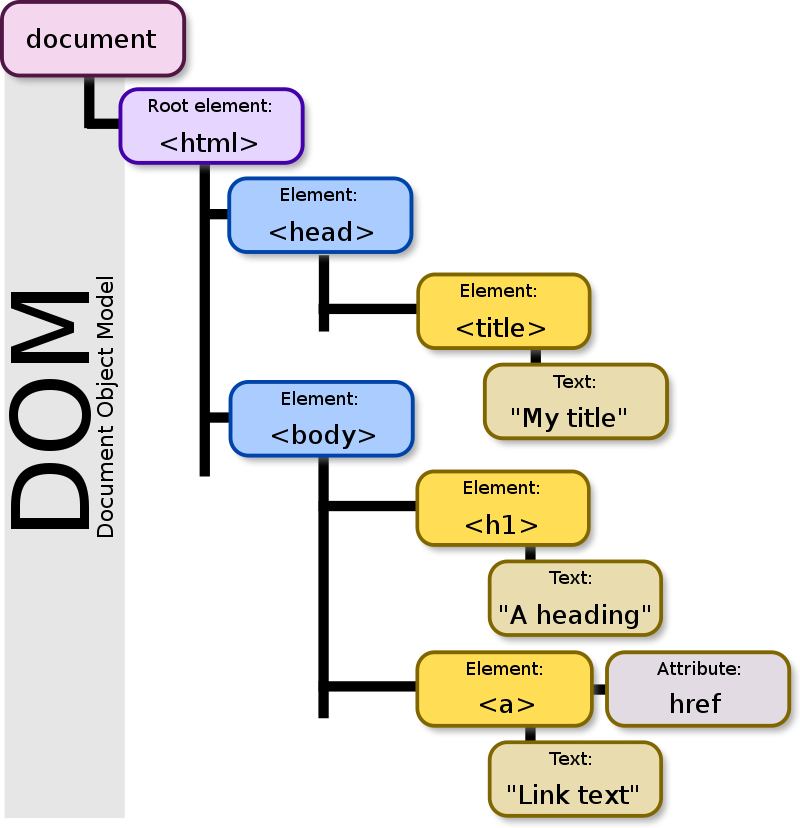
The Document Object Model (DOM) is a cross-platform and language-independent API that treats an HTML or XML document as a tree structure wherein each node is an object representing a part of the document. The DOM represents a document with a logical tree. Each branch of the tree ends in a node, and each node contains objects. DOM methods allow programmatic access to the tree; with them one can change the structure, style or content of a document. Nodes can have event handlers (also known as event listeners) attached to them. Once an event is triggered, the event handlers get executed.
The principal standardization of the DOM was handled by the World Wide Web Consortium (W3C), which last developed a recommendation in 2004. WHATWG took over the development of the standard, publishing it as a living document. The W3C now publishes stable snapshots of the WHATWG standard.
Excerpted from Wikipedia’s “Document Object Model” article, available under the CC BY-SA 4.0 licence.