Category
page 1XML-based standards

RSS

HTML5
HTML5 (Hypertext Markup Language 5) is a markup language used for structuring and presenting hypertext documents on the World Wide Web. It was the fifth and final major HTML version that is now a retired World Wide Web Consortium (W3C) recommendation. The current specification is known as the HTML Living Standard. It is maintained by the Web Hypertext Application Technology Working Group (WHATWG), a consortium of the major browser vendors (Apple, Google, Mozilla, and Microsoft).

Extensible HyperText Markup Language
Extensible HyperText Markup Language (XHTML) is part of the family of XML markup languages which mirrors or extends versions of the widely used HyperText Markup Language (HTML), the language in which Web pages are formulated.
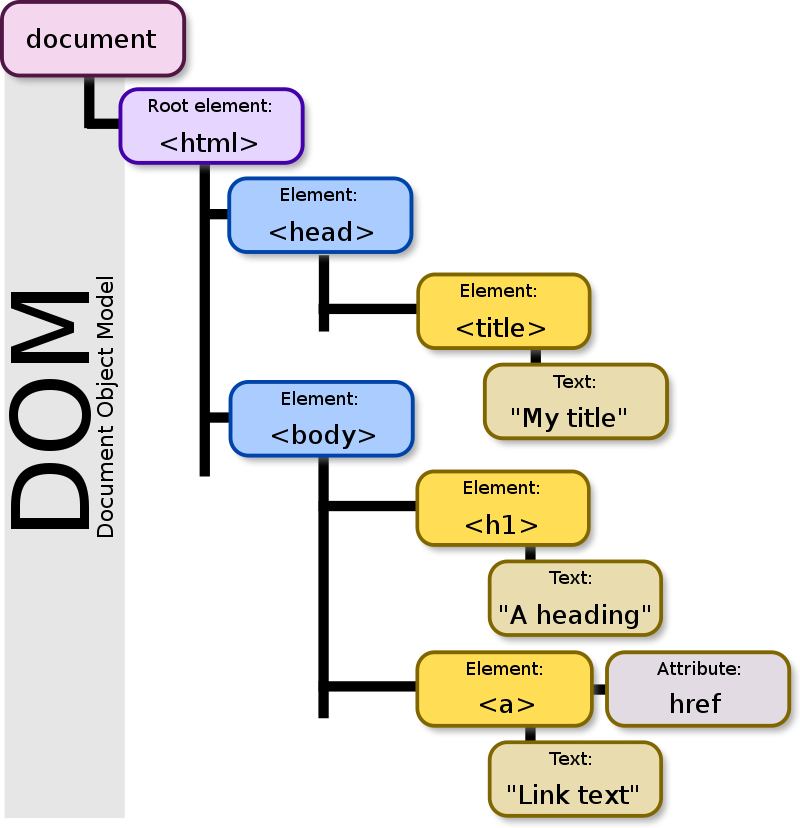
Document Object Model
convention for representing and interacting with objects in HTML, XHTML and XML documents

XMPP
Extensible Messaging and Presence Protocol (abbreviation XMPP, originally named Jabber) is an open communication protocol designed for instant messaging (IM), presence information, and contact list maintenance. Based on XML (Extensible Markup Language), it enables the near-real-time exchange of structured data between two or more network entities. Designed to be extensible, the protocol offers a multitude of applications beyond traditional IM in the broader realm of message-oriented middleware, including signalling for VoIP, video, file transfer, gaming and other uses.

XSLT
XSLT (Extensible Stylesheet Language Transformations) is a language originally designed for transforming XML documents into other XML documents, or other formats such as HTML for web pages, plain text, or XSL Formatting Objects. These formats can be subsequently converted to formats such as PDF, PostScript, and PNG. Support for JSON and plain-text transformation was added in later updates to the XSLT 1.0 specification.

SOAP
SOAP (originally an acronym for Simple Object Access Protocol) is a messaging protocol specification for exchanging structured information in the implementation of web services in computer networks. It uses XML Information Set for its message format, and relies on application layer protocols, most often Hypertext Transfer Protocol (HTTP), although some legacy systems communicate over Simple Mail Transfer Protocol (SMTP), for message negotiation and transmission.
Resource Description Framework
data model for describing resources on the Web

MathML
Mathematical Markup Language (MathML) is a pair of mathematical markup languages, an application of XML for describing mathematical notation and capturing both its structure and content. Its aim is to natively integrate mathematical formulae into World Wide Web pages and other documents. It is part of HTML5 and standardised by ISO/IEC since 2015.
XSL
In computing, the term Extensible Stylesheet Language (XSL) is used to refer to a family of languages used to transform and render XML documents (e.g., XSL is used to determine how to display a XML document as a webpage).
MARC standards
digital formats for library cataloguing
Atom
Atom Syndication Format (XML)-used for web feeds Atom Publishing Protocol (HTTP)-protocol for creating and updating web resources
Web Services Description Language
XML-based interface description language
web feed
data format used for providing users with frequently updated content
XML Schema
W3C XML schema language
Keyhole Markup Language
notation for expressing geographic annotation and visualization within Internet-based maps

XML User Interface Language
XUL ( ), which stands for XML User Interface Language, is a user interface markup language developed by Mozilla. XUL is an XML dialect for writing graphical user interfaces, enabling developers to write user interface elements in a manner similar to web pages.
Extensible Application Markup Language
programming language
Simple API for XML
parsing algorithm for XML documents
Web Ontology Language
family of knowledge representation languages
Synchronized Multimedia Integration Language
XML-based markup language for multimedia presentations
Digital Accessible Information System (DAISY)
technical standard for digital audiobooks, periodicals and computerized text
Health Level 7
Health Level Seven (HL7) is a set of technical standards for health information exchange between software applications. The name is a reference to the 7th layer, the application layer, in the OSI model. The standards are produced by HL7 International, an international standards organization, and are adopted by other standards-issuing bodies such as American National Standards Institute and International Organization for Standardization.

OPML
OPML (Outline Processor Markup Language) is an XML format for outlines (defined as "a tree, where each node contains a set of named attributes with string values"). Originally developed by UserLand Software as a native file format for the outliner application in its Radio UserLand product, it has since been adopted for other uses, the most common being to exchange lists of web feeds between web feed aggregators.
Sitemaps
Sitemaps is a protocol in XML format meant for a webmaster to inform search engines about URLs on a website that are available for web crawling. It allows webmasters to include additional information about each URL: when it was last updated, how often it changes, and how important it is in relation to other URLs of the site. This allows search engines to crawl the site more efficiently and to find URLs that may be isolated from the rest of the site's content. The Sitemaps protocol is a URL inclusion protocol and complements robots.txt, a URL exclusion protocol.
XSL Formatting Objects
markup language for XML document formatting
GPS Exchange Format
XML based open file format to share GNSS data
XForms
XForms is an XML format used for collecting inputs from web forms. XForms was designed to be the next generation of HTML / XHTML forms, but is generic enough that it can also be used in a standalone manner or with presentation languages other than XHTML to describe a user interface and a set of common data manipulation tasks.
Business Process Execution Language
language for specifying actions within business processes with web services
XML-RPC
XML-RPC is a remote procedure call (RPC) protocol which uses XML to encode its calls and HTTP as a transport mechanism.

eXtensible Business Reporting Language
XBRL (eXtensible Business Reporting Language) is a freely available global framework for exchanging business information. XBRL allows the expression of semantics commonly required in business reporting. The standard was originally based on XML, but now supports reports in JSON and CSV formats in addition to the original XML-based syntax. XBRL is also increasingly used in its Inline XBRL variant, which embeds XBRL tags into an HTML document. One common use of XBRL is the exchange of financial information, such as in a company's annual financial report. The XBRL standard is developed and publish
Document Type Declaration
instruction that associates a particular SGML or XML document with a document type definition (DTD)
SyncML
SyncML, or Synchronization Markup Language, was originally developed as a platform-independent standard for information synchronization. Established by the SyncML Initiative, this project has evolved to become a key component in data synchronization and device management. The project is currently referred to as Open Mobile Alliance Data Synchronization and Device Management. The purpose of SyncML is to offer an open standard as a replacement for existing data synchronization solutions; which have mostly been somewhat vendor, application, or operating system specific. SyncML 1.0 specification w
Open XML Paper Specification
file format

International Press Telecommunications Council
consortium of the world's major news agencies and news industry vendors

Security Assertion Markup Language
Security Assertion Markup Language (SAML, pronounced SAM-el, ) is an open standard for exchanging authentication and authorization data between parties, in particular, between an identity provider and a service provider. SAML is an XML-based markup language for security assertions (statements that service providers use to make access-control decisions). SAML is also:
A set of XML-based protocol messages
A set of protocol message bindings
A set of profiles (utilizing all of the above)
VoiceXML
VoiceXML (VXML) is a digital document standard for specifying interactive media and voice dialogs between humans and computers. It is used for developing audio and voice response applications, such as banking systems and automated customer service portals. VoiceXML applications are developed and deployed in a manner analogous to how a web browser interprets and visually renders the Hypertext Markup Language (HTML) it receives from a web server. VoiceXML documents are interpreted by a voice browser and in common deployment architectures, users interact with voice browsers via the public switche
Text Encoding Initiative
an academic community concerned with practices for semantic markup of texts
XLink
XML Linking Language, or XLink, is an XML markup language and W3C specification that provides methods for creating internal and external links within XML documents, and associating metadata with those links.

MusicXML
MusicXML is an XML-based file format for representing Western musical notation. The format is open, fully documented, and can be freely used under the W3C Community Final Specification Agreement.
FictionBook
FictionBook is an open XML-based e-book format which originated and gained popularity in Russia. FictionBook files have the or filename extension, according to their version. All FB2/FB3 capable readers also support ZIP-compressed FictionBook files ( or ).
XML schema
description of a type of XML document
XLIFF
XLIFF (XML Localization Interchange File Format) is an XML-based bitext format created to standardize the way localizable data are passed between and among tools during a localization process and a common format for CAT tool exchange. The XLIFF Technical Committee (TC) first convened at OASIS in December 2001 (first meeting in January 2002), but the first fully ratified version of XLIFF appeared as XLIFF Version 1.2 in February 2008. Its current specification is v2.2 released on 2025-03-13, which is backwards compatible with v2.1 released on 2018-02-13.
XHTML Friends Network
HTML microformat developed in 2003
XML Binding Language
XML Binding Language (XBL) is an XML-based markup language for altering the behavior of XUL widgets. It was devised at Netscape in the late 1990s as an extension of XUL.
Vector Markup Language
graphics format

Digital Asset Exchange
COLLADA (for 'collaborative design activity') is an interchange file format for interactive 3D applications. It is managed by the nonprofit technology consortium, the Khronos Group, and has been adopted by ISO as a publicly available specification, ISO/PAS 17506.
Speech Synthesis Markup Language
XML-based markup language

Extensible Provisioning Protocol
computer network protocol
WebSub
WebSub (formerly PubSubHubbub) is an open protocol for distributed publish–subscribe communication on the Internet. Initially designed to extend the Atom (and RSS) protocols for data feeds, the protocol can be applied to any data type (e.g. HTML, text, pictures, audio, video) as long as it is accessible via HTTP. Its main purpose is to provide real-time notifications of changes, which improves upon the typical situation where a client periodically polls the feed server at some arbitrary interval. In this way, WebSub provides pushed HTTP notifications without requiring clients to spend resource

Darwin Information Typing Architecture
XML data model for topic-based authoring and publishing
Extensible Resource Identifier
URI scheme
WS-Security
Web Services Security (WS-Security, WSS) is an extension to SOAP to apply security to Web services. It is a member of the Web service specifications and was published by OASIS.
RELAX NG
XML schema language

XPDL
300px|thumb|Process represented in XPDL (healthcare domain example, Hepatitis A immunization)
The XML Process Definition Language (XPDL) is a format standardized by the Workflow Management Coalition (WfMC) to interchange business process definitions between different workflow products, i.e. between different modeling tools and management suites.
XPDL defines an XML schema for specifying the declarative part of workflow / business process.

RDFa
RDFa or Resource Description Framework in Attributes is a W3C Recommendation that adds a set of attribute-level extensions to HTML, XHTML and various XML-based document types for embedding rich metadata within web documents. The Resource Description Framework (RDF) data-model mapping enables the use of RDFs for embedding RDF subject-predicate-object expressions within XHTML documents. RDFa also enables the extraction of RDF model triples by compliant user agents.
Open Data Protocol
open protocol which allows the creation and consumption of queryable and interoperable RESTful APIs in a simple and standard way
ebXML
Electronic Business using eXtensible Markup Language, commonly known as e-business XML, or ebXML (pronounced ) as it is typically referred to, is a family of XML based standards sponsored by OASIS and UN/CEFACT whose mission is to provide an open, XML-based infrastructure that enables the global use of electronic business information in an interoperable, secure, and consistent manner by all trading partners.
Railway Markup Language
railML (Railway Markup Language) is a proprietary freeware XML Schema-based data exchange format for data interoperability of railway applications.
Metalink
Metalink is an extensible metadata file format that describes one or more computer files available for download. It specifies files appropriate for a user's language and operating system; facilitates file verification and recovery from data corruption; and lists alternate download sources (mirror URIs).