Category
page 1Yahweh

Jehovah
thumb|"Jehovah" at Book of Exodus|Exodus 6:3 (1611 [[King James Version)]]
Jehovah () is a Latinization of the Hebrew , one vocalization of the Tetragrammaton (YHWH), the proper name of the God of Israel in the Hebrew BibleOld Testament. The Tetragrammaton is considered one of the seven names of God in Judaism and a form of God's name in Christianity.

Tetragrammaton
thumb|class=skin-invert-image|The Tetragrammaton in Hebrew letters (yod/Y) (he/H) (vav/W) (he/H)
The Tetragrammaton is the four-letter Hebrew-language theonym (transliterated as YHWH), the name of God in the Hebrew Bible. The four Hebrew letters, written and read from right to left, are yod, he, vav, and he. The name may be derived from a verb that means 'to be', 'to exist', 'to cause to become', or 'to come to pass'.

Yahweh
Yahweh was an ancient Semitic deity in the southeastern ancient Levant that became the national god of the Iron Age kingdoms of Israel-Samaria and Judah. Although there is no clear consensus regarding the geographic origins of the deity, most modern scholars favor a southern origin hypothesis. The worship of the deity goes back to at least the early Iron Age and apparently to the late Bronze Age.
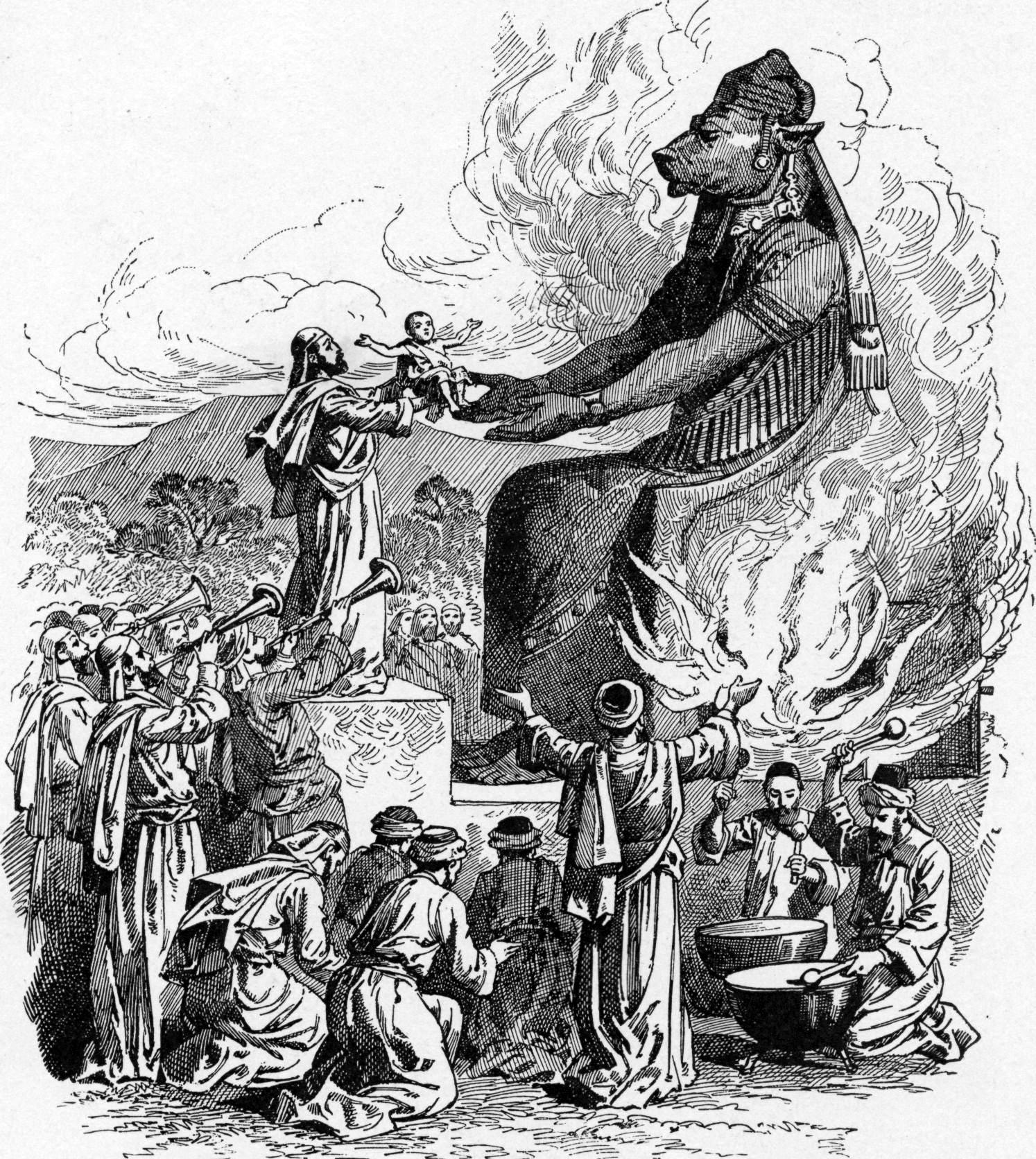
Moloch
thumb|Offering to Molech in Bible Pictures and What They Teach Us, by Charles Foster, 1897. The drawing is typical of Moloch depictions in nineteenth-century illustrations.
Moloch, Molech, or Molek is a word which appears in the Hebrew Bible several times, primarily in the Book of Leviticus. The Greek Septuagint translates many of these instances as "their king", but maintains the word or name Moloch in others, including one additional time in the Book of Amos where the Hebrew text does not attest the name. The Bible strongly condemns practices that are associated with Moloch, which are heavil

Jahwist
thumb|upright=0.6|The supplementary hypothesis, a popular model of the [[composition of the Torah. The Jahwist is shown as J.]]
thumb|The 20th-century documentary hypothesis.
The Jahwist or Yahwist (J) is one of the most widely recognized sources of the Pentateuch (Torah), together with the Deuteronomist (D), the Priestly source (P) and the Elohist (E). The existence of the Jahwist text is somewhat controversial, with a number of scholars, especially in Europe, denying that it ever existed as a coherent independent document. Nevertheless, many scholars do assume its existence. The Jahwist is
God in Judaism
Jewish conception of God

Yahwism
Yahwism, also known as the Israelite religion, was the ancient Semitic religion of ancient Israel and Judah and the ethnic religion of the Israelites. The Israelite religion was a derivative of the Canaanite religion and a polytheistic religion that had a pantheon with various gods and goddesses. The primary deity of the religion and the head of the pantheon was Yahweh, the national god of the kingdoms of Judah and Israel. The majority of scholars hold that the goddess Asherah was the consort of Yahweh, though some scholars disagree. Below this divine pair were secondary gods and goddesses, su

Yaldabaoth
thumb|A lion-faced, Snakes in mythology|serpentine [[deity found on a Gnostic gem in Bernard de Montfaucon's ''L'antiquité expliquée et représentée en figures'', a depiction of Yaldabaoth.]]

Teraphim
thumb|Teraphim depicted in the Oedipus Aegyptiacus ([[Athanasius Kircher, 1652)]]
Teraphim () is a word from the Hebrew Bible, found only in the plural, and of uncertain etymology. Despite being plural, teraphim may refer to singular objects. Teraphim is defined in classical rabbinical literature as "disgraceful things", but this is dismissed by modern etymologists. Many Bible translations into English translate it as idols or household god(s); its exact meaning in ancient times is unknown.
Kuntillet Ajrud
archaeological site in the Sinai Peninsula
Hand of God
Jewish and Christian motif signifying divine intervention

I am the Lord thy God
First of the Ten Commandments
Thou shalt not take the name of the Lord thy God in vain
part of the Ten Commandments (Exod. 20:7): “Thou shalt not take the name of the LORD thy God in vain; for the LORD will not hold him guiltless that taketh his name in vain.”
Numbers 31
thirty-first chapter of Numbers in the Hebrew and Christian Bible
high place
elevated spot regarded as a shrine for worship in the belief that, being nearer heaven than the plains and valleys, it might also be a more favorable place for prayer
Zipporah at the inn
Biblical event recorded in the book of Exodus
Adon
Adon () literally means "lord." Adon has an uncertain etymology, although it is generally believed to be derived from the Ugaritic ad, “father.”
Bull Site
open air ancient cult installation now in the West Bank
Khirbet el-Qom
archaeological tomb-site in the territory of the biblical kingdom of Judah, between Lachish and Hebron