
File:Chariklo_2013_occultation_diagram.png · Wikimedia Commons · See Wikimedia Commons
OverviewAI-generated
10199 Chariklo is a centaur-type asteroid that orbits the Sun. It was discovered by Spacewatch on February 15, 1997, and received the provisional designation 1997 CU26. The object is named after Chariclo and possesses a diameter of 302 km with an albedo of 0.045. Its rotation period is 7.004 hours, and it has a minimum orbit intersection distance of 12.1 au.
Orbital parameters include a semi-major axis of 15.8416269, an eccentricity of 0.1759675, and an inclination of 23.43032406764174. The periapsis is 13.1387668 and the apoapsis is 18.544, resulting in an orbital period of 22808.8566569889. The mean anomaly is 126.9607892395604, the longitude of the ascending node is 300.4752379514439, and the argument of periapsis is 243.35826. Chariklo has an absolute magnitude of 6.7 and an apparent magnitude of 18.3. It is accompanied by the rings of Chariklo.
Synthesized by Vinony from 35 facts across 4 sources: Wikidata, NASA, Jpl Sbdb, Vinony graph. Generated from structured data (not the Wikipedia text) and checked against those facts — may still contain errors.
Picture of the Day · NASA
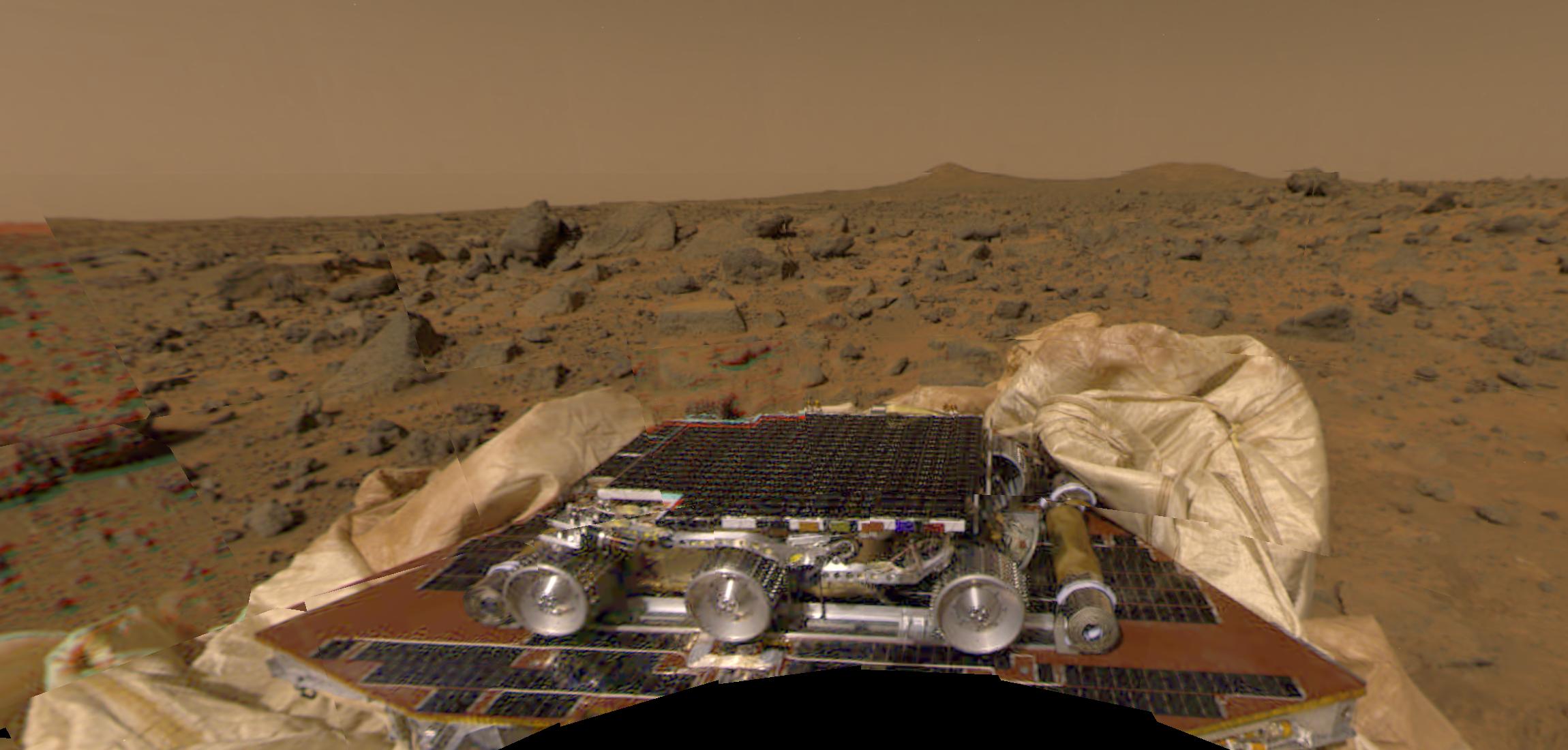
Pathfinder on Mars
2026-07-04
On July 4th, 1997, using its own array of fireworks, a parachute, and a cocoon of airbags, the Mars Pathfinder spacecraft bounced like a giant beach ball at least 15 times before it came to rest on the surface of Mars at 10:07 AM Pacific Daylight Time. After its then novel airbag-assisted landing sequence was completed, Pathfinder transmitted this color mosaic to mission operators on Earth. In the scene from another world, the Mars Sojourner robot rover is visible in the foreground, crouched on top of the unfolded Pathfinder. About the size of a large house cat, the six-wheeled, solar-powered Sojourner became the first successful Martian rover. Surrounding Pathfinder are deflated airbags and the rock-strewn terrain of the Ares Vallis floodplain. In the distance Martian hills appear against a dusty brownish sky. The Pathfinder lander was subsequently renamed the Carl Sagan Memorial Station.
via NASA APOD
Small body data
10199 Chariklo (1997 CU26)
- Orbit class
- Centaur
- Diameter
- 302 km
- Albedo
- 0.045
- Rotation period
- 7.004 h
- Absolute magnitude
- 6.550 H
- Earth MOID
- 12.100 AU
via NASA/JPL Small-Body Database
Key facts
- Discovered by
- Spacewatch
- Discovery site
- Kitt Peak Obs.
- Discovery date
- 15 February 1997
- Pronunciation
- / ˈ k ær ə k l oʊ /
- Named after
- Χαρικλώ Khariklō , (Ancient Greek nymph)
- Alternative designations
- 1997 CU 26
- Minor planet category
- centaur · distant
- Adjectives
- Charikloan, Charikloian / k ær ə ˈ k l oʊ ( i ) ə n /
- Observation arc
- 36+ yr
- Earliest precovery date
- 5 November 1988
- Aphelion
- 18.420 AU
- Perihelion
- 13.077 AU
- Semi major axis
- 15.748 AU
- Orbital period sidereal
- 62.50 yr (22,827 days)
- Mean anomaly
- 123.744 °
- Mean motion
- 0° 0 56.774 / day
- Inclination
- 23.425°
- Longitude of ascending node
- 300.470°
via Wikipedia infobox
Wikidata facts
- Instance of
- asteroid
- Named after
- Chariclo
- Followed by
- 10200 Quadri
- Follows
- 10198 Pinelli
- Parent body
- Sun
- Child body
- rings of Chariklo
- Minor-planet group
- centaur
- Diameter
- 302.0
- Radius
- 143
- Orbital period
- 22808.8566569889
- Image
- 10199 Chariklo.jpg
Show 22 more facts
- discoverer or inventor
- Spacewatch
- provisional designation
- 1997 CU26
- time of discovery or invention
- 1997-02-15
- Commons category
- 10199 Chariklo
- orbital inclination
- 23.43032406764174
- orbital eccentricity
- 0.1702459918732082
- apparent magnitude
- 18.3
- periapsis
- 13.06028793057127
- apoapsis
- 18.41961527605613
- semi-major axis of an orbit
- 15.7399516033137
- mean anomaly
- 126.9607892395604
- longitude of ascending node
- 300.4752379514439
- argument of periapsis
- 241.2242290125233
- absolute magnitude
- 6.55
- site of astronomical discovery
- Kitt Peak National Observatory
- albedo
- 0.045
- rotation period
- 7.004
- asteroid spectral type
- D-type asteroid
- has characteristic
- planetary ring
- color index
- 1.01
- time of periapsis
- 2452956.526547713
- epoch
- November 21, 2025
via Wikidata · CC0
~16 min read
Encyclopedic overview
10199 Chariklo /ˈkærəkloʊ/ is a ringed asteroid and centaur in the outer Solar System. It is the largest known centaur, with a diameter of about 250 km (160 mi). It orbits the Sun between Saturn and Uranus with an orbital period of 62.5 years. It was discovered on 15 February 1997 by the University of Arizona's Spacewatch project at Kitt Peak National Observatory. Chariklo has a dark, reddish surface composed of water ice, silicate minerals, amorphous carbon, and various complex organic compounds (also known as tholins).
Chariklo's ring system consists of two narrow rings of icy particles in orbit around the object. The rings of Chariklo were discovered in 2013, when astronomers observed Chariklo occulting or passing in front of a star. Chariklo was the first minor planet discovered to have rings, and as of 2025, it is one of the four minor planets known to have rings (the three others being 2060 Chiron, Haumea, and Quaoar). It is unknown what keeps Chariklo's rings stable, as it has been predicted that they should decay within a few million years. Astronomers have hypothesized that Chariklo's rings might be maintained by the gravitational influence of yet-undiscovered shepherd moons orbiting Chariklo. The origin of Chariklo's rings is uncertain, with various possible explanations including ejection of surface material via outgassing or tidal disruption of a moon around Chariklo.
Excerpted from Wikipedia’s “10199 Chariklo” article, available under the CC BY-SA 4.0 licence.