File:Ecliptic_grid_globe.png · Wikimedia Commons · See Wikimedia Commons
ecliptic coordinate system
Sign in to savecelestial coordinate system used for representing the positions of Solar System objects
Wikidata facts
- Subclass of
- astronomical coordinate system
Show 2 more facts
- Commons category
- Ecliptic coordinate system
- different from
- Geodetic coordinates
Sources (1)
via Wikidata · CC0
~9 min read
Encyclopedic overview
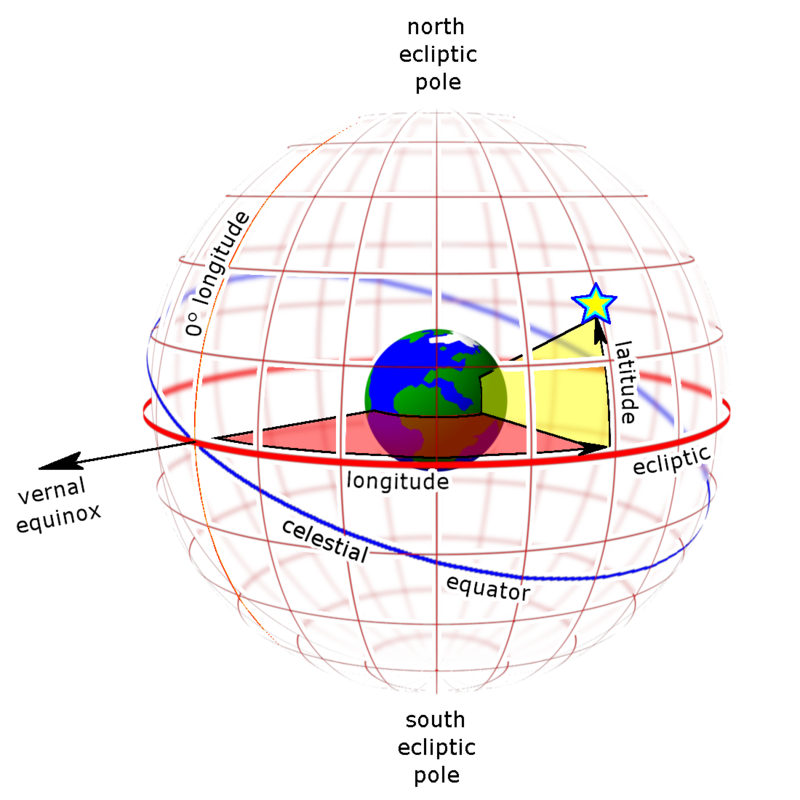
In astronomy, the ecliptic coordinate system is a celestial coordinate system commonly used for representing the apparent positions, orbits, and pole orientations of Solar System objects. Because most planets (except Mercury) and many small Solar System bodies have orbits with only slight inclinations to the ecliptic, using it as the fundamental plane is convenient. The system's origin can be the center of either the Sun or Earth, its primary direction is towards the March equinox, and it has a right-hand convention. It may be implemented in spherical or rectangular coordinates.
Earth-centered ecliptic coordinates as seen from outside the celestial sphere. Ecliptic longitude; measured along the ecliptic from the March equinox
Excerpted from Wikipedia’s “ecliptic coordinate system” article, available under the CC BY-SA 4.0 licence.