File:1810s_collage.jpg · Wikimedia Commons · See Wikimedia Commons
1810s
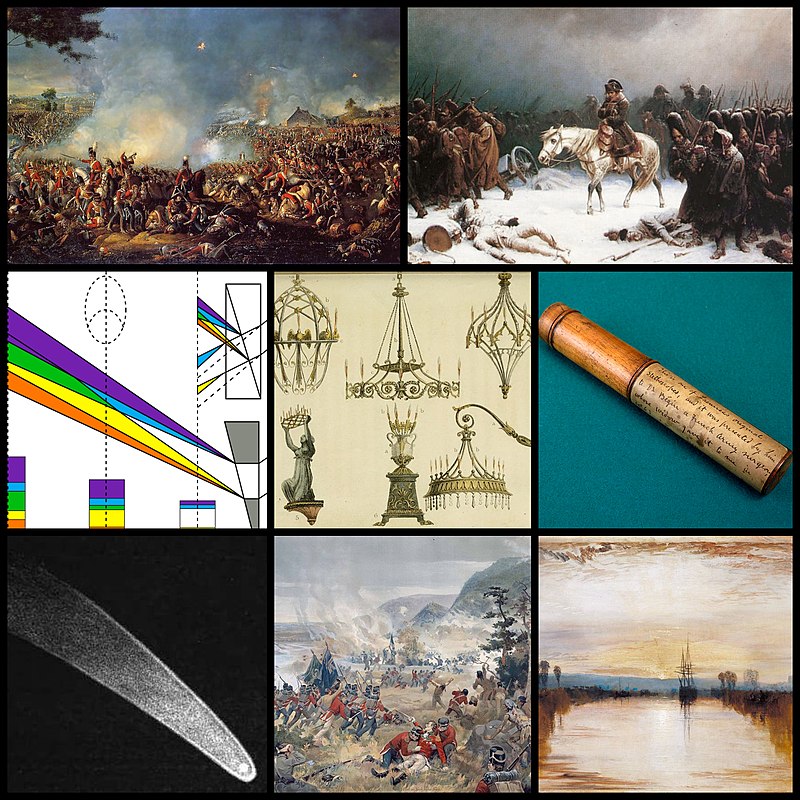
Sign in to saveFile:1810s collage.jpg|thumb|335x335px|From top left, clockwise: the Battle of Waterloo signified the end of Napoleon's conquests, as it sealed the downfall of his empire and brought his campaigns to an end; The French invasion of Russia and the subsequent retreat from Russia's harsh winter proved to be a turning point in the Napoleonic Wars, as food shortages and drastic supply loss led to catastrophic French losses from which Napoleon would never recover; The stethoscope was invented – its first prototype made by Frenchman René Laennec could be shown here. His invention proved to be an innov
The 1810s was a decade marked by major military and political upheaval, most notably the Napoleonic Wars, which saw Napoleon's empire collapse following his disastrous invasion of Russia and his final defeat at the Battle of Waterloo. Beyond warfare, this period also witnessed important scientific advances, such as the invention of the stethoscope, which represented progress in medical innovation and technology.
AI-generated from the Wikipedia summary — may contain errors.
Wikidata facts
- Instance of
- decade
- Part of
- 19th century
- Has part
- 1819
- Followed by
- 1820s
- Follows
- 1800s
Show 5 more facts
- Commons category
- 1810s
- topic's main category
- Category:1810s
- point in time
- 1810-01-01
- category for births in this time period
- Category:1810s births
- category for deaths in this time period
- Category:1810s deaths
Sources (2)
via Wikidata · CC0
~41 min read
Encyclopedic overview
40 sectionsContents
- Politics and wars
- Napoleonic Wars
- Spanish American wars of independence
- War of 1812
- 1804–1813 Russo-Persian War
- Concert of Europe
- Other political events
- Australia
- Asia
- Europe
- Africa
- North America
- South America
- Commerce
- Trading companies
- Establishments
- Slavery, Serfdom and Labor
- Luddites
- Economics
- Science and technology
- Astronomy
- Steamboats
- Locomotives
- Other transportation
- Natural events
- Year Without a Summer
- Culture
- Literature
- Fashion
- Theatre
- Music
- Other
- Other
- People
- Authors
- Composers
- Disasters
- Establishments
- Other events
- References
File:1810s collage.jpg|thumb|335x335px|From top left, clockwise: the Battle of Waterloo signified the end of Napoleon's conquests, as it sealed the downfall of his empire and brought his campaigns to an end; The French invasion of Russia and the subsequent retreat from Russia's harsh winter proved to be a turning point in the Napoleonic Wars, as food shortages and drastic supply loss led to catastrophic French losses from which Napoleon would never recover; The stethoscope was invented – its first prototype made by Frenchman René Laennec could be shown here. His invention proved to be an innovation that changed the course of medical diagnosis and overall medicinal sciences; Mount Tambora's eruption in 1815 – the world's largest volcanic eruption in recorded history – inflicted over 90,000 human deaths, a cycle of famines, and a series harsh winters over the next few years, in a period that would be known as the Year Without a Summer. Its global impact had arguably made its eruption the world's most influential –and worst– volcanic eruption on contemporary history; - War of 1812 was fought over Canada and the U.S, and largely involved the struggle between remnants of British imperialism on the continent, with the then-fledgeling nationalist movements that sprung as the aftermath of the American Revolutionary War and the United States' independence. It is widely considered as a spillover political conflict of the Napoleonic Wars; The Great Comet of 1811 made a brief appearance. Observations made by amateur scientists evolved modern-day understanding of comets, and eventually forged a way for astronomy knowledge; Theory of Colours was first published. The German-made theory helped inspire countless of visual arts and design concepts in the future, as well as nurturing further understanding on colours; The gas light becomes widely implemented into urban systems – mainly as streetlights – after its inception on the 1800s. rect 30 30 1632 1077 Battle of Waterloo rect 1663 30 3332 1077 French invasion of Russia rect 30 1108 1088 2155 Theory of Colours rect 1119 1108 2166 2155 Gas lighting rect 2197 1108 3223 2155 Stethoscope rect 30 2186 1088 3233 Great Comet of 1811 rect 1119 2186 2166 3223 War of 1812 rect 2197 2186 3223 2702 Year Without a Summer rect 2191 2704 3223 3223 1815 eruption of Mount Tambora
The 1810s (pronounced "eighteen-tens") was a decade of the Gregorian calendar that began on January 1, 1810, and ended on December 31, 1819.
Excerpted from Wikipedia’s “1810s” article, available under the CC BY-SA 4.0 licence.
Gallery (36)
Available in 96 languages
- Español
- Français
- Deutsch
- 中文
- 日本語
- Русский
- Português
- Italiano
- العربية
- Albanian
- Aragonese
- Arpitan
- Asturian
- Azerbaijani
- Bahasa Indonesia
- Balinese
- Basque
- be_x_old
Show 77 more
- Belarusian
- Bosnian
- Breton
- Bulgarian
- Catalan
- cdo
- Chuvash
- Czech
- Danish
- Egyptian Arabic
- eml
- Erzya
- Esperanto
- Estonian
- Faroese
- Fiji Hindi
- Finnish
- Galician
- Gan Chinese
- Georgian
- Hebrew
- Hungarian
- Icelandic
- Ido
- Irish
- Javanese
- Komi
- Latvian
- Ligurian
- Macedonian
- Malay
- Marathi
- Mingrelian
- Moksha
- Moroccan Arabic
- Nederlands
- Northern Sami
- Northern Sotho
- Norwegian
- nrm
- Occitan
- olo
- Ossetic
- Polski
- Punjabi
- Quechua
- Romanian
- Scottish Gaelic
- Serbian
- Serbian (Latin)
- Sicilian
- simple
- Slovak
- Slovenian
- Sundanese
- Svenska
- Swahili
- Tajik
- Tamil
- Tatar
- Tiếng Việt
- Türkçe
- Turkmen
- Ukrainian
- Urdu
- Uzbek
- Walloon
- Waray
- Welsh
- Wu Chinese
- Yakut
- Yiddish
- zh_min_nan
- zh_yue
- فارسی
- ไทย
- 한국어
via Wikidata sitelinks · CC0