
Image by Radfotosonn on Pixabay · Pixabay License
Picture of the Day · NASA
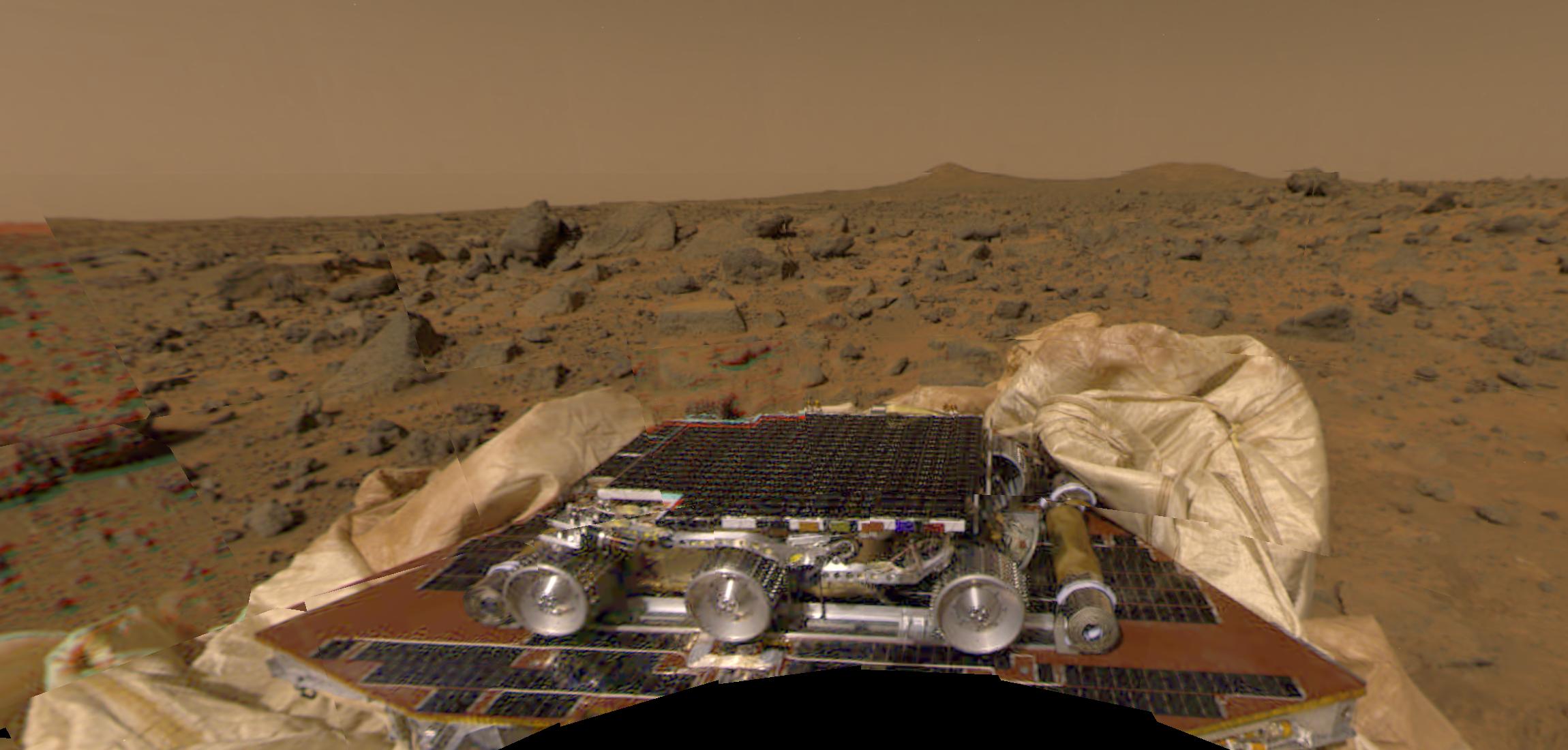
Pathfinder on Mars
2026-07-04
On July 4th, 1997, using its own array of fireworks, a parachute, and a cocoon of airbags, the Mars Pathfinder spacecraft bounced like a giant beach ball at least 15 times before it came to rest on the surface of Mars at 10:07 AM Pacific Daylight Time. After its then novel airbag-assisted landing sequence was completed, Pathfinder transmitted this color mosaic to mission operators on Earth. In the scene from another world, the Mars Sojourner robot rover is visible in the foreground, crouched on top of the unfolded Pathfinder. About the size of a large house cat, the six-wheeled, solar-powered Sojourner became the first successful Martian rover. Surrounding Pathfinder are deflated airbags and the rock-strewn terrain of the Ares Vallis floodplain. In the distance Martian hills appear against a dusty brownish sky. The Pathfinder lander was subsequently renamed the Carl Sagan Memorial Station.
via NASA APOD
Wikidata facts
- Instance of
- near-Earth object
- Parent body
- Sun
- Minor-planet group
- Aten asteroid
- Diameter
- 0.06
- Mass
- 230000000
- Orbital period
- 361.2214279465976
- Image
- 2002AA29.gif
Show 20 more facts
- provisional designation
- 2002 AA29
- Commons category
- 2002 AA29
- orbital inclination
- 10.74823891329897
- Commons gallery
- 2002 AA29
- discoverer or inventor
- Lincoln Near-Earth Asteroid Research
- time of discovery or invention
- 2002-01-09
- orbital eccentricity
- 0.01301769448259856
- mean anomaly
- 298.5698970468795
- argument of periapsis
- 101.7744667328592
- longitude of ascending node
- 106.3483649086126
- absolute magnitude
- 24.1
- rotation period
- 0.55
- surface gravity
- 0.000017
- albedo
- 0.1
- temperature
- 279
- semi-major axis of an orbit
- 0.9926208321195582
- periapsis
- 0.979699197389963
- apoapsis
- 1.005542466849153
- time of periapsis
- 2461062.13852641
- epoch
- November 21, 2025
Sources (2)
via Wikidata · CC0
Article · Deutsch
2002 AA29 ist ein sehr kleiner erdnaher Asteroid, der am 9. Januar 2002 durch die automatische Himmelsüberwachung LINEAR (Lincoln Near Earth Asteroid Research) entdeckt wurde. Der Durchmesser des Asteroiden beträgt nur zirka 50 bis 110 Meter. Er umkreist die Sonne auf einer der Erdbahn sehr ähnlichen, fast kreisförmigen Umlaufbahn. Sie verläuft zum größten Teil innerhalb der Erdumlaufbahn und kreuzt diese im sonnenfernsten Punkt des Asteroiden, dem Aphel. Er wird wegen dieser Umlaufbahn nach dem namensgebenden Asteroiden Aten als Aten-Typ klassifiziert. Eine weitere Besonderheit ist, dass seine mittlere Umlaufdauer um die Sonne exakt einem siderischen Jahr entspricht. Das bedeutet, dass er in Wechselwirkung mit der Erde steht, da eine solche Umlaufbahn nur unter bestimmten Voraussetzungen stabil ist. Bislang sind erst wenige derartige, in 1:1-Bahnresonanz mit der Erde wechselwirkende Asteroiden bekannt. Der erste war der 1986 entdeckte (3753) Cruithne. Asteroiden, die in 1:1-Resonanz mit einem Planeten stehen, werden auch koorbitale Objekte genannt, da sie der Bahn des Planeten folgen. 2002 AA29 gehört jedoch nicht zu den Trojanern, die die bekanntesten koorbitalen Asteroiden sind und sich in den Lagrangepunkten L4 und L5 des jeweiligen Planeten aufhalten. Er befindet sich vielmehr auf einer sogenannten Hufeisenumlaufbahn entlang der Erdbahn.
Abstract from DBpedia / Wikipedia · CC BY-SA