
Image by chriscastagneri on Pixabay · Pixabay License
Picture of the Day · NASA
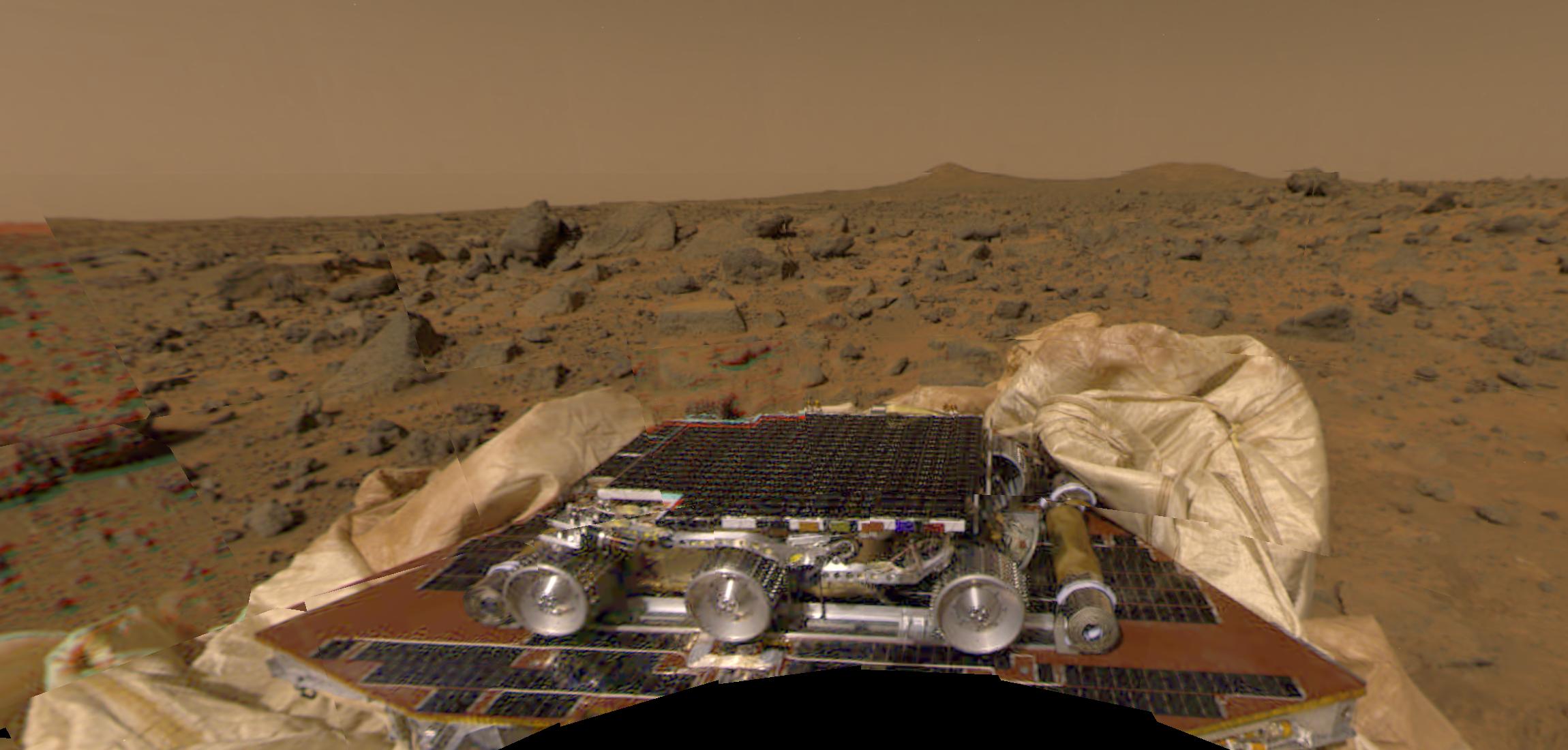
Pathfinder on Mars
2026-07-04
On July 4th, 1997, using its own array of fireworks, a parachute, and a cocoon of airbags, the Mars Pathfinder spacecraft bounced like a giant beach ball at least 15 times before it came to rest on the surface of Mars at 10:07 AM Pacific Daylight Time. After its then novel airbag-assisted landing sequence was completed, Pathfinder transmitted this color mosaic to mission operators on Earth. In the scene from another world, the Mars Sojourner robot rover is visible in the foreground, crouched on top of the unfolded Pathfinder. About the size of a large house cat, the six-wheeled, solar-powered Sojourner became the first successful Martian rover. Surrounding Pathfinder are deflated airbags and the rock-strewn terrain of the Ares Vallis floodplain. In the distance Martian hills appear against a dusty brownish sky. The Pathfinder lander was subsequently renamed the Carl Sagan Memorial Station.
via NASA APOD
Wikidata facts
- Instance of
- near-Earth object
- Parent body
- Sun
- Minor-planet group
- Apollo asteroid
- Orbital period
- 894.0765770864784
Show 13 more facts
- orbital inclination
- 1.047106433322256
- discoverer or inventor
- MIT Lincoln Laboratory
- time of discovery or invention
- 2002-06-17
- orbital eccentricity
- 0.4995261267908903
- absolute magnitude
- 23.7
- semi-major axis of an orbit
- 1.816285825648254
- periapsis
- 0.9090036020169877
- apoapsis
- 2.723568049279521
- longitude of ascending node
- 85.29139444921415
- argument of periapsis
- 131.5994411736643
- mean anomaly
- 224.0599809587702
- time of periapsis
- 2461338.113296982
- epoch
- November 21, 2025
Sources (2)
via Wikidata · CC0
Article · Italiano
2002 MN è la designazione data all'asteroide di 73 m che il 14 giugno 2002 transitò a soli 120000 km dalla Terra, circa un terzo della distanza del pianeta stesso dalla Luna, diventando uno degli asteroidi di passaggio ad essersi più avvicinato al pianeta, similmente a 1994 XM1, che passò a soli 100000 km di distanza dall'atmosfera terrestre e, per dimensioni, il maggiore tra quelli transitati a meno di 1 distanza lunare. 2002 MN è stato scoperto solo tre giorni dopo il suo massimo avvicinamento, il 17 giugno 2002, la sua massa e velocità relativa erano nella stessa gamma generale dell'oggetto attribuito all'evento di Tunguska del 1908, che rase al suolo oltre 2100 km² di vegetazione in Siberia. L'asteroide ha un arco di osservazione di 53 giorni con un parametro di incertezza pari a 6. C'è un cumulativo di 1 su 50.000 possibilità che l'asteroide possa avere un impatto sulla Terra verso il 2100, in particolare per il 16 giugno dello stesso anno.
Abstract from DBpedia / Wikipedia · CC BY-SA
Gallery (2)
Available in 9 languages
via Wikidata sitelinks · CC0