
Picture of the Day · NASA
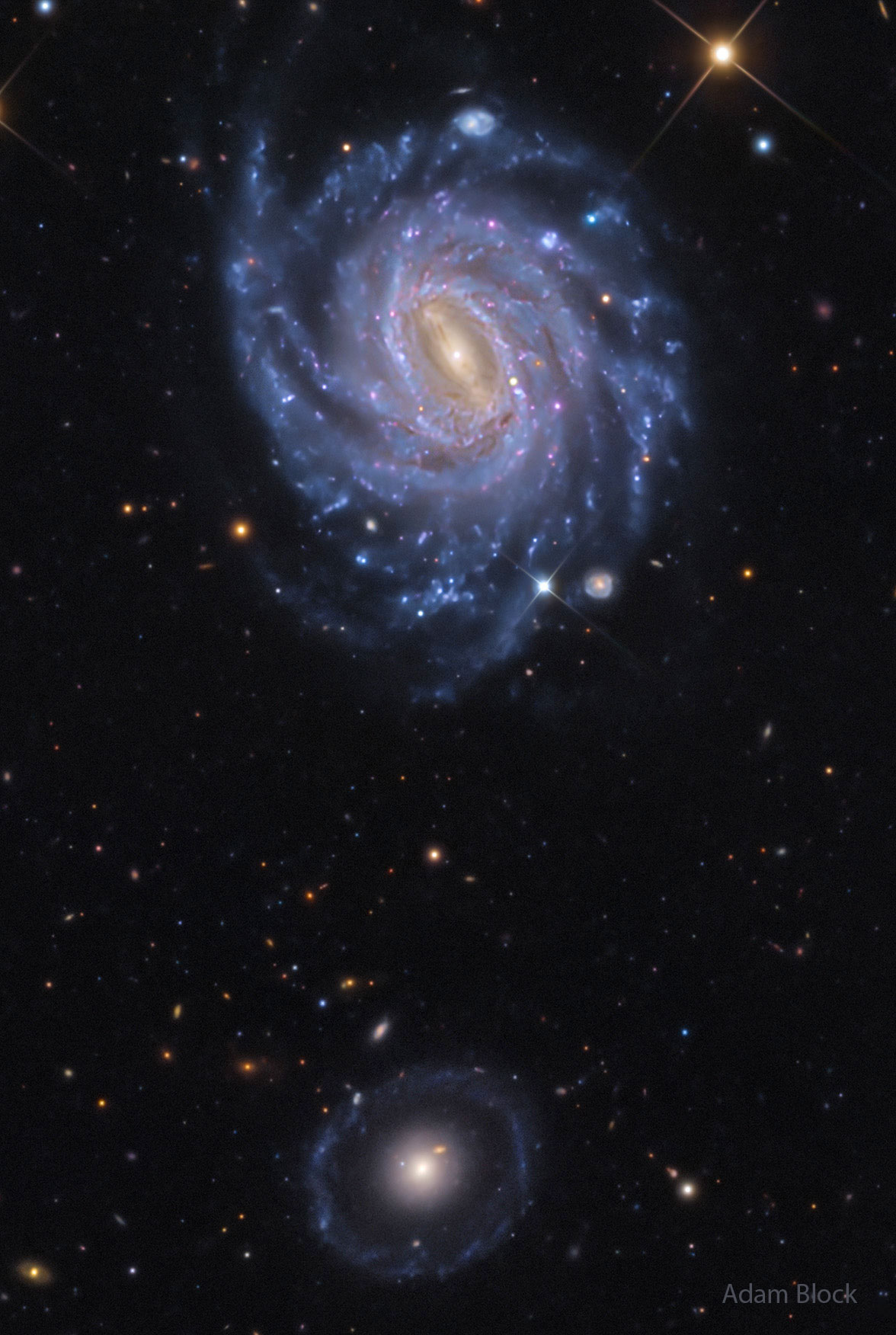
NGC 3660 and Burçin's Galaxy
2026-05-26
The upper galaxy might be more photogenic, but the lower galaxy is more unusual. The galaxy up top is NGC 3660, a spiral galaxy similar to our own Milky Way galaxy in that it has several bright blue spiral arms and a central bar of stars, dust, and gas. Captured by chance in the featured deep and colorful image, surprisingly, is SN 2026cff, a supernova found just to the right of the central bar. Farther in the distance is the bottom galaxy, known informally as Burçin’s galaxy, but formally cataloged as LEDA 1000714. The center of this galaxy appears to be an old elliptical galaxy, but it is strangely surrounded by not one but two rings of stars. What created Burçin's galaxy is a mystery and remains a continuing topic of research, but it likely involves the accretion of one or more smaller galaxies.
via NASA APOD
Article · Italiano
306367 Nut è un asteroide Apollo. Scoperto nel 1960, presenta un'orbita caratterizzata da un semiasse maggiore pari a 2,5318090 au e da un'eccentricità di 0,7426888, inclinata di 3,77253° rispetto all'eclittica. Dal 6 aprile al 3 luglio 2012, quando 322390 Planes de Son ricevette la denominazione ufficiale, è stato l'asteroide denominato con il più alto numero ordinale. Prima della sua denominazione, il primato era di 305660 Romyhaag. L'asteroide è dedicato all'omonima dea della mitologia egizia.
Abstract from DBpedia / Wikipedia · CC BY-SA
Gallery (2)
Available in 11 languages
via Wikidata sitelinks · CC0