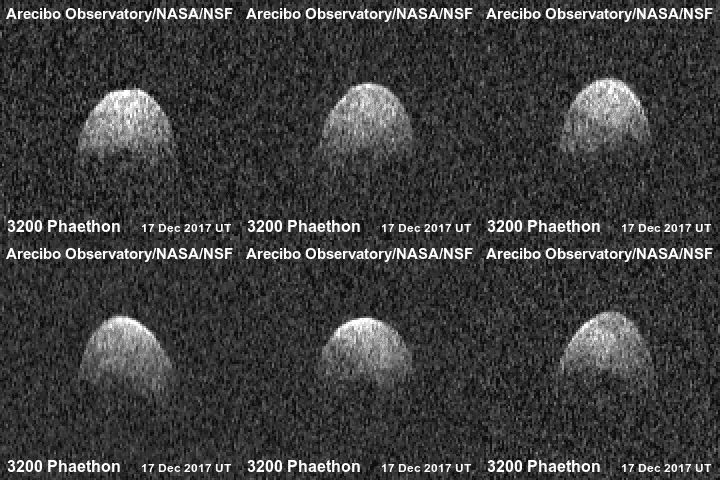
File:PIA22185.gif · Wikimedia Commons · See Wikimedia Commons
3200 Phaethon
Sign in to saveAlso known as 1983 TB, Phaethon
Apollo asteroid notable for its very small perihelion and for being the progenitor of the Geminid meteor shower
Key facts
- Discovered by
- Simon Green John K. Davies / IRAS
- Discovery date
- October 11, 1983
- Pronunciation
- / ˈ f eɪ . ə θ ɒ n /
- Named after
- Phaëthon
- Alternative designations
- 1983 TB
- Minor planet category
- Apollo asteroid Potentially hazardous asteroid Mercury-crosser asteroid Venus-crosser asteroid Earth-crosser asteroid Mars-crosser asteroid
- Adjectives
- Phaethonian / f eɪ ə ˈ θ oʊ n i ə n /
- Observation arc
- 12,941 days (35.43 yr)
- Aphelion
- 2.4028 AU (359 million km )
- Perihelion
- 0.13998 AU (20.9 million km)
- Semi major axis
- 1.2714 AU (190 million km)
- Orbital period sidereal
- 523.6 days (1.434 yr)
- Average orbital speed
- 19.9 km/s (45,000 mph)
- Mean anomaly
- 313.94°
- Mean motion
- 0° 41 15.108 / day
- Inclination
- 22.260°
- Longitude of ascending node
- 265.22°
- Time of perihelion
- May 15, 2022
via Wikipedia infobox
Wikidata facts
- Instance of
- near-Earth asteroid
- Named after
- Phaethon
- Followed by
- 3201 Sijthoff
- Follows
- 3199 Nefertiti
- Parent body
- Sun
- Child body
- Geminids
- Minor-planet group
- asteroid belt
- Diameter
- 6.25
- Orbital period
- 523.6236739942816
- Image
- Asteroid Phaethon 25dec2010 stack.jpg
Show 19 more facts
- discoverer or inventor
- IRAS
- provisional designation
- 1983 TB
- time of discovery or invention
- 1983-10-11
- orbital eccentricity
- 0.8897184635457245
- orbital inclination
- 22.31263747259711
- Commons category
- 3200 Phaethon
- site of astronomical discovery
- IRAS
- absolute magnitude
- 14.39
- mean anomaly
- 163.9750967783587
- longitude of ascending node
- 265.0955719893683
- argument of periapsis
- 322.3065124633594
- periapsis
- 0.1402114151284196
- apoapsis
- 2.402578967313405
- semi-major axis of an orbit
- 1.271395191220912
- albedo
- 0.1066
- rotation period
- 3.604
- asteroid spectral type
- F-type asteroid
- time of periapsis
- 2460761.9965482815
- epoch
- November 21, 2025
Sources (2)
via Wikidata · CC0
~9 min read
Encyclopedic overview
3200 Phaethon (/ˈfeɪ.əˌθɒn/; previously sometimes spelled Phæton), provisionally designated 1983 TB, is an active Apollo asteroid with an orbit that brings it closer to the Sun than any other named asteroid (though there are numerous unnamed asteroids with smaller perihelia, such as (137924) 2000 BD19). For this reason, it was named after the Greek Hero, Phaëthon, son of the sun god Helios. It is 5.8 km (3.6 mi) in diameter and is the parent body of the Geminids meteor shower of mid-December. With an observation arc of 35+ years, it has a very well determined orbit. The 2017 Earth approach distance of about 10 million km was known with an accuracy of ±700 m.
Discovery
Excerpted from Wikipedia’s “3200 Phaethon” article, available under the CC BY-SA 4.0 licence.