
File:423_Diotima.png · Wikimedia Commons · See Wikimedia Commons
OverviewAI-generated
423 Diotima is a C-type asteroid located in the main asteroid belt, orbiting the Sun. It was discovered by Auguste Charlois at the Nice Observatory on December 7, 1896. The object carries the provisional designations A896 XA, 1951 UV, and 1975 LV, and is named after Diotima of Mantinea.
Physically, 423 Diotima has a diameter of 175.859 kilometers and an albedo of 0.067. Its absolute magnitude is 7.38, and it completes a rotation every 4.775 hours. The asteroid’s orbit is characterized by a semi-major axis of 3.066783528161626 AU, an eccentricity of 0.03387291592402812, and an inclination of 11.24258762408431 degrees. Its periapsis is 2.962902627555013 AU, while its apoapsis is 3.17066442876824 AU.
Synthesized by Vinony from 35 facts across 4 sources: Wikidata, NASA, Jpl Sbdb, Vinony graph. Generated from structured data (not the Wikipedia text) and checked against those facts — may still contain errors.
Picture of the Day · NASA
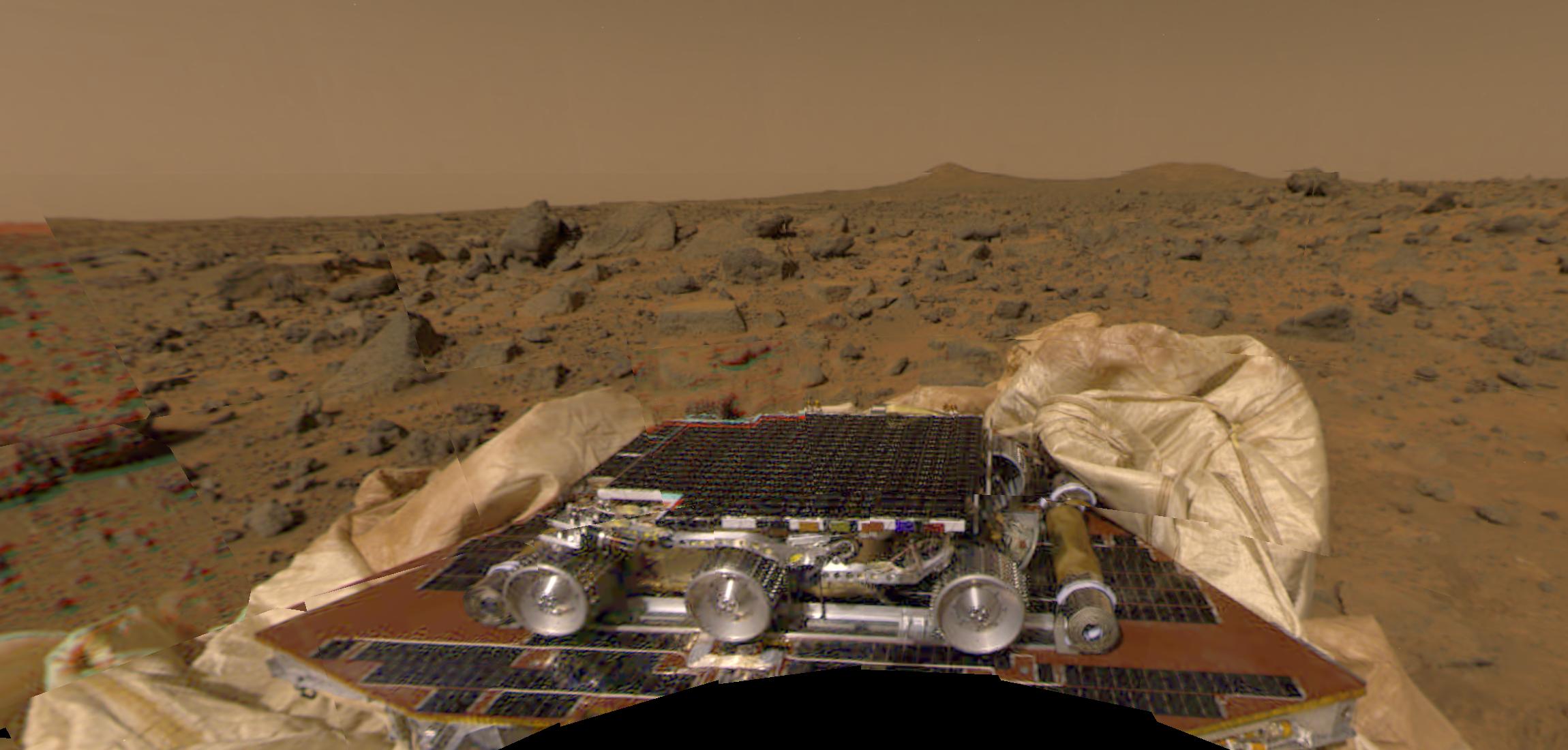
Pathfinder on Mars
2026-07-04
On July 4th, 1997, using its own array of fireworks, a parachute, and a cocoon of airbags, the Mars Pathfinder spacecraft bounced like a giant beach ball at least 15 times before it came to rest on the surface of Mars at 10:07 AM Pacific Daylight Time. After its then novel airbag-assisted landing sequence was completed, Pathfinder transmitted this color mosaic to mission operators on Earth. In the scene from another world, the Mars Sojourner robot rover is visible in the foreground, crouched on top of the unfolded Pathfinder. About the size of a large house cat, the six-wheeled, solar-powered Sojourner became the first successful Martian rover. Surrounding Pathfinder are deflated airbags and the rock-strewn terrain of the Ares Vallis floodplain. In the distance Martian hills appear against a dusty brownish sky. The Pathfinder lander was subsequently renamed the Carl Sagan Memorial Station.
via NASA APOD
Small body data
423 Diotima (A896 XA)
- Orbit class
- Main-belt Asteroid
- Diameter
- 175.859 km
- Albedo
- 0.067
- Rotation period
- 4.775 h
- Absolute magnitude
- 7.380 H
- Earth MOID
- 1.950 AU
- Semi-major axis
- 3.068 AU
- Eccentricity
- 0.033
- Inclination
- 11.239 °
via NASA/JPL Small-Body Database · Minor Planet Center
Key facts
- Discovered by
- Auguste Charlois
- Discovery date
- 7 December 1896
- Pronunciation
- / d aɪ . ə ˈ t aɪ m ə /
- Named after
- Diotima of Mantinea (Διοτίμα Diotīma )
- Alternative designations
- 1896 DB
- Minor planet category
- Main belt
- Adjectives
- Diotimean / d aɪ . ɒ t ə ˈ m iː ə n / , Diotimian / d aɪ . ə ˈ t ɪ m i ə n /
- Observation arc
- 116.96 yr (42719 d)
- Aphelion
- 3.18523 AU (476.504 Gm )
- Perihelion
- 2.95026 AU (441.353 Gm)
- Semi major axis
- 3.06774 AU (458.927 Gm)
- Orbital period sidereal
- 5.37 yr (1962.6 d )
- Mean anomaly
- 237.495 °
- Mean motion
- 0° 11 0.355 / day
- Inclination
- 11.2304°
- Longitude of ascending node
- 69.4710°
- Argument of perihelion
- 200.103°
- Dimensions
- 171 km × 138 km
via Wikipedia infobox
Wikidata facts
- Instance of
- asteroid
- Named after
- Diotima of Mantinea
- Followed by
- 424 Gratia
- Follows
- 422 Berolina
- Parent body
- Sun
- Minor-planet group
- asteroid belt
- Diameter
- 175.859
- Orbital period
- 1961.657169323514
- Image
- 423Diotima (Lightcurve Inversion).png
Show 19 more facts
- discoverer or inventor
- Auguste Charlois
- site of astronomical discovery
- Nice Observatory
- provisional designation
- 1975 LV
- time of discovery or invention
- 1896-12-07
- orbital inclination
- 11.24258762408431
- albedo
- 0.067
- Commons category
- 423 Diotima
- rotation period
- 4.775
- asteroid spectral type
- C-type asteroid
- absolute magnitude
- 7.38
- orbital eccentricity
- 0.03387291592402812
- semi-major axis of an orbit
- 3.066783528161626
- periapsis
- 2.962902627555013
- apoapsis
- 3.17066442876824
- longitude of ascending node
- 69.34900085250402
- argument of periapsis
- 199.0873714069367
- mean anomaly
- 142.0724614957277
- time of periapsis
- 2460226.3403815096
- epoch
- November 21, 2025
Sources (2)
via Wikidata · CC0
~1 min read
Encyclopedic overview
423 Diotima is one of the larger main-belt asteroids. It is classified as a C-type asteroid and is probably composed of primitive carbonaceous material.
It was discovered by Auguste Charlois on 7 December 1896, in Nice. In the late 1990s, a network of astronomers worldwide gathered lightcurve data that was ultimately used to derive the spin states and shape models of 10 new asteroids, including 423 Diotima. The light curve for this asteroid varies "a lot" depending on the position, with the brightness variations ranging from almost zero to up to 0.2 in magnitude. Dunham (2002) used 15 chords and obtained an estimated size of 171 km × 138 km.
Excerpted from Wikipedia’s “423 Diotima” article, available under the CC BY-SA 4.0 licence.