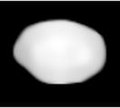
File:45_Eugenia_VLT_(2021),_deconvolved.pdf · Wikimedia Commons · See Wikimedia Commons
45 Eugenia is an asteroid located in the main asteroid belt between Mars and Jupiter. It is notable as one of the larger main-belt asteroids and has been of scientific interest for astronomical study and observation.
AI-generated from the Wikipedia summary — may contain errors.
Picture of the Day · NASA
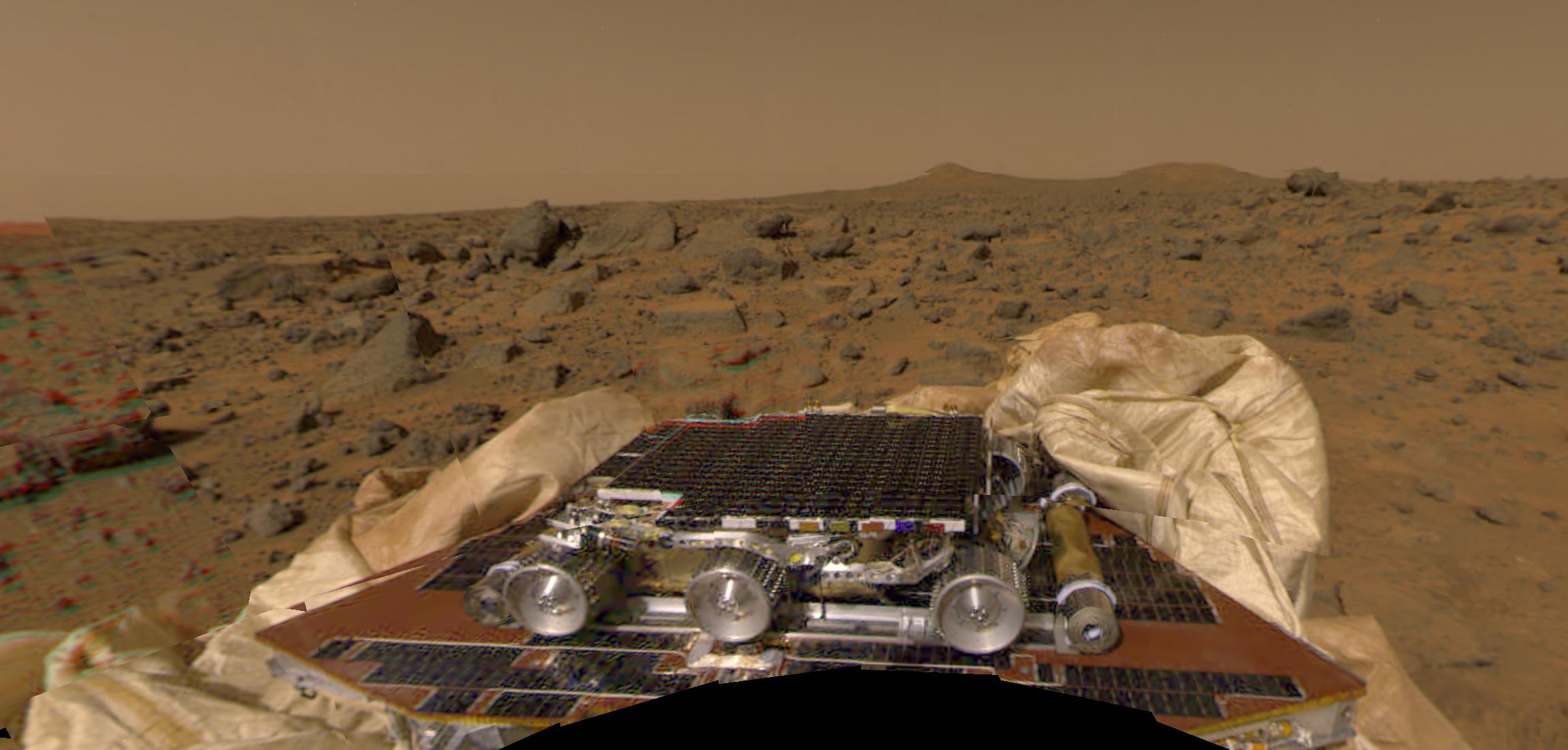
Pathfinder on Mars
2026-07-04
On July 4th, 1997, using its own array of fireworks, a parachute, and a cocoon of airbags, the Mars Pathfinder spacecraft bounced like a giant beach ball at least 15 times before it came to rest on the surface of Mars at 10:07 AM Pacific Daylight Time. After its then novel airbag-assisted landing sequence was completed, Pathfinder transmitted this color mosaic to mission operators on Earth. In the scene from another world, the Mars Sojourner robot rover is visible in the foreground, crouched on top of the unfolded Pathfinder. About the size of a large house cat, the six-wheeled, solar-powered Sojourner became the first successful Martian rover. Surrounding Pathfinder are deflated airbags and the rock-strewn terrain of the Ares Vallis floodplain. In the distance Martian hills appear against a dusty brownish sky. The Pathfinder lander was subsequently renamed the Carl Sagan Memorial Station.
via NASA APOD
Small body data
(45) Eugenia
- Orbit class
- Main-belt
- Semi-major axis
- 2.723 AU
- Eccentricity
- 0.081
- Inclination
- 6.609 °
- Absolute magnitude
- 7.740 H
via Minor Planet Center
Key facts
- Discovered by
- H. Goldschmidt
- Discovery date
- 27 June 1857
- Pronunciation
- / j uː ˈ dʒ iː n i ə /
- Named after
- Empress Eugénie
- Alternative designations
- 1941 BN
- Minor planet category
- Main belt
- Adjectives
- Eugenian
- Aphelion
- 440.305 million km (2.943 AU)
- Perihelion
- 373.488 million km (2.497 AU)
- Semi major axis
- 406.897 million km (2.720 AU )
- Orbital period sidereal
- 1,638.462 d (4.49 a )
- Mean anomaly
- 45.254°
- Inclination
- 6.610°
- Longitude of ascending node
- 147.939°
- Argument of perihelion
- 85.137°
- Known satellites
- Petit-Prince , S/2004 (45) 1
- Dimensions
- 232 × 193 × 161 km , 305 × 220 × 145 km
- Mean radius
- 94 ± 1 km , 107.3 ± 2.1 km
via Wikipedia infobox
Wikidata facts
- Instance of
- asteroid
- Named after
- Eugénie de Montijo
- Followed by
- 46 Hestia
- Follows
- 44 Nysa
- Parent body
- Sun
- Minor-planet group
- asteroid belt
- Diameter
- 202.327
- Mass
- 5.69
- Orbital period
- 1639.950122778466
- Image
- 45 Eugenia VLT (2021), deconvolved.pdf
Show 19 more facts
- discoverer or inventor
- Hermann Goldschmidt
- provisional designation
- A857 MA
- time of discovery or invention
- 1857-06-27
- site of astronomical discovery
- Paris Observatory, PSL University
- albedo
- 0.045
- Commons category
- 45 Eugenia
- rotation period
- 5.699
- asteroid spectral type
- C-type asteroid
- absolute magnitude
- 7.77
- orbital eccentricity
- 0.08217242216777412
- semi-major axis of an orbit
- 2.721582321239637
- periapsis
- 2.497943309774383
- apoapsis
- 2.945221332704891
- orbital inclination
- 6.60563730913436
- longitude of ascending node
- 147.5550150459778
- argument of periapsis
- 87.29357605845786
- mean anomaly
- 206.5522386956124
- time of periapsis
- 2461699.5185416425
- epoch
- November 21, 2025
Sources (2)
via Wikidata · CC0
Article · Italiano
45 Eugenia è un grande asteroide della Fascia principale, con un diametro di 214 km. È conosciuto come uno dei primi asteroidi per i quali sia stato individuato un satellite naturale in orbita attorno ad essi. È stato il secondo asteroide per cui si è accertato che fosse un sistema triplo. Eugenia fu scoperto il 27 giugno 1857 da Hermann Mayer Salomon Goldschmidt all'Osservatorio astronomico di Parigi. Goldschmidt stesso lo battezzò così in onore dell'Imperatrice Eugenia de Montijo, moglie di Napoleone III, e fu il primo asteroide ad essere chiamato con il nome di una persona realmente esistente, piuttosto che una figura delle leggende classiche (anche se la coincidenza del nome del pianetino 12 Victoria con quello della Regina Vittoria allora regnante, scatenò una controversia, alimentata da chi sostenne che in realtà il nome non fosse riferito alla figura mitologica, ma alla sovrana). Eugenia è un asteroide di tipo F, ciò significa che è di colore molto scuro (nero come la fuliggine) con una composizione carboniosa. Come 253 Mathilde, la sua densità sembra essere stranamente bassa; potrebbe quindi trattarsi di un cumulo di pietrisco altamente poroso e non di un oggetto monolitico. Nel 1998, gli astronomi del Canada-France-Hawaii Telescope a Mauna Kea, Hawaii, scoprirono una piccola luna orbitante attorno a Eugenia. IAUC 7503 Il nuovo satellite fu chiamato (45 Eugenia I, S/1998 (45) 1), in onore del figlio dell'Imperatrice Eugenia, il Principe Imperiale Napoleone Eugenio; è stata la prima luna asteroidale a essere individuata da un telescopio situato al suolo. Petit-Prince è molto più piccolo di Eugenia (circa 13 km di diametro) e impiega cinque giorni per descrivere un'orbita completa intorno ad esso. Nel 2004 dall'analisi delle immagini raccolte dal telescopio Yepun del VLT dell'ESO a Cerro Paranal in Cile, è stato individuato un secondo satellite più piccolo (diametro stimato 6 km) a cui è stato assegnato il nome provvisorio di S/2004 (45) 1
Abstract from DBpedia / Wikipedia · CC BY-SA