Picture of the Day · NASA
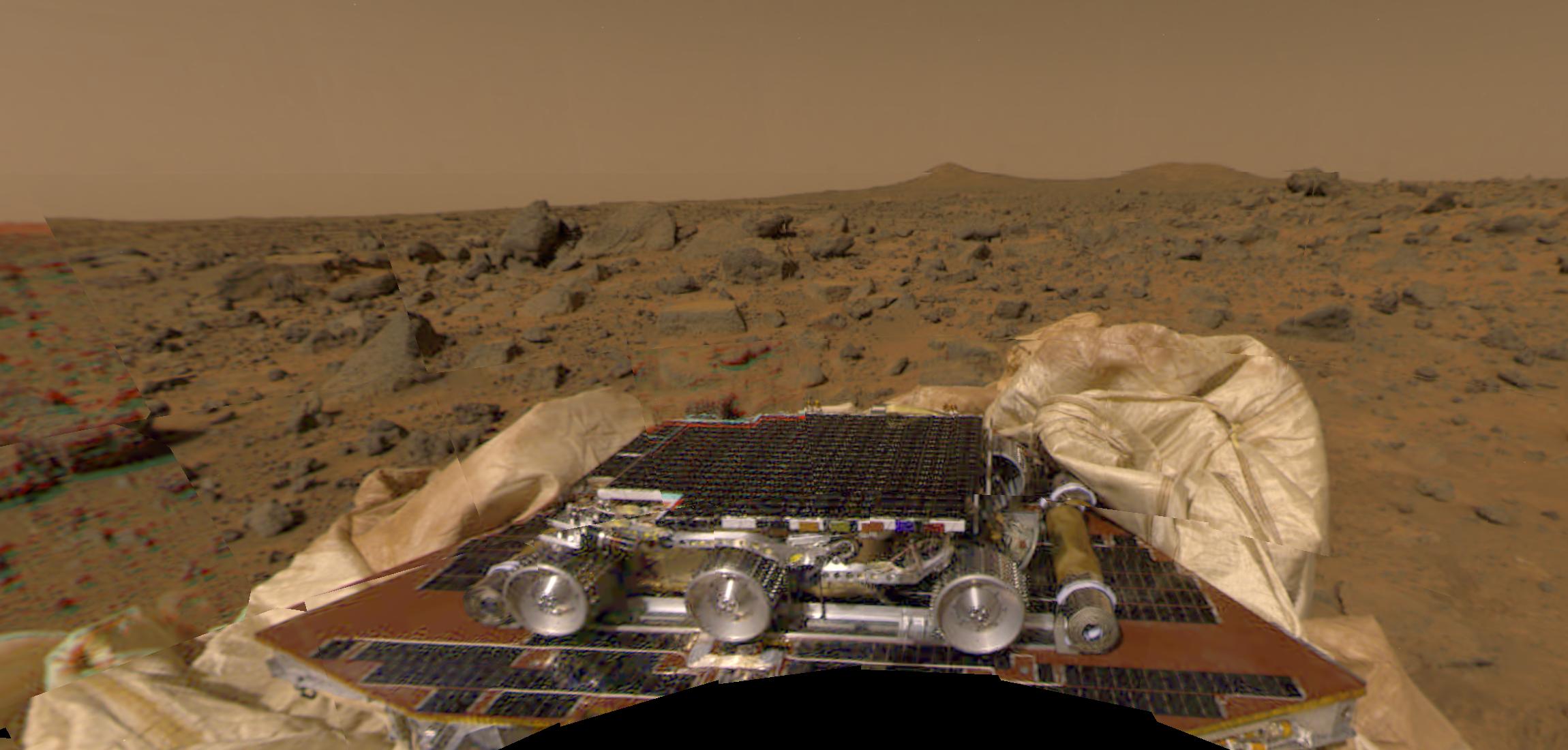
Pathfinder on Mars
2026-07-04
On July 4th, 1997, using its own array of fireworks, a parachute, and a cocoon of airbags, the Mars Pathfinder spacecraft bounced like a giant beach ball at least 15 times before it came to rest on the surface of Mars at 10:07 AM Pacific Daylight Time. After its then novel airbag-assisted landing sequence was completed, Pathfinder transmitted this color mosaic to mission operators on Earth. In the scene from another world, the Mars Sojourner robot rover is visible in the foreground, crouched on top of the unfolded Pathfinder. About the size of a large house cat, the six-wheeled, solar-powered Sojourner became the first successful Martian rover. Surrounding Pathfinder are deflated airbags and the rock-strewn terrain of the Ares Vallis floodplain. In the distance Martian hills appear against a dusty brownish sky. The Pathfinder lander was subsequently renamed the Carl Sagan Memorial Station.
via NASA APOD
Wikidata facts
- Diameter
- 28.38
- Orbital period
- 2093.636275268911
Show 15 more facts
- provisional designation
- 1986 TT1
- time of discovery or invention
- 1969-10-15
Article · Deutsch
(6355) Univermoscow ist ein Asteroid des äußeren Hauptgürtels, der von der sowjetischen Astronomin Ljudmila Tschernych am 15. Oktober 1969 am Krim-Observatorium in Nautschnyj (IAU-Code 095) entdeckt wurde. Der mittlere Durchmesser des Asteroiden wurde mit 28,38 (± 1,9) km bestimmt. Er hat eine dunkle Oberfläche mit einer Albedo von 0,066. (6355) Univermoscow ist Namensgeber einer Asteroidenfamilie. Gemeinsam ist den Mitgliedern dieser Familie, dass die Sonnenumlaufbahn der Asteroiden mit mehr als 20° relativ stark gegenüber der Ekliptik des Sonnensystems geneigt ist. Zur Univermoscow-Familie gehören zum Beispiel die Asteroiden , , , , , , , , , , und . (6355) Univermoscow wurde am 6. März 2004 nach der Moskauer Lomonossow-Universität benannt, auch Staatliche Universität Moskau genannt, der größten Hochschule Russlands.
Abstract from DBpedia / Wikipedia · CC BY-SA