
File:773_Irmintraud_preliminary_spectrum.JPG · Wikimedia Commons · See Wikimedia Commons
OverviewAI-generated
773 Irmintraud is an asteroid located in the asteroid belt, orbiting the Sun. It was discovered on December 22, 1913, by Franz Kaiser at the Heidelberg-Königstuhl State Observatory. The object carries the provisional designations 1913 TV, 1946 SO, A910 CG, and A913 YF. It is classified as both a D-type and T-type asteroid.
The asteroid has a diameter of 91.672 km and an albedo of 0.048. Its absolute magnitude is 9.13, and it completes a rotation every 6.7514 hours. Orbital parameters include a semi-major axis of 2.859995945422819 AU, an eccentricity of 0.07912150326562387, and an inclination of 16.69156001036437 degrees. The periapsis is 2.633708766887377 AU, while the apoapsis is 3.086283123958262 AU.
Synthesized by Vinony from 35 facts across 4 sources: Wikidata, NASA, Jpl Sbdb, Vinony graph. Generated from structured data (not the Wikipedia text) and checked against those facts — may still contain errors.
Picture of the Day · NASA
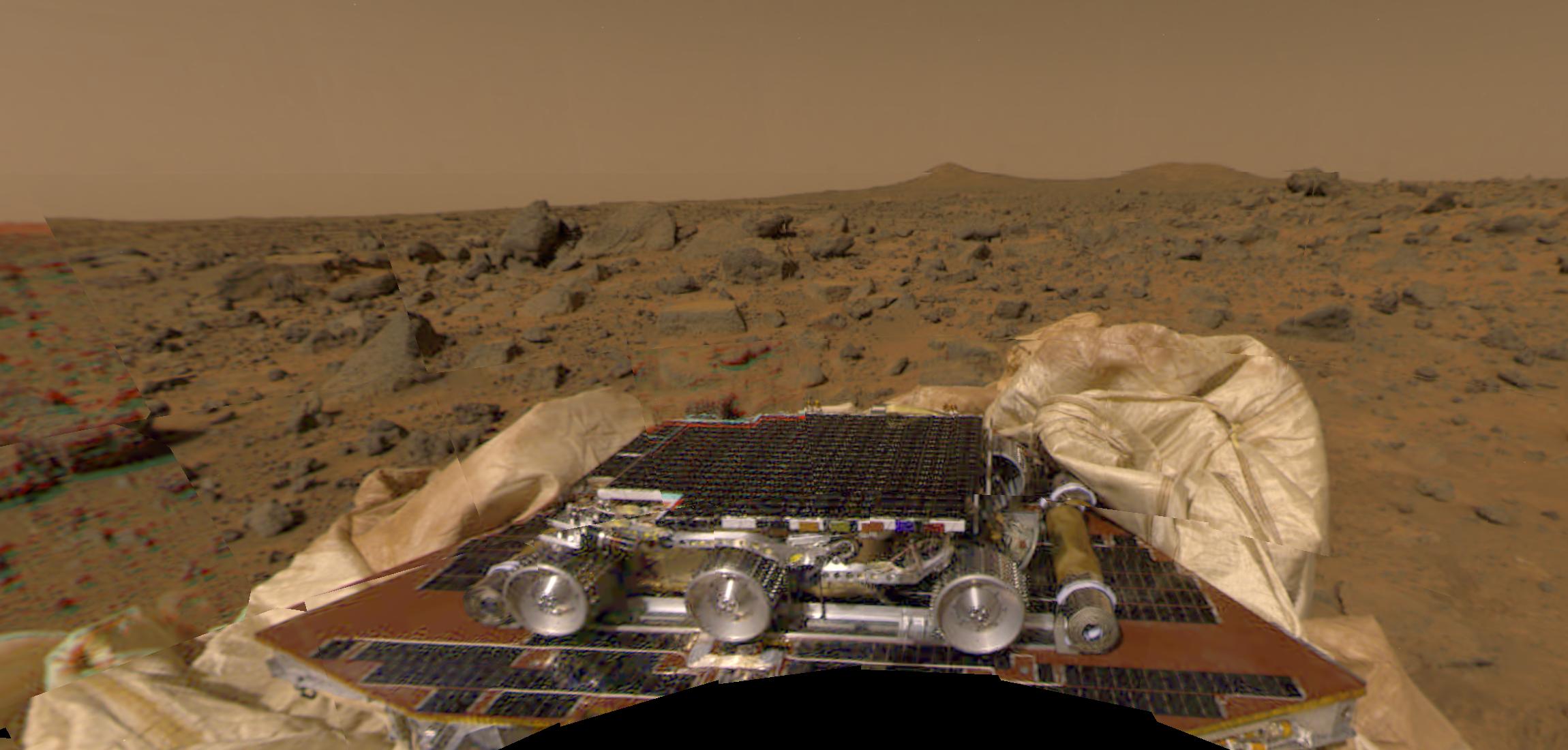
Pathfinder on Mars
2026-07-04
On July 4th, 1997, using its own array of fireworks, a parachute, and a cocoon of airbags, the Mars Pathfinder spacecraft bounced like a giant beach ball at least 15 times before it came to rest on the surface of Mars at 10:07 AM Pacific Daylight Time. After its then novel airbag-assisted landing sequence was completed, Pathfinder transmitted this color mosaic to mission operators on Earth. In the scene from another world, the Mars Sojourner robot rover is visible in the foreground, crouched on top of the unfolded Pathfinder. About the size of a large house cat, the six-wheeled, solar-powered Sojourner became the first successful Martian rover. Surrounding Pathfinder are deflated airbags and the rock-strewn terrain of the Ares Vallis floodplain. In the distance Martian hills appear against a dusty brownish sky. The Pathfinder lander was subsequently renamed the Carl Sagan Memorial Station.
via NASA APOD
Small body data
773 Irmintraud (A913 YF)
- Orbit class
- Main-belt Asteroid
- Diameter
- 91.672 km
- Albedo
- 0.048
- Rotation period
- 6.751 h
- Absolute magnitude
- 9.130 H
- Earth MOID
- 1.620 AU
- Semi-major axis
- 2.858 AU
- Eccentricity
- 0.080
- Inclination
- 16.699 °
via NASA/JPL Small-Body Database · Minor Planet Center
Key facts
- Discovered by
- F. Kaiser
- Discovery site
- Heidelberg Obs.
- Discovery date
- 22 December 1913
- Pronunciation
- German: [ ˈɪʁmɪntʁaʊt ]
- Named after
- Irmtraud , (German given-name)
- Alternative designations
- 1913 TV · 1946 SO, A910 CG
- Minor planet category
- main-belt · (outer)
- Observation arc
- 102.32 yr (37372 d)
- Aphelion
- 3.0876 AU (461.90 Gm )
- Perihelion
- 2.6294 AU (393.35 Gm)
- Semi major axis
- 2.8585 AU (427.63 Gm)
- Orbital period sidereal
- 4.83 yr (1765.2 d )
- Mean anomaly
- 220.21 °
- Mean motion
- 0° 12 14.184 / day
- Inclination
- 16.684°
- Longitude of ascending node
- 322.41°
- Argument of perihelion
- 331.91°
- Earth moid
- 1.62349 AU (242.871 Gm)
via Wikipedia infobox
Wikidata facts
- Instance of
- asteroid
- Followed by
- 774 Armor
- Follows
- 772 Tanete
- Parent body
- Sun
- Minor-planet group
- asteroid belt
- Diameter
- 91.672
- Orbital period
- 1766.633872144535
Show 19 more facts
- discoverer or inventor
- Franz Kaiser
- site of astronomical discovery
- Heidelberg-Königstuhl State Observatory
- provisional designation
- A913 YF
- time of discovery or invention
- 1913-12-22
- orbital inclination
- 16.69156001036437
- Commons category
- 773 Irmintraud
- albedo
- 0.048
- rotation period
- 6.7514
- asteroid spectral type
- T-type asteroid
- absolute magnitude
- 9.13
- orbital eccentricity
- 0.07912150326562387
- semi-major axis of an orbit
- 2.859995945422819
- periapsis
- 2.633708766887377
- apoapsis
- 3.086283123958262
- longitude of ascending node
- 322.0947491247121
- argument of periapsis
- 335.0596922368339
- mean anomaly
- 190.3817916555691
- time of periapsis
- 2461832.870200538
- epoch
- November 21, 2025
Sources (2)
via Wikidata · CC0
~5 min read
Encyclopedic overview
773 Irmintraud, provisional designation 1913 TV, is a dark and reddish, rare-type asteroid from the outer region of the asteroid belt, about 92 kilometers in diameter. It was discovered on 22 December 1913, by German astronomer Franz Kaiser at Heidelberg Observatory in southern Germany.
The asteroid is classified as a D-type and T-type body in the Tholen and SMASS taxonomy, respectively. The rare spectral T-type is similar to D-types which are often found among Jupiter trojans thought to have originated from the Kuiper belt. It orbits the Sun at a distance of 2.6–3.1 AU once every 4 years and 10 months (1,763 days). Its orbit is tilted by 17 degrees to the plane of the ecliptic and shows a low eccentricity of 0.08. According to the surveys carried out by the Infrared Astronomical Satellite, IRAS, the Japanese Akari satellite, and the Wide-field Infrared Survey Explorer with its subsequent NEOWISE mission, the minor planet's low albedo lies in the range of 0.04–0.05. It has a well-defined rotation period of 6.75 hours, determined by several concurring observations.
Excerpted from Wikipedia’s “773 Irmintraud” article, available under the CC BY-SA 4.0 licence.