
Image by 1319631 on Pixabay · Pixabay License
In the Vinony graph
Vinony's link graph records 9 inbound references to 934 Thüringia, and connects out to asteroid family, Paul Herget and asteroid belt.
It is catalogued under topics including Astronomical objects discovered in 1920, Background asteroids and Ch-type asteroids (SMASS).
Vinony links it to 40 Wikipedia language editions.
Picture of the Day · NASA
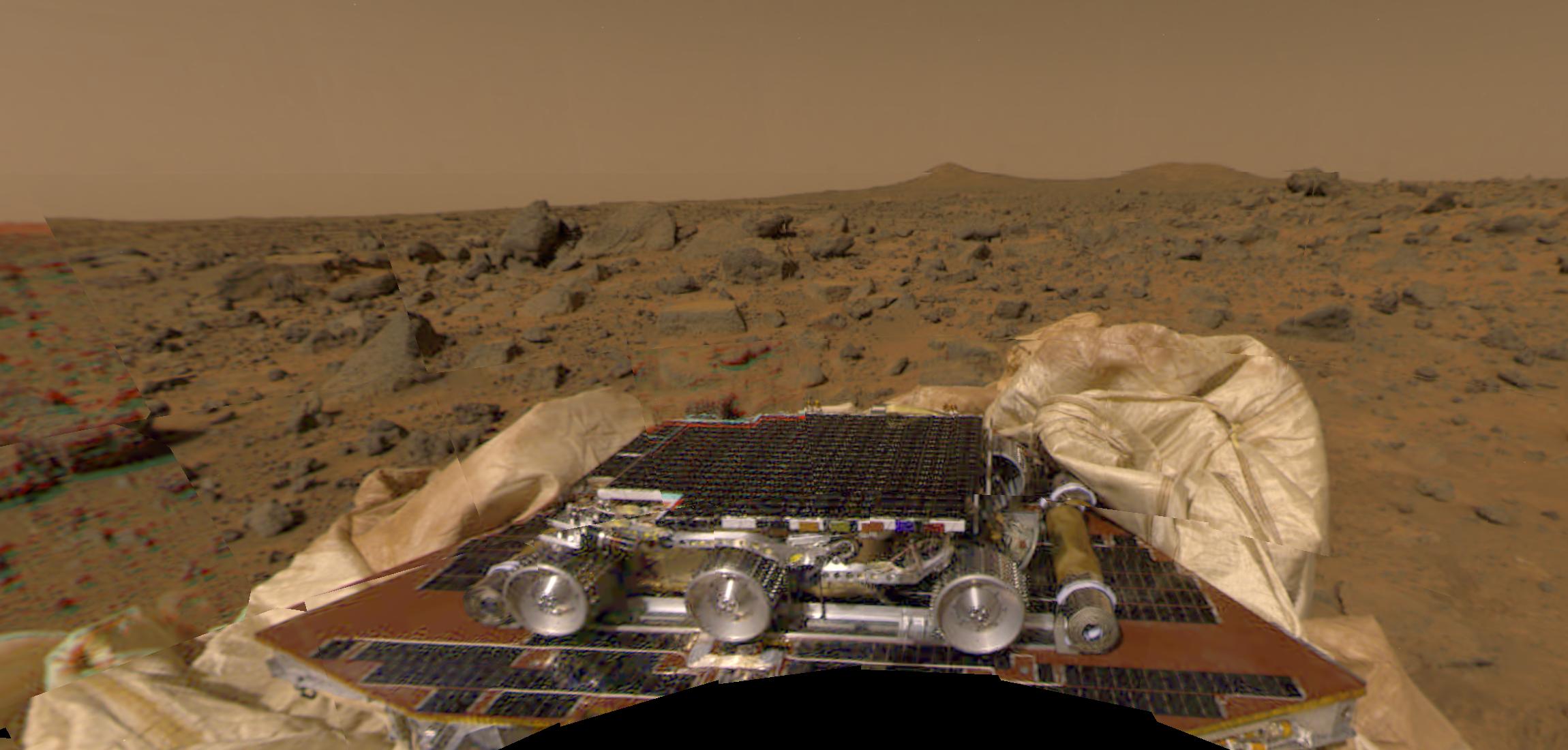
Pathfinder on Mars
2026-07-04
On July 4th, 1997, using its own array of fireworks, a parachute, and a cocoon of airbags, the Mars Pathfinder spacecraft bounced like a giant beach ball at least 15 times before it came to rest on the surface of Mars at 10:07 AM Pacific Daylight Time. After its then novel airbag-assisted landing sequence was completed, Pathfinder transmitted this color mosaic to mission operators on Earth. In the scene from another world, the Mars Sojourner robot rover is visible in the foreground, crouched on top of the unfolded Pathfinder. About the size of a large house cat, the six-wheeled, solar-powered Sojourner became the first successful Martian rover. Surrounding Pathfinder are deflated airbags and the rock-strewn terrain of the Ares Vallis floodplain. In the distance Martian hills appear against a dusty brownish sky. The Pathfinder lander was subsequently renamed the Carl Sagan Memorial Station.
via NASA APOD
Key facts
- Discovered by
- W. Baade
- Discovery site
- Bergedorf Obs.
- Discovery date
- 15 August 1920
- Pronunciation
- / θ ɜː ˈ r ɪ n dʒ i ə /
- Named after
- Thuringia SS Thuringia (German state and ship)
- Alternative designations
- A920 PA · 1920 HK, 1952 OP · 1974 HP 3
- Minor planet category
- main-belt · ( middle ) background
- Observation arc
- 98.68 yr (36,042 d)
- Aphelion
- 3.3473 AU
- Perihelion
- 2.1546 AU
- Semi major axis
- 2.7509 AU
- Orbital period sidereal
- 4.56 yr (1,667 d)
- Mean anomaly
- 273.96 °
- Mean motion
- 0° 12 57.6 / day
- Inclination
- 14.076°
- Longitude of ascending node
- 325.40°
- Argument of perihelion
- 64.133°
- Mean diameter
- 53.35 ± 5.2 km 53.714 ± 0.361 km 58.00 ± 0.70 km
via Wikipedia infobox
Wikidata facts
- Instance of
- asteroid
- Followed by
- 935 Clivia
- Follows
- 933 Susi
- Parent body
- Sun
- Minor-planet group
- asteroid belt
- Diameter
- 53.714
- Orbital period
- 1664.790722577752
- Image
- 000934-asteroid shape model (934) Thüringia.png
Show 19 more facts
- discoverer or inventor
- Walter Baade
- site of astronomical discovery
- Hamburg-Bergedorf Observatory
- provisional designation
- A920 PA
- time of discovery or invention
- 1920-08-15
- orbital inclination
- 14.08160736510782
- Commons category
- 934 Thüringia
- albedo
- 0.047
- rotation period
- 8.166
- asteroid spectral type
- C-type asteroid
- absolute magnitude
- 10.19
- orbital eccentricity
- 0.2156589942694322
- semi-major axis of an orbit
- 2.748996245879011
- periapsis
- 2.156150480242299
- apoapsis
- 3.341842011515724
- longitude of ascending node
- 325.3452058406288
- argument of periapsis
- 64.58037671300335
- mean anomaly
- 345.7775270116999
- time of periapsis
- 2461066.270669675
- epoch
- November 21, 2025
Sources (2)
via Wikidata · CC0
Article · Polski
(934) Thüringia – planetoida z pasa głównego asteroid okrążająca Słońce w ciągu 4 lat i 204 dni w średniej odległości 2,75 au. Została odkryta 15 sierpnia 1920 roku w Hamburg-Bergedorf Observatory w Bergedorfie przez Waltera Baade. Nazwa planetoidy pochodzi od transatlantyku Thüringia, którym z wizytą do Nowego Jorku płynął odkrywca. Kapitan transatlantyku był amatorem astronomem i prosił Waltera Baade o nazwę planetoidy. Nazwa transatlantyku pochodzi od Turyngii, krainy w Niemczech. Przed nadaniem nazwy planetoida nosiła oznaczenie tymczasowe (934) 1920 HK.
Abstract from DBpedia / Wikipedia · CC BY-SA