946 Poësia
Also known as (946) Poësia, Poësia
main-belt asteroid
Picture of the Day · NASA
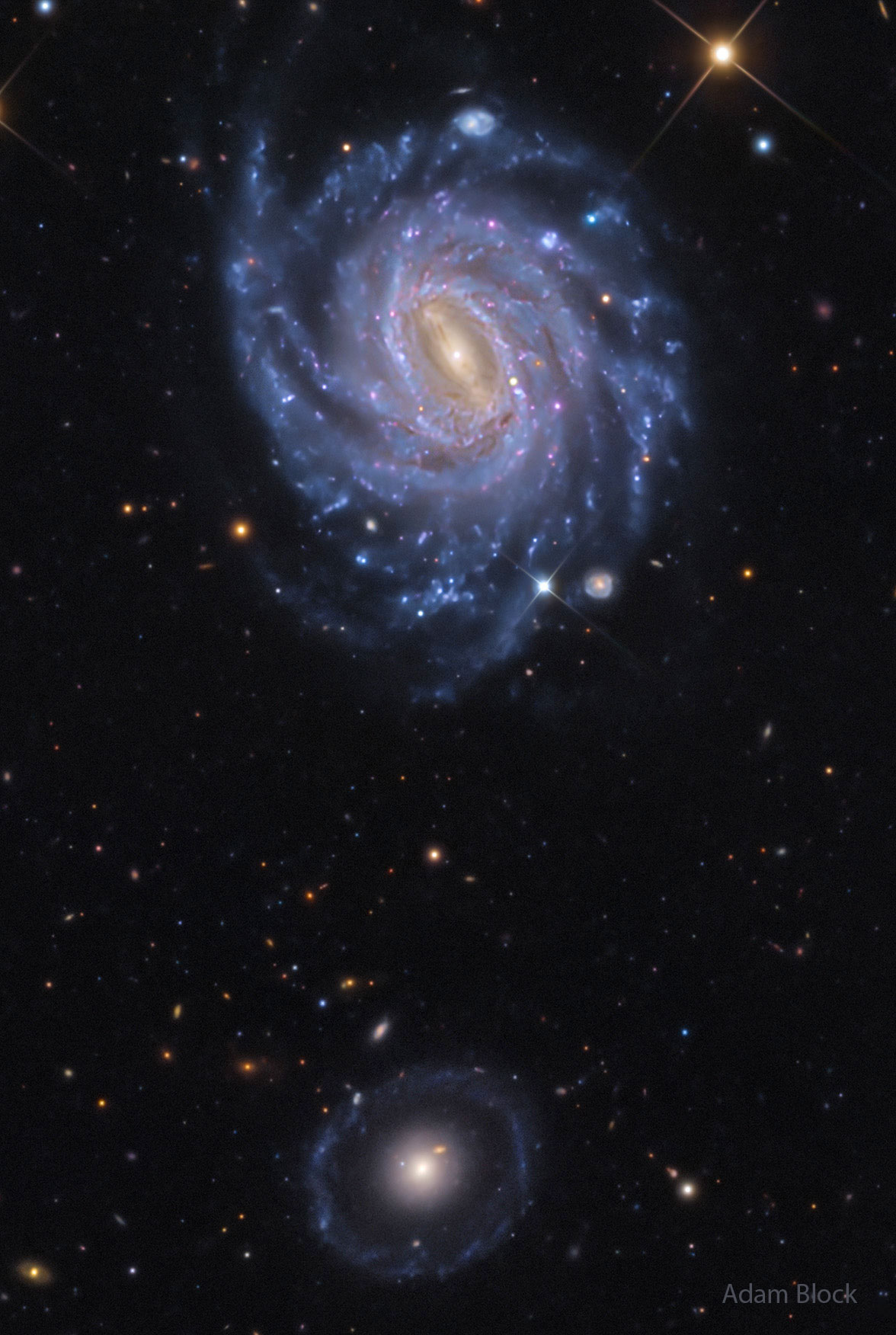
NGC 3660 and Burçin's Galaxy
2026-05-26
The upper galaxy might be more photogenic, but the lower galaxy is more unusual. The galaxy up top is NGC 3660, a spiral galaxy similar to our own Milky Way galaxy in that it has several bright blue spiral arms and a central bar of stars, dust, and gas. Captured by chance in the featured deep and colorful image, surprisingly, is SN 2026cff, a supernova found just to the right of the central bar. Farther in the distance is the bottom galaxy, known informally as Burçin’s galaxy, but formally cataloged as LEDA 1000714. The center of this galaxy appears to be an old elliptical galaxy, but it is strangely surrounded by not one but two rings of stars. What created Burçin's galaxy is a mystery and remains a continuing topic of research, but it likely involves the accretion of one or more smaller galaxies.
via NASA APOD
Key facts
- Discovered by
- M. F. Wolf
- Discovery site
- Heidelberg Obs.
- Discovery date
- 11 February 1921
- Pronunciation
- / p oʊ ˈ iː s i ə /
- Named after
- poetry , (goddess of poetry)
- Alternative designations
Article
946 Poësia /poʊˈiːsiə/ is a Themis asteroid and slow rotator, approximately 39 kilometers (24 miles) in diameter, located in the outer regions of the asteroid belt. It was discovered by German astronomer Max Wolf at the Heidelberg-Königstuhl State Observatory on 11 February 1921 and given the provisional designations A921 CD and 1921 JC. The F-type asteroid has a long rotation period of 108.5 hours. It was named after the goddess of poetry.
Orbit and classification