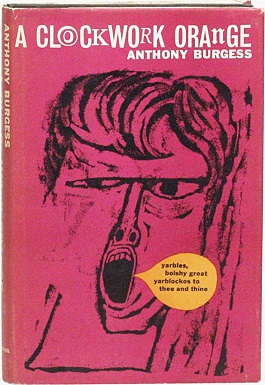
File:Clockwork_orange.jpg · Wikimedia Commons · See Wikimedia Commons
"A Clockwork Orange" is a 1962 novel by Anthony Burgess about a violent young man in a dystopian future. It remains significant for its controversial exploration of free will, morality, and whether society can or should forcibly reform violent criminals.
AI-generated from the Wikipedia summary — may contain errors.
Key facts
- Author
- Anthony Burgess
- Cover artist
- Barry Trengove
- Language
- English
- Genre
- Science fiction , dystopian fiction , satire , black comedy
- Published
- 17 March 1962 ( William Heinemann , UK)
- Publication place
- United Kingdom
- Media type
- Print ( hardback & paperback ) & audio book ( cassette , CD )
- Pages
- 192 pages (hardback edition), 176 pages (paperback edition)
- Isbn
- 978-0-434-09800-2
via Wikipedia infobox
Wikidata facts
- Instance of
- literary work
- Author
- Anthony Burgess
- Country of origin
- United Kingdom
- Publisher
- Heinemann
- Main subject
- free will
- Narrative location
- England
- Distribution format
- video on demand
Show 11 more facts
- topic's main category
- Category:A Clockwork Orange
- language of work or name
- Nadsat
- Commons category
- A Clockwork Orange
- publication date
- 1962-01-01
- title
- A Clockwork Orange
- first line
- “What's it going to be then, eh?” There was me, that is Alex, and my three droogs, that is Pete, Georgie, and Dim, Dim being really dim, and we sat in the Korova Milkbar making up our rassoodocks what to do with the evening, a flip dark chill winter bastard though dry.
- last line
- And all that cal. A terrible grahzny vonny world, really, O my brothers. And so farewell from your little droog. And to all others in this story profound shooms of lipmusic brrrrrr. And they can kiss my sharries. But you, O my brothers, remember sometimes thy little Alex that was. Amen. And all that cal.
- distributed by
- Fandango at Home
- derivative work
- Vinyl
- form of creative work
- novel
- different from
- A Clockwork Orange
Sources (8)
via Wikidata · CC0
Article · Deutsch
Uhrwerk Orange oder Die Uhrwerk-Orange (englisch A Clockwork Orange) ist ein 1962 veröffentlichter dystopischer Roman von Anthony Burgess. Stanley Kubrick verfilmte das Werk 1971 unter gleichem Titel. Das Magazin Time zählt diesen Roman zu den besten 100 englischsprachigen Romanen, die zwischen 1923 und 2005 veröffentlicht wurden. 2015 wählten 82 internationale Literaturkritiker und -wissenschaftler den Roman zu einem der bedeutendsten britischen Romane. Der Titel ist vermutlich von einer Cockney-Redewendung für etwas sehr Seltsames inspiriert: as queer as a clockwork orange. Andere leiten ihn vom malaiischen Wort „orang“ ab, das auch in „Orang-Utan“ vorkommt und so viel wie „Mensch“ bedeutet – also dann Uhrwerk-Mensch. Beide Interpretationen laufen darauf hinaus, dass ein Mensch etwas Organisch-Natürliches ist (wie eine Orange), das man nicht mit sinnvollem Ergebnis wie ein Uhrwerk funktionieren lassen kann.
Abstract from DBpedia / Wikipedia · CC BY-SA