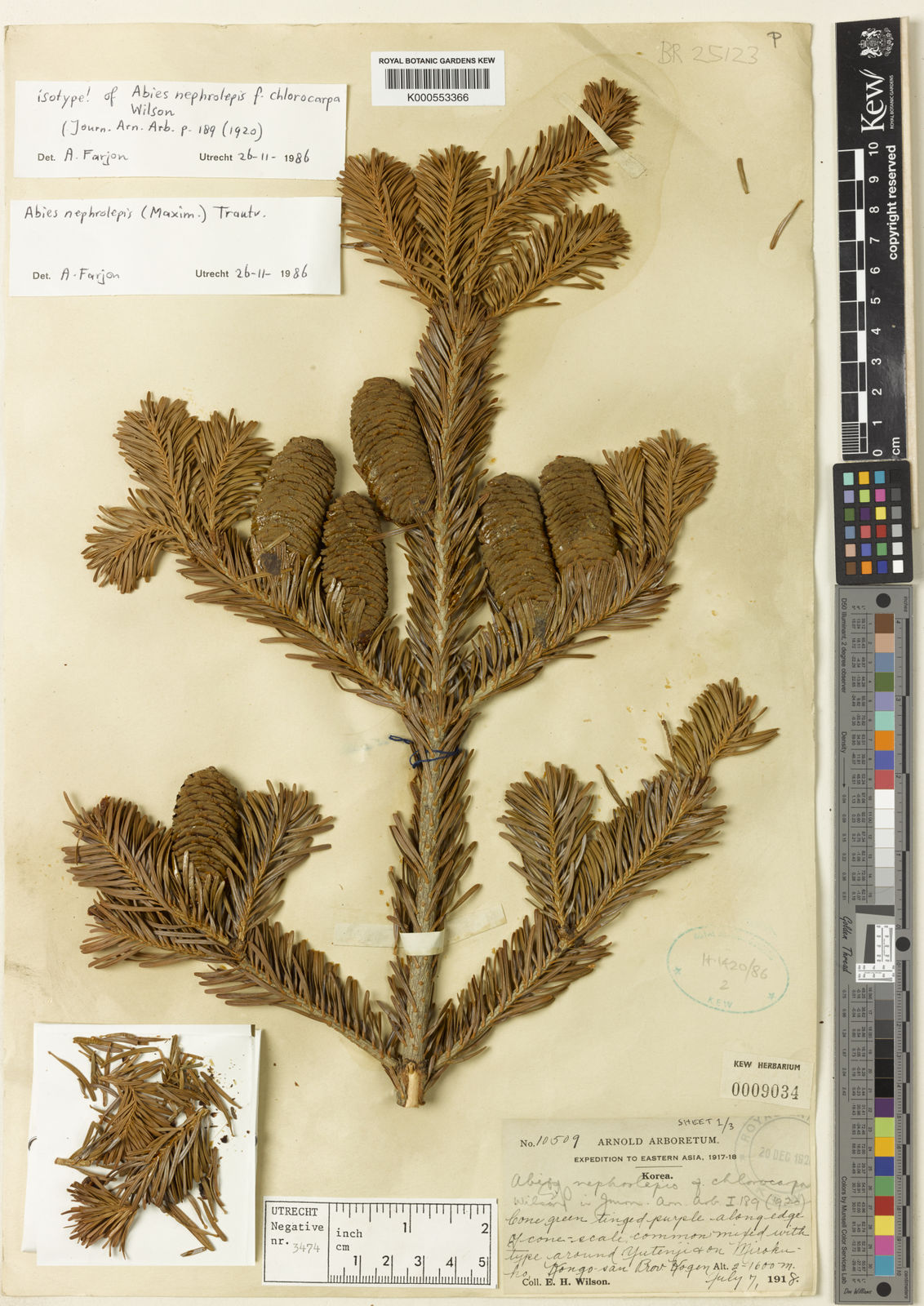
Abies nephrolepis · Kew POWO · Kew Plants of the World Online
Species
Least ConcernSPECIES
- KingdomPlantae
- PhylumTracheophyta
- ClassPinopsida
- OrderPinales
- FamilyPinaceae
General: Abies nephrolepis is rated as Least Concerned (LC
via GBIF · IUCN · Kew POWO
Museum specimens
- Specimen records
- 110
- With media
- 108
- Family
- Pinaceae
- Collections
- MOR, NY, CM, MICH, MOAR, A
- Recorded in
- China, United States, Russia, South Korea, North Korea, North Korea / South Korea, Finland, Russian Federation
Wikidata facts
- Instance of
- taxon
- Parent taxon
- Abies
- Image
- Пихта цельнолистная - самое высокое дерево - 46 м!.jpg
- Has use
- medicinal plant
Show 9 more facts
- taxon rank
- species
- IUCN conservation status
- Least Concern
- taxon name
- Abies nephrolepis
- Commons category
- Abies nephrolepis
- Commons gallery
- Abies nephrolepis
- taxon common name
- 杉松
- taxon range
- China
- short name
- A. nephrolepis
Sources (2)
via Wikidata · CC0
~2 min read
Encyclopedic overview
Abies nephrolepis, commonly known as Khingan fir, is a species of fir native to northeastern China (Hebei, Heilongjiang, Jilin, Liaoning, Shaanxi), North Korea, South Korea, and southeastern Russia (Amur Oblast, Jewish Autonomous Oblast, Primorsky Krai, southern Khabarovsk Krai).
It is a medium-sized evergreen coniferous tree growing to 30 m tall with a trunk up to 1.2 m diameter and a narrow conic to columnar crown. The bark is grey-brown, smooth on young trees, becoming fissured on old trees. The leaves are flat needle-like, 10–30 mm long and 1.5–2 mm broad, green above, and with two dull greenish-white stomatal bands below; they are spirally arranged, but twisted at the base to lie flattened either side of and forwards across the top of the shoots. The cones are 4.5–7 cm (rarely to 9.5 cm) long and 2–3 cm broad, green or purplish ripening grey-brown, and often very resinous; the tips of the bract scales are slightly exserted between the seed scales. Each seed scale bears two winged seeds, released when the cones disintegrate at maturity in the autumn.
Excerpted from Wikipedia’s “Abies nephrolepis” article, available under the CC BY-SA 4.0 licence.