Described at
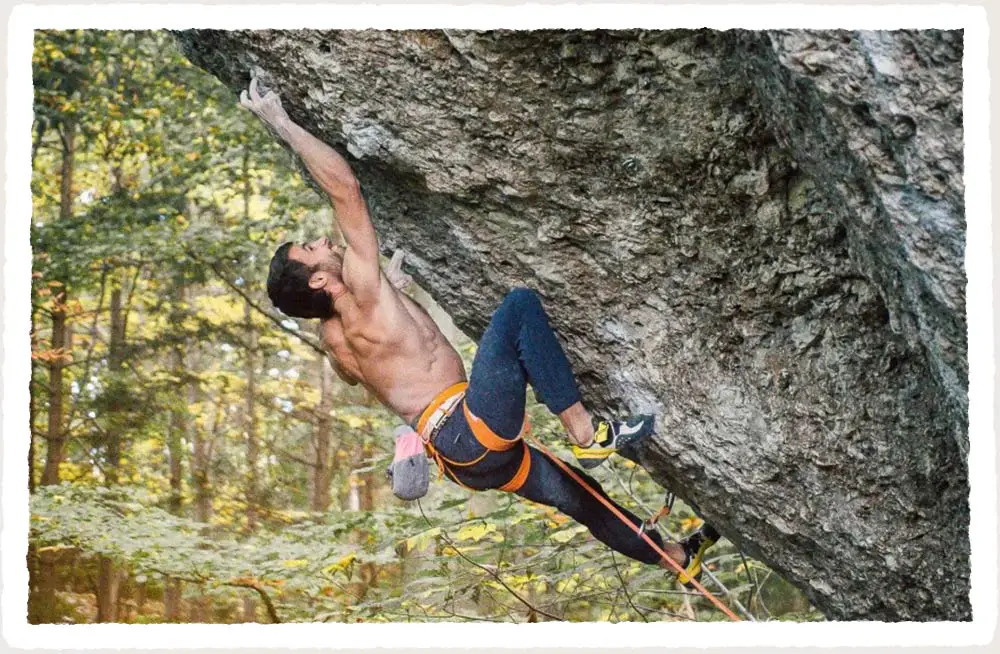
Action Directe: The First 9a In History
In the forests of Frankenjura, Germany, lies the world’s first 9a. It’s the most repeated and attempted route of this grade, and a climb that is widely considered as one of the most important landmarks in climbing history - one that changed what is ‘possible’ in the world of climbing.
hardclimbs.info →Milan Sykora, a renowned German climber, first stumbled upon Action Directe in the 80s. At the time, Sykora was already known for bolting and pioneering challenging climbs. With Action Directe, he bolted the route and traversed it from the right to complete the top moves. However, he found the lower part of the climb seemingly impossible. That was until he considered his friend, Wolfgang Gullich, and invited him to attempt it directly from the base. This led to the christening of the route as “Directe”. Gullich also noted that the name referenced a French revolutionary group active in 1979, known as Action Directe, notorious for their attacks and assassinations. In the annals of climbing history, Wolfgang Gullich occupies a place of remarkable distinction, not only as the first individual to ascend Action Directe, but also as the originator of the precise training method that made such iconic moves possible. A tribute to his ingenuity and perseverance, the campus board, was birthed from Gullich’s dedication to mono-dynos, a testament to his unyielding pursuit of physical strength and climbing finesse. It was this relentless dedication to training that saw him complete the climb in just 11 days from the onset of his attempt. On the memorable day of September 14, 1991, Gullich achieved what was then a world-first 9a climb. This monumental ascent would only be replicated four years later, and since then, the climb has seen dozens of successful attempts, although one of which is subject to debate – a fascinating story revolving around Said Belhaj . Among these repeat ascents, some have been especially awe-inspiring. Among them, the ascent by Adam Ondra at a young age of 15 stands out, as does the astonishing completion by Alex Megos in less than two hours. Yet, rising above them all, a particular ascent holds a unique place of honor. In May 2020, Melissa Le Neve made climbing history by becoming the first woman to conquer Action Directe. This incredible achievement is notable due to the climb’s characteristics, which are typically associated with powerful, traditionally ‘masculine’ climbing techniques. Both height and raw strength play crucial roles in this ascent. Le Neve, the French climber, embraced this formidable challenge as her long-term project. She trained specifically for the climb and returned to Frankenjura persistently over 6 years until she finally achieved her breathtaking send. Her words encapsulate the euphoria and profound emotion of her triumph: “I was hoping this moment wiIl arrive for ages. Never I would have imagined how emotional it would be to clip the anchor. I totally fell in love with the process, to solve the puzzle and unlock this jump” . This extraordinary narrative of achievement, both by Gullich and those who followed his path, serves as a testimony to human potential and the power of dedication. May the legacy of Wolfgang Gullich continue to inspire future generations of climbers. On the 21st May 2020, Melissa Le Neve became the first woman to climb Action Directe. We are yet to see another woman complete Action Directe. Quite likely the only idiot currently hauling a 70-meter rope and four pairs of climbing shoes around the world. Sam lives for backpacking, adventure, and of course, climbing. If he's not exploring crags and getting shut down on new projects, you can find him sharing his passion for climbing in publications such as Climbing Shoe Review, Climbing.com, Gear Junkie, and UK Climbing. Save my name, email, and website in this browser for the next time I comment.
Excerpt from a page describing this subject · 12,433 chars · not written by Vinony
Wikidata facts
- Country
- Germany
- Located in
- Amberg-Sulzbach
- Material used
- limestone
- Creator
- Wolfgang Güllich
- Sport
- sport climbing
- Image
- Action Directe (Waldkopf).JPG
- Length
- 15
Show 3 more facts
- mountain range
- Franconian Jura
- name
- Action Directe
- described at URL
- hardclimbs.info/climbs/action-directe
Sources (1)
via Wikidata · CC0