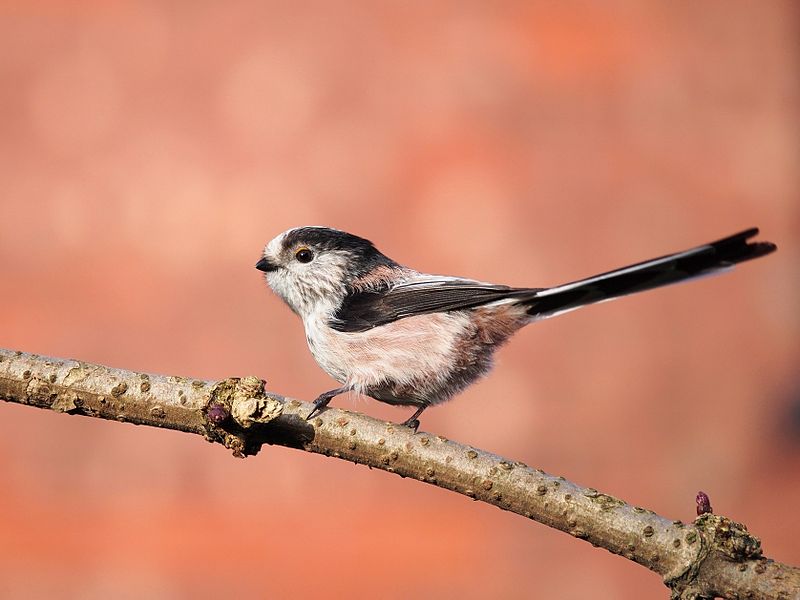
File:Aegithalos_caudatus_side-on.jpg · Wikimedia Commons · See Wikimedia Commons
Aegithalidae
Sign in to saveThe bushtits or long-tailed tits are small passerine birds from the family Aegithalidae, containing 13 species in three genera, all but one of which (Psaltriparus) are found in Eurasia. Bushtits are active birds with long tails compared to their size, moving almost constantly while they forage for insects in shrubs and trees. During non-breeding season, birds live in flocks of up to 50 individuals. Several bushtit species display cooperative breeding behavior, also called helpers at the nest.
OverviewAI-generated
Aegithalidae is a family of birds within the order Passeriformes, class Aves, and phylum Chordata. It belongs to the superfamily Sylvioidea in the kingdom Animalia. The family is also referred to by common names such as Long-tailed Tits, Bushtits, Aegithalidés, stjertmeisfamilien, and dolgorepke.
The taxon has an accepted status and is documented in various databases. Records indicate occurrences in countries including Nepal and the United States, with specimens held by institutions such as CM and UCLA. While specific occurrence counts vary by source, the family is referenced by 576 other encyclopedia articles.
Synthesized by Vinony from 30 facts across 6 sources: Wikidata, GBIF, Gbif Occ, iDigBio, WoRMS, Vinony graph. Generated from structured data (not the Wikipedia text) and checked against those facts — may still contain errors.
Species
Aegithalidae
FAMILY
- KingdomAnimalia
- PhylumChordata
- ClassAves
- OrderPasseriformes
- FamilyAegithalidae
Les Aegithalidae, aussi appelées mésanges à longue queue, tupinets ou orites, forment une famille de passereaux constituée de trois genres et treize espèces. L'espèce Aegithalos caudatus du Paléarctique, dont le nom vulgaire français est « Mésange à longue queue », donne son nom aux autres espèces de la famille. Cependant, si les Aegithalidae sont appelés « mésanges » dans le langage courant, ainsi que les Remizidae et les Panuridae, ils ne sont pas directement apparentés aux « mésanges vraies » de la famille des Paridae ; il est donc proposé de remplacer leurs noms normalisés. Sommaire 1 Position systématique 2 Étymologie 3 Liste alphabétique des genres 4 Liste des espèces 5 Références 6 Liens externes Position systématique Étymologie Liste alphabétique des genres D'après la classification de référence du Congrès ornithologique international (version 8.2, 2018)[1] : Aegithalos Hermann, 1804 Leptopoecile Severtzov 1873 Psaltriparus Bonaparte, 1850 Liste des espèces D'après la classification de référence du Congrès ornithologique international (version 8.2, 2018)[1] (ordre phylogénique) : Aegithalos caudatus – Mésange à longue queue Aegithalos glaucogularis – Mésange à gorge argent
via GBIF
Museum specimens
- Specimen records
- 2
- Family
- Aegithalidae
- Collections
- CM, UCLA
- Recorded in
- Nepal, United States
Wikidata facts
- Instance of
- taxon
- Parent taxon
- Sylvioidea
- Image
- Long-tailed Tit Aegithalos caudatus.jpg
Show 6 more facts
- Commons category
- Aegithalidae
- taxon rank
- family
- taxon name
- Aegithalidae
- topic's main category
- Category:Aegithalidae
- Commons gallery
- Aegithalidae
- taxon common name
- Dugorepe sjenice
Sources (1)
via Wikidata · CC0
~7 min read
Encyclopedic overview
8 sectionsContents
- Distribution and habitat
- Description
- Behaviour
- Diet and feeding
- Breeding
- Taxonomy
- References
- External links
The bushtits or long-tailed tits are small passerine birds from the family Aegithalidae, containing 13 species in three genera, all but one of which (Psaltriparus) are found in Eurasia. Bushtits are active birds with long tails compared to their size, moving almost constantly while they forage for insects in shrubs and trees. During non-breeding season, birds live in flocks of up to 50 individuals. Several bushtit species display cooperative breeding behavior, also called helpers at the nest.
== Distribution and habitat == All the Aegithalidae are forest birds, particularly forest edge and understory habitats. The species in the genus Aegithalos prefer deciduous or mixed deciduous forests, while the Indonesian pygmy bushtit is found mostly in montane coniferous forest. Bushtits are found in a wide range of habitats, including on occasion sagebrush steppe and other arid shrublands, but are most common in mixed woodland. Most species in this family live in mountainous habitats in and around the Himalayas, and all are found in Eurasia except the American bushtit, which is native to western North America. The long-tailed tit has the most widespread distribution of any species of Aegithalidae, occurring across Eurasia from Britain to Japan. Two species, in contrast, have tiny distributions, the Burmese bushtit, which is entirely restricted to two mountains in Burma, and the pygmy bushtit, which is restricted to the mountains of western Java. The species in this family are generally not migratory, although the long-tailed tit is prone to dispersing in the northern edges of its range (particularly in Siberia). Many mountainous species move to lower ground during the winter.
Excerpted from Wikipedia’s “Aegithalidae” article, available under the CC BY-SA 4.0 licence.