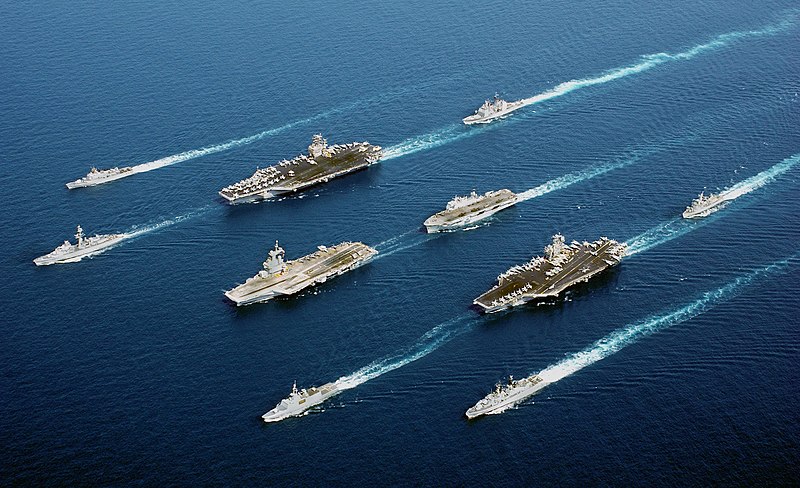
File:Fleet_5_nations.jpg · Wikimedia Commons · See Wikimedia Commons
aircraft carrier
Sign in to saveAlso known as CV
warship primarily designed to carry, support, launch, and recover naval aircraft at sea
An aircraft carrier is a large warship built to carry and operate military planes and helicopters from the ocean. It serves as a floating base that allows a navy to project air power across vast distances of water.
AI-generated from the Wikipedia summary — may contain errors.
Wikidata facts
- Subclass of
- ship
- Image
- USS John C. Stennis (CVN-74) and HMS Illustrious (R 06) in the Persian Gulf on April 9, 1998.jpg
Show 7 more facts
- exact match
- wordnet-rdf.princeton.edu/wn30/02687172-n
- designed to carry
- military aircraft
- Commons category
- Aircraft carriers
- topic's main category
- Category:Aircraft carriers
- history of topic
- history of the aircraft carrier
- has list
- list of aircraft carriers
- on focus list of Wikimedia project
- Wikipedia:Vital articles/Level/4
via Wikidata · CC0
~40 min read
Encyclopedic overview
Three steam catapult equipped aircraft carriers of various types—USS John C. Stennis, Charles de Gaulle (French Navy), USS John F. Kennedy along with the helicopter carrier HMS Ocean—and escort vessels, 2002 Chinese PLAN's electromagnetic catapult equipped aircraft carrier Fujian transiting the East China Sea, September 2025 Indian ski-jump based aircraft carriers INS Vikrant and INS Vikramaditya, June 2023 An aircraft carrier is a warship designed to carry, launch, recover and support aircraft at sea, equipped with a full-length flight deck and hangar facilities that allow it to serve as a mobile, seagoing airbase. Typically it is the capital ship of a fleet (known as a carrier battle group), as it allows a naval force to project seaborne air power far from national territory without depending on local airfields for the staging of aircraft operations. Since their inception in the early 20th century, aircraft carriers have evolved from wooden vessels used to deploy individual tethered reconnaissance balloons, to nuclear-powered supercarriers that carry dozens of fighters, strike aircraft, military helicopters, AEW&Cs and other types of aircraft such as UCAVs. While heavier fixed-wing aircraft such as airlifters, gunships and bombers have been launched from aircraft carriers, these aircraft do not often land on a carrier due to flight deck limitations.
The aircraft carrier, along with its onboard aircraft and defensive ancillary weapons, is the largest weapon system ever created. By their tactical prowess, mobility, autonomy and the variety of operational means, aircraft carriers are often the centerpiece of modern naval warfare, and have significant diplomatic influence in deterrence, command of the sea and air supremacy. Since the Second World War, the aircraft carrier has replaced the battleship in the role of flagship of a fleet, and largely transformed naval battles from gunfire to beyond-visual-range air strikes. In addition to tactical aptitudes, it has great strategic advantages in that, by sailing in international waters, it does not need to interfere with any territorial sovereignty and thus does not risk diplomatic complications or conflict escalation due to trespassing, and obviates the need for land use authorizations from third-party countries, reduces the times and transit logistics of aircraft and therefore significantly increases the time of availability on the combat zone.
Excerpted from Wikipedia’s “aircraft carrier” article, available under the CC BY-SA 4.0 licence.
Gallery (12)
Available in 93 languages
- Español
- Français
- Deutsch
- 中文
- 日本語
- Русский
- Português
- Italiano
- العربية
- हिन्दी
- Afrikaans
- Albanian
- Aragonese
- Armenian
- Asturian
- azb
- Azerbaijani
- Bahasa Indonesia
Show 74 more
- Bangla
- Bashkir
- Basque
- be_x_old
- Belarusian
- Bosnian
- Breton
- Bulgarian
- Burmese
- Catalan
- Central Kurdish
- Chechen
- Croatian
- Czech
- Danish
- Esperanto
- Estonian
- Finnish
- Galician
- Georgian
- Greek
- Guarani
- Gujarati
- Hebrew
- Hungarian
- Icelandic
- Ido
- Irish
- Kannada
- Kazakh
- Latin
- Latvian
- Lithuanian
- Lombard
- Luxembourgish
- Malay
- Malayalam
- Marathi
- Minangkabau
- Mongolian
- Navajo
- Nederlands
- Norwegian
- Norwegian Nynorsk
- Occitan
- Old English
- Piedmontese
- Polski
- Punjabi
- Romanian
- Serbian
- Serbian (Latin)
- simple
- Sinhala
- Slovak
- Slovenian
- Svenska
- Tamil
- Tatar
- Telugu
- Tiếng Việt
- Türkçe
- Ukrainian
- Urdu
- Welsh
- Western Frisian
- Wu Chinese
- Yiddish
- zh_classical
- zh_min_nan
- zh_yue
- فارسی
- ไทย
- 한국어
via Wikidata sitelinks · CC0