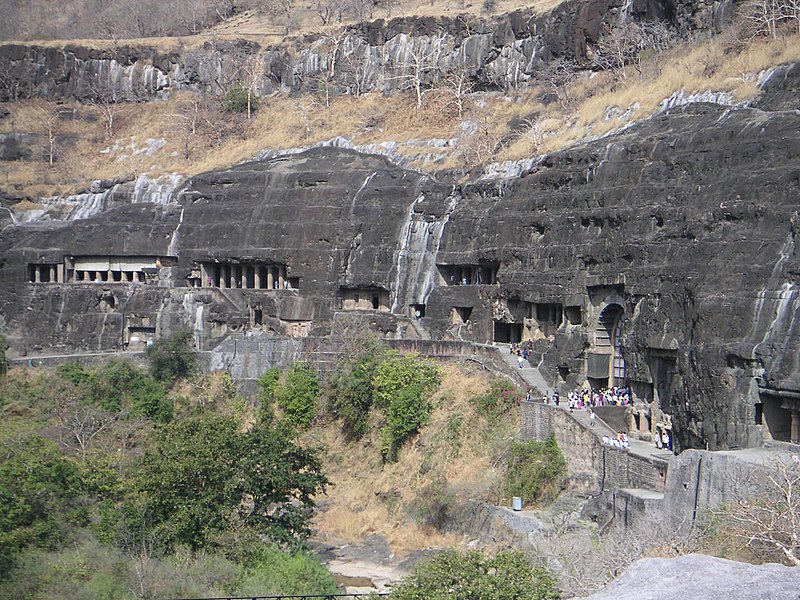
File:Ajanta_(63).jpg · Wikimedia Commons · See Wikimedia Commons
Ajanta Caves
Sign in to save2nd century BCE to 1st century CE Buddhist cave monuments located in Maharashtra, India
The Ajanta Caves are a group of Buddhist cave temples carved into a hillside in Maharashtra, India, dating from the 2nd century BCE to the 1st century CE. They are historically significant as outstanding examples of ancient Buddhist architecture and art from this period of Indian history.
AI-generated from the Wikipedia summary — may contain errors.
Wikidata facts
- Instance of
- temple
- Country
- India
- Located in
- Aurangabad district
- Area
- 78676
- Time zone
- UTC+05:30
- Image
- Ajanta (63).jpg
Show 4 more facts
- Commons category
- Ajanta Caves
- Commons gallery
- Ajanta Caves
- native label
- अजिंठा लेणी/गुहा
- inception
- 0200-00-00
Sources (4)
via Wikidata · CC0
~40 min read
Encyclopedic overview
Cave 19, Ajanta 5th-century chaitya hall.
The Ajanta Caves are 30 rock-cut Buddhist cave monuments dating from the second century BCE to about 480 CE in Aurangabad district of Maharashtra state in India. Ajanta Caves are a UNESCO World Heritage Site. Universally regarded as masterpieces of Buddhist religious art, the caves include paintings and rock-cut sculptures, described as among the finest surviving examples of ancient Indian art, particularly expressive paintings that present emotions through gesture, pose and form.
Excerpted from Wikipedia’s “Ajanta Caves” article, available under the CC BY-SA 4.0 licence.
Gallery (12)
On the map
Available in 79 languages
- Español
- Français
- Deutsch
- 中文
- 日本語
- Русский
- Português
- Italiano
- العربية
- हिन्दी
- Albanian
- Armenian
- Assamese
- Bahasa Indonesia
- Bangla
- Basque
- Belarusian
- Bulgarian
Show 60 more
- Burmese
- Catalan
- Cebuano
- Chechen
- Croatian
- Czech
- Danish
- Egyptian Arabic
- Esperanto
- Finnish
- Georgian
- Goan Konkani
- Greek
- Gujarati
- Hebrew
- Hungarian
- Igbo
- Kannada
- Kazakh
- Kyrgyz
- Latvian
- Lithuanian
- Macedonian
- Maithili
- Malay
- Malayalam
- Maltese
- Marathi
- mnw
- Nederlands
- Nepali
- Norwegian
- Odia
- Polski
- Punjabi
- Romanian
- Sanskrit
- Scots
- Serbian
- Serbian (Latin)
- Shan
- simple
- Sindhi
- Sinhala
- Slovak
- Slovenian
- Svenska
- Tamil
- Telugu
- Tiếng Việt
- Türkçe
- Ukrainian
- Urdu
- Uzbek
- Western Panjabi
- Wu Chinese
- zh_yue
- فارسی
- ไทย
- 한국어
via Wikidata sitelinks · CC0