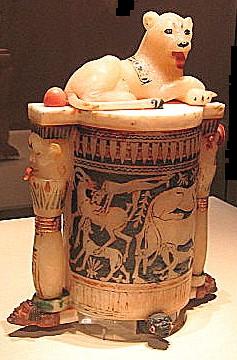
File:Lioness_Bast_cosmetic_jar_83d40m_tut_burial_artifact.jpg · Wikimedia Commons · See Wikimedia Commons
อะลาบาสเทอร์
Sign in to savethumb|Calcite alabaster: The tomb of Tutankhamun (d. 1323 BC) contained a practical objet d’art, a cosmetics jar made of Egyptian alabaster, which features a lid surmounted by a lioness (goddess Bast).
Alabaster is a soft, light-colored stone that ancient peoples like the Egyptians carved into decorative and practical objects, such as the cosmetics jar found in Tutankhamun's tomb. It matters historically because these carved alabaster pieces provide insights into ancient craftsmanship, religious beliefs, and daily life from thousands of years ago.
AI-generated from the Wikipedia summary — may contain errors.
Wikidata facts
- Instance of
- mineral variety
- Subclass of
- gypsum
- Image
- Alabaster.jpg
Show 5 more facts
- described by source
- Explanatory Dictionary of the Living Great Russian Language
- topic's main category
- Category:Alabaster
- Commons category
- Alabaster
- described at URL
- materialarchiv.ch/de/ma:material_1190
- different from
- Alabaster
via Wikidata · CC0
Gallery (322)
Available in 65 languages
- Español
- Français
- Deutsch
- 中文
- 日本語
- Русский
- Português
- Italiano
- العربية
- Aragonese
- Armenian
- Azerbaijani
- Bahasa Indonesia
- Basque
- be_x_old
- Belarusian
- Bulgarian
- Catalan
Show 46 more
- Chuvash
- Crimean Tatar
- Danish
- Egyptian Arabic
- Esperanto
- Estonian
- Finnish
- Galician
- Greek
- Hebrew
- Hungarian
- Icelandic
- Ido
- Irish
- Kashubian
- Kazakh
- Kyrgyz
- Latvian
- Lithuanian
- Macedonian
- Malay
- Mongolian
- Nederlands
- Norwegian
- Norwegian Nynorsk
- Occitan
- Piedmontese
- Polski
- Romanian
- Scots
- Serbian
- Serbian (Latin)
- simple
- Slovenian
- Svenska
- Tajik
- Tibetan
- Türkçe
- Ukrainian
- Uzbek
- Wolof
- Wu Chinese
- zh_yue
- فارسی
- ไทย
- 한국어
via Wikidata sitelinks · CC0