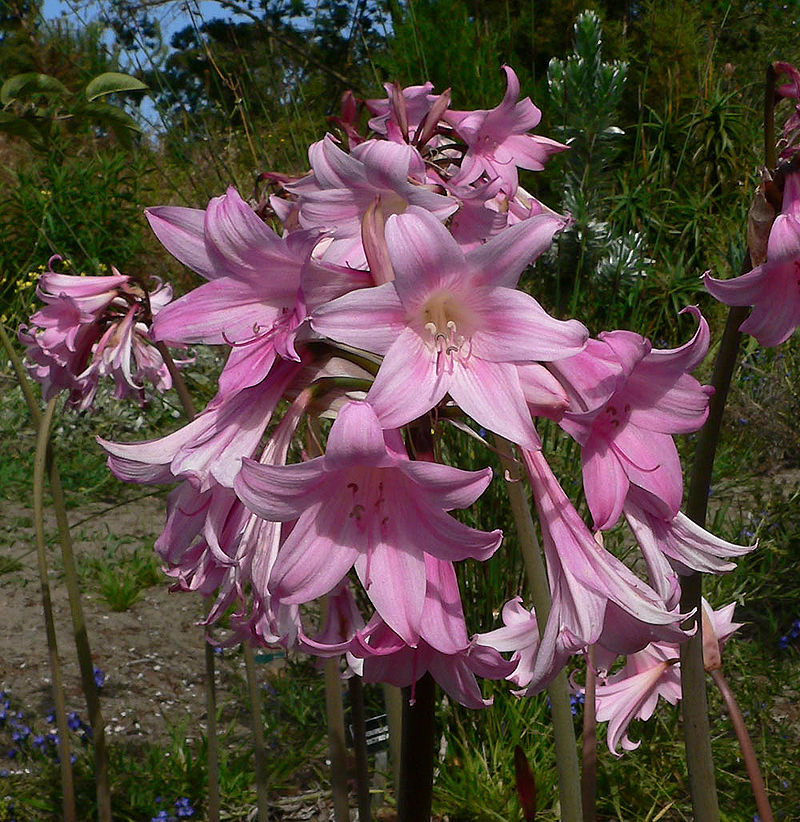
File:Amaryllis_belladonna_sfbg_2.jpg · Wikimedia Commons · See Wikimedia Commons
Amaryllidaceae
Sign in to saveThe Amaryllidaceae are a family of herbaceous, mainly perennial and bulbous (rarely rhizomatous) flowering plants in the monocot order Asparagales. The family takes its name from the genus Amaryllis and is commonly known as the amaryllis family. The leaves are usually linear, and the flowers are usually bisexual and symmetrical, arranged in umbels on the stem. The petals and sepals are undifferentiated as tepals, which may be fused at the base into a floral tube. Some also display a corona. Allyl sulfide compounds produce the characteristic odour of the onion subfamily (Allioideae).
OverviewAI-generated
Amaryllidaceae is a family of plants within the order Asparagales. It belongs to the class Liliopsida and the phylum Tracheophyta in the kingdom Plantae. The taxonomic type for this family is Amaryllis. Synonyms for the family include Agapanthaceae and Alliaceae. The fruit types associated with this group are capsules and berries.
Records for Amaryllidaceae have been documented in Mexico, Guatemala, the United States, the Philippines, and Angola. These records are held by institutions including INECOL, UCSB, USCH, BRIT, and US. The family has an accepted status in taxonomic databases.
Synthesized by Vinony from 39 facts across 8 sources: Wikidata, GBIF, PubMed, Gbif Occ, Plants of the World, iDigBio, WoRMS, Vinony graph. Generated from structured data (not the Wikipedia text) and checked against those facts — may still contain errors.
Species
amariliniai
Amaryllidaceae
FAMILY
- KingdomPlantae
- PhylumTracheophyta
- ClassLiliopsida
- OrderAsparagales
- FamilyAmaryllidaceae
石蒜科(学名:Amaryllidaceae)是單子葉植物綱,天門冬目的一個科。石蒜科分为三个亚科,約有60屬,800多種,主要生长在世界各地的温带地区,中国有12属约25种。早期的分類系統(克朗奎斯特分类法)將石蒜科分類在百合目內,2003年经过改进的以基因亲缘关系分类的APG II 分类法认为可以和葱科及百子莲科合并,也可以单分。 本科植物为多年生草本,地下部有一被薄膜的鳞茎,较少为根茎;基生少数细长叶;花两性,单生或数朵排列成伞形花序,生于花茎顶端,下有一总苞,通常二至多枚膜质苞片构成,被片6枚、2轮,成美丽的花瓣状,下部常和生成长短不同的管,裂片上有附属物(副花冠),子房下位3枚;蒴果或肉质浆果。 下列各屬常被栽培做為庭園觀賞植物: 孤挺花屬 君子蘭屬 - 君子蘭 雪滴花屬 朱頂紅屬 - 朱頂紅 蜘蛛百合屬 雪片蓮屬 石蒜屬 - 石蒜 水仙屬 - 水仙
via GBIF · Kew POWO
Museum specimens
- Specimen records
- 964
- With media
- 633
- Family
- Amaryllidaceae
- Collections
- INECOL, UCSB, USCH, BRIT, US, TCSW
- Recorded in
- Mexico, Guatemala, United States, Philippines, Angola, Namibia, Kenya, Venezuela
Research
10,930 papers- Amaryllidaceae and Sceletium alkaloids.ReviewNatural product reports · 2019Jin Z, Yao GDOI: 10.1039/c8np00055g
- Recent Progress in Amaryllidaceae Biotechnology.ReviewMolecules (Basel, Switzerland) · 2020Georgiev V, Ivanov I, Pavlov ADOI: 10.3390/molecules25204670
- Pharmacological and toxicological effects of Amaryllidaceae.ReviewBrazilian journal of biology = Revista brasleira de biologia · 2023Paiva MJM, Nascimento GNL, Damasceno IAM et al.DOI: 10.1590/1519-6984.277092
- Navigating Amaryllidaceae alkaloids: bridging gaps and charting biosynthetic territories.ReviewJournal of experimental botany · 2025Liyanage NS, Awwad F, Gonçalves Dos Santos KC et al.DOI: 10.1093/jxb/erae187
- Antiviral alkaloid principles of the plant family Amaryllidaceae.ReviewPhytomedicine : international journal of phytotherapy and phytopharmacology · 2023Nair JJ, van Staden JDOI: 10.1016/j.phymed.2022.154480
- The Amaryllidaceae as a source of antiplasmodial crinane alkaloid constituents.ReviewFitoterapia · 2019Nair JJ, van Staden JDOI: 10.1016/j.fitote.2019.02.009
- Anti-inflammatory Principles of the Plant Family Amaryllidaceae.ReviewPlanta medica · 2024Nair JJ, van Staden JDOI: 10.1055/a-2369-8104
- Anti-inflammatory effects of the plant family Amaryllidaceae.ReviewJournal of ethnopharmacology · 2024Nair JJ, van Staden JDOI: 10.1016/j.jep.2024.117943
via PubMed
Wikidata facts
- Instance of
- taxon
- Image
- Amaryllis belladonna sfbg 2.jpg
Show 9 more facts
- taxon rank
- family
- Commons category
- Amaryllidaceae
- taxon name
- Amaryllidaceae
- topic's main category
- Category:Amaryllidaceae
- taxon common name
- narcisovke
- taxon synonym
- Alliaceae
- has fruit type
- berry
- taxonomic type
- Amaryllis
via Wikidata · CC0
~25 min read
Encyclopedic overview
23 sectionsContents
- Description
- Taxonomy
- History
- Pre-Darwinian
- Post-Darwinian
- {{anchor|Phylogenetic era}}Phylogenetic era
- Subdivision
- Angiosperm Phylogeny Group
- Genera
- Distribution
- Cultivation and uses
- References
- Bibliography
- Books
- Historical
- Modern
- Symposia
- Articles and theses
- APG system
- Pharmacology
- Websites
- Databases
- External links
The Amaryllidaceae are a family of herbaceous, mainly perennial and bulbous (rarely rhizomatous) flowering plants in the monocot order Asparagales. The family takes its name from the genus Amaryllis and is commonly known as the amaryllis family. The leaves are usually linear, and the flowers are usually bisexual and symmetrical, arranged in umbels on the stem. The petals and sepals are undifferentiated as tepals, which may be fused at the base into a floral tube. Some also display a corona. Allyl sulfide compounds produce the characteristic odour of the onion subfamily (Allioideae).
The family, which was originally created in 1805, now contains about 1600 species, divided into 71 genera, 17 tribes and three subfamilies, the Agapanthoideae (Agapanthus), Allioideae (onions, garlic and chives) and Amaryllidoideae (amaryllis, daffodils, snowdrops). Over time, it has seen much reorganisation and at various times was combined with the related Liliaceae. Since 2009, a very broad view has prevailed based on phylogenetics, and including a number of other former families.
Excerpted from Wikipedia’s “Amaryllidaceae” article, available under the CC BY-SA 4.0 licence.
Gallery (20)
Available in 75 languages
- Español
- Français
- Deutsch
- 中文
- 日本語
- Русский
- Português
- Italiano
- العربية
- हिन्दी
- Afrikaans
- Armenian
- Asturian
- Azerbaijani
- Bahasa Indonesia
- Basque
- be_x_old
- Belarusian
Show 56 more
- Bosnian
- Bulgarian
- Catalan
- Cebuano
- Chuvash
- Corsican
- Croatian
- Czech
- Danish
- Egyptian Arabic
- Esperanto
- Estonian
- Finnish
- Galician
- Georgian
- Greek
- Hebrew
- Hungarian
- Kannada
- Kazakh
- Latin
- Latvian
- Lithuanian
- Macedonian
- Malagasy
- Malayalam
- Nederlands
- Northern Frisian
- Norwegian
- Norwegian Nynorsk
- Ossetic
- Polski
- Quechua
- Romanian
- Scots
- Serbian
- Serbian (Latin)
- simple
- Slovak
- Sundanese
- Svenska
- Tajik
- Tamil
- Tiếng Việt
- Türkçe
- Ukrainian
- Upper Sorbian
- Urdu
- Waray
- West Flemish
- Western Panjabi
- Wu Chinese
- zh_yue
- فارسی
- ไทย
- 한국어
via Wikidata sitelinks · CC0