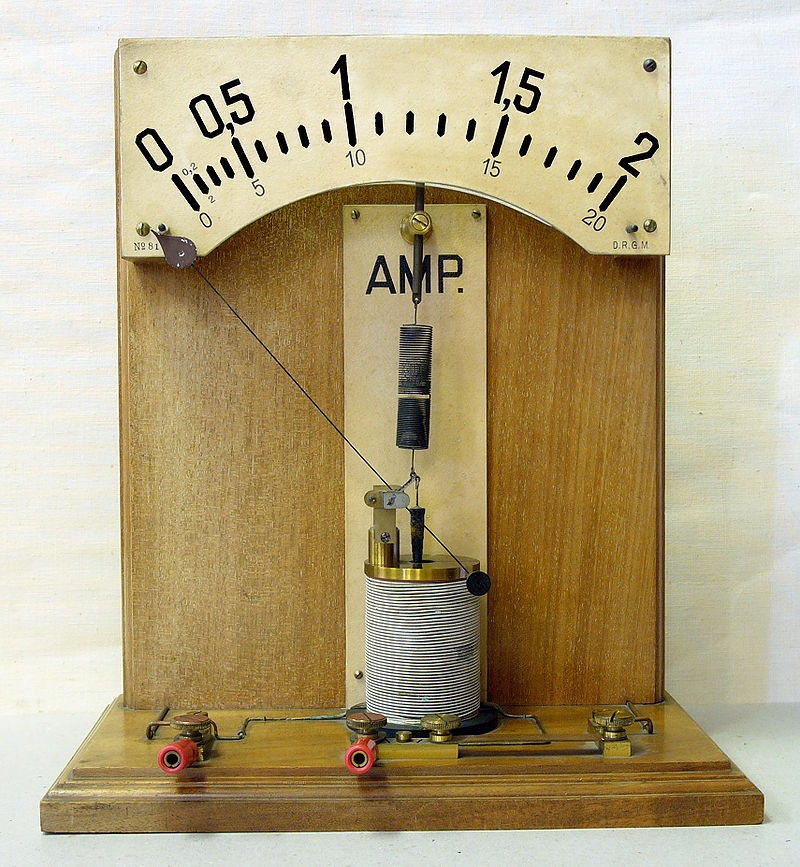
File:Amperemeter_hg.jpg · Wikimedia Commons · See Wikimedia Commons
ampere
Sign in to saveAlso known as amp, A, amperage, amperes, amps
The ampere ( , ; symbol: A), often shortened to amp, is the unit of electric current in the International System of Units (SI). One ampere is equal to 1 coulomb (C) moving past a point per second. It is named after French mathematician and physicist André-Marie Ampère (1775–1836), considered the father of electromagnetism along with Danish physicist Hans Christian Ørsted.
An ampere (or amp) is the standard unit used to measure the amount of electric current flowing through something, defined as one coulomb of charge passing a point every second. It matters because it's the internationally agreed-upon way to quantify electrical flow, making it essential for understanding and working with electricity in everyday applications from household devices to industrial systems.
AI-generated from the Wikipedia summary — may contain errors.
Key facts
- Unit.name
- ampere
- Unit.image
- File:Amperemeter hg.jpg
- Unit.caption
- Demonstration model of a moving iron ammeter. As the current through the coil increases, the plunger is drawn further into the coil and the pointer deflects to the right.
- Unit.standard
- SI
- Unit.quantity
- electric current
- Unit.symbol
- A
- Unit.dimension
- I
- Unit.namedafter
- André-Marie Ampère
via Wikipedia infobox
Wikidata facts
- Part of
- MKSA system of units
- Named after
- André-Marie Ampère
- Image
- Ampere-o-meter-vintage-HDR-0h.jpg
Show 7 more facts
- Wikidata SPARQL query equivalent
- wd:Q25272 p:P2370/psn:P2370 [wikibase:quantityAmount ?source; wikibase:quantityUnit ?base]. ?item p:P2370/psn:P2370 [wikibase:quantityAmount ?target; wikibase:quantityUnit ?base]. BIND(?source / ?target as ?value)
- conversion to SI unit
- 1
- unit symbol
- A
- different from
- A
- on focus list of Wikimedia project
- Wikipedia:Vital articles/Level/4
- Commons category
- Ampere (unit)
- NCI Thesaurus ID
- C42536
Sources (3)
via Wikidata · CC0
~7 min read
Encyclopedic overview
8 sectionsContents
- History
- Former definition in the SI
- Present definition
- Units derived from the ampere
- SI prefixes
- See also
- References
- External links
The ampere ( , ; symbol: A), often shortened to amp, is the unit of electric current in the International System of Units (SI). One ampere is equal to 1 coulomb (C) moving past a point per second. It is named after French mathematician and physicist André-Marie Ampère (1775–1836), considered the father of electromagnetism along with Danish physicist Hans Christian Ørsted.
As of the 2019 revision of the SI, the ampere is defined by fixing the elementary charge to be exactly , which means an ampere is an electric current equivalent to elementary charges moving every seconds, or approximately elementary charges moving in a second. Prior to the redefinition, the ampere was defined as the current passing through two parallel wires 1 metre apart that produces a magnetic force of newtons per metre.
Excerpted from Wikipedia’s “ampere” article, available under the CC BY-SA 4.0 licence.
Available in 119 languages
- Español
- Français
- Deutsch
- 中文
- 日本語
- Русский
- Português
- Italiano
- العربية
- हिन्दी
- Afrikaans
- Albanian
- Albanian
- Armenian
- Assamese
- Asturian
- azb
- Azerbaijani
Show 100 more
- Bahasa Indonesia
- Bangla
- Basque
- Bavarian
- be_x_old
- Belarusian
- Bosnian
- Breton
- Bulgarian
- Burmese
- Catalan
- Central Kurdish
- Church Slavic
- Chuvash
- Croatian
- Czech
- Danish
- Esperanto
- Estonian
- Filipino
- Finnish
- Friulian
- Galician
- Gan Chinese
- Georgian
- Greek
- Guarani
- Haitian Creole
- Hebrew
- Hungarian
- hyw
- Icelandic
- Ido
- Interlingua
- Irish
- Jamaican Creole English
- Kabyle
- Kannada
- Kazakh
- Khmer
- Kurdish
- Latin
- Latvian
- Limburgish
- Lithuanian
- Lojban
- Lombard
- Low German
- Luxembourgish
- Macedonian
- Malay
- Malayalam
- Marathi
- Mongolian
- Moroccan Arabic
- Nederlands
- Nepali
- Newari
- Northern Frisian
- Norwegian
- Norwegian Nynorsk
- Occitan
- Piedmontese
- Polski
- Punjabi
- Romanian
- Sardinian
- Scots
- Serbian
- Serbian (Latin)
- Sicilian
- simple
- Slovak
- Slovenian
- Somali
- Svenska
- Swahili
- Tajik
- Tamil
- Telugu
- Tibetan
- Tiếng Việt
- Türkçe
- Tuvinian
- Ukrainian
- Urdu
- Uzbek
- Waray
- Welsh
- West Flemish
- Western Frisian
- Western Panjabi
- Wu Chinese
- Zaza
- zh_classical
- zh_min_nan
- zh_yue
- فارسی
- ไทย
- 한국어
via Wikidata sitelinks · CC0